Comet C/2026 A1 (MAPS), discovered Jan. 13 from AMACS1 in San Pedro de Atacama, is an inbound member of the Kreutz sungrazers and was first seen at magnitude +17.8 about 191 million miles from the Sun. MAPS will pass roughly 99,600 miles above the solar surface around April 4, exposing it to extreme heat and tidal forces that may fragment or vaporize it. Astronomers disagree on its fate: some expect disintegration, while others think it could be a mid‑size Kreutz that survives and becomes visible to the naked eye in mid‑April. Observers should watch for clearer signs by early March.
Will Comet C/2026 A1 (MAPS) Light Up Early Spring? Astronomers Watch a Rare Kreutz Sungrazer
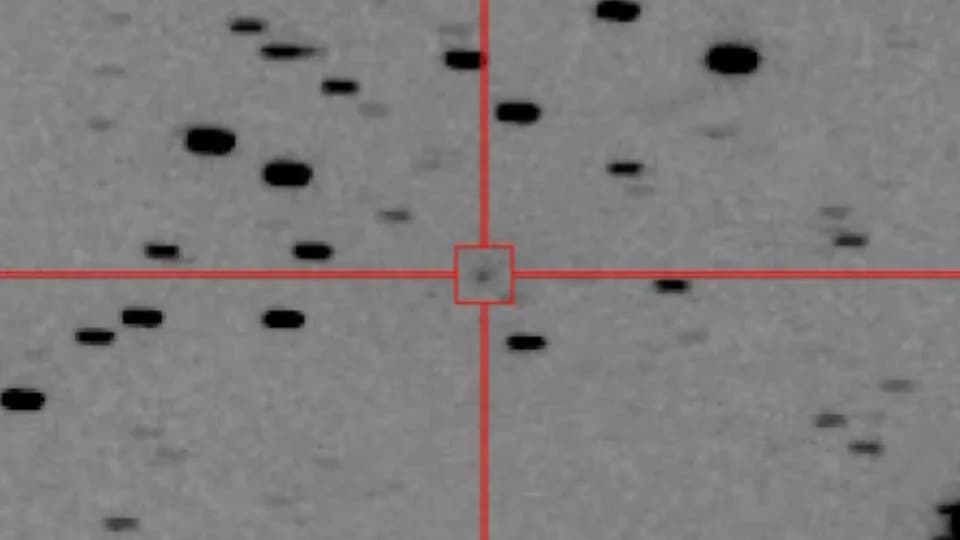
A view of comet C/2026 A1 (MAPS). . | Credit: Denis Huber/Wikimedia Commons/CC BY-SA 4.0
A newly discovered comet, C/2026 A1 (MAPS), has drawn wide interest because it belongs to the Kreutz sungrazers — a family that has occasionally produced spectacular, daylight-visible comets. MAPS was discovered on Jan. 13 from the AMACS1 site in San Pedro de Atacama, Chile, and follow-up observations including a December 2025 pre-discovery image allowed astronomers to compute its orbit.
Discovery and Early Observations
MAPS was first recorded with an 11-inch (0.28 m) f/2.2 Schmidt telescope equipped with a CCD camera. At discovery it lay roughly 191 million miles (308 million km) from the Sun in the constellation Columba and shone at an extremely faint visual magnitude of about +17.8. Additional astrometry quickly showed the object to be a member of the Kreutz family.
Why the Kreutz Family Matters
The Kreutz sungrazers are thought to be fragments of a very large parent comet that broke apart in antiquity. Historical records point to candidate progenitors such as the Great Comet of 371 BC and a very bright comet seen in 1106 AD. Over centuries those fragments repeatedly split, producing a stream of objects with similar, extremely sun‑skimming orbits. Some Kreutz members have been enormous and spectacular — notably the Great Comets of 1843 and 1882 and C/1965 S1 (Ikeya–Seki) — while many thousands of much smaller fragments have been found in recent decades by solar coronagraphs and do not survive perihelion.
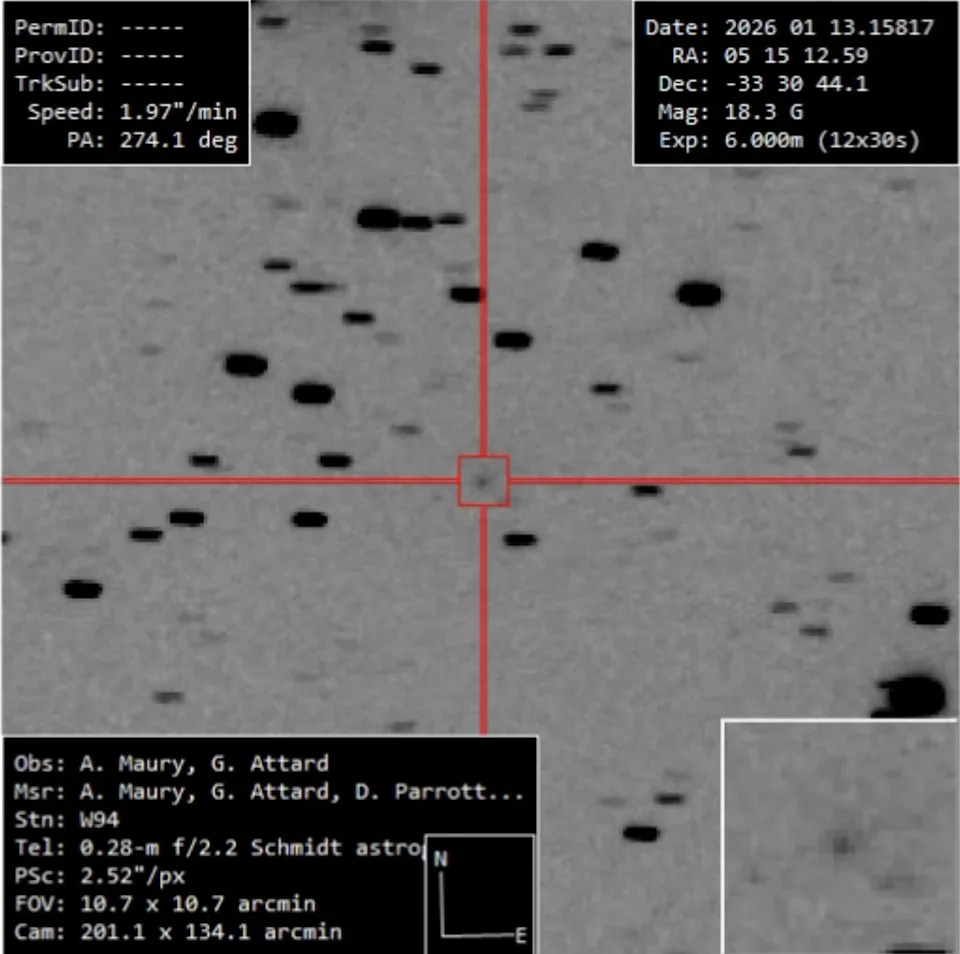
Another look at comet C/2026 A1 (MAPS) | Credit: Denis Huber/Wikimedia Commons/CC BY-SA 4.0
How Unusual Is This Detection?
MAPS is unusual because it was discovered inbound at a much greater distance and far earlier than is typical for a Kreutz comet. It was identified some 11.5 weeks before perihelion — a longer lead time than any previously known inbound Kreutz detection (the prior record was 33 days for Ikeya–Seki in 1965). While early detection gives astronomers more time to monitor its activity, it does not guarantee a dramatic outcome.
Perihelion, Survival Odds, and Forecasts
Comet MAPS is expected to reach perihelion early on April 4, passing about 99,600 miles (160,200 km) above the Sun's photosphere. At perihelion it will be traveling at extremely high speed and exposed to intense heating and tidal forces. Smaller Kreutz fragments (meter-scale) typically disintegrate; larger nuclei (likely miles across) can survive and produce very bright displays. Experts differ: Daniel Green (Central Bureau for Astronomical Telegrams) has noted the comet's faint absolute magnitude and warned its survival is unlikely, while experienced observer Jakub Černý suggests MAPS could be a mid‑size Kreutz and might survive to produce a naked-eye display.
What To Watch For
Astronomers expect to know much more by early March as brightness measurements and activity indicators accumulate. If MAPS brightens substantially it could become visible low in the western sky after sunset during the second week of April. If it disintegrates, observers will likely see a brightening in coronagraph imagery near the Sun followed by a fading or a diffuse, headless tail.
Observer Note: If MAPS develops into a naked-eye comet, careful observing near the western horizon just after sunset will be necessary — use binoculars or a low-power telescope to help locate a faint, low object.
Author: Joe Rao is an instructor and guest lecturer at New York's Hayden Planetarium and a contributor to Natural History, Sky & Telescope, The Old Farmer's Almanac and other publications.
Help us improve.