NASA's TESS captured images of interstellar comet 3I/ATLAS during a Jan. 15–22 monitoring run, recording it as a bright, fast-moving point with a faint tail. MIT researcher Daniel Muthukrishna compiled early-January frames into a 28-hour video, though a safe-mode event produced a Jan. 15–18 gap. TESS measured the comet at about 11.5 apparent magnitude, and the January data are now publicly available via MAST for analysis of its activity and rotation.
TESS Tracks Interstellar Comet 3I/ATLAS — New Data May Reveal Its Spin
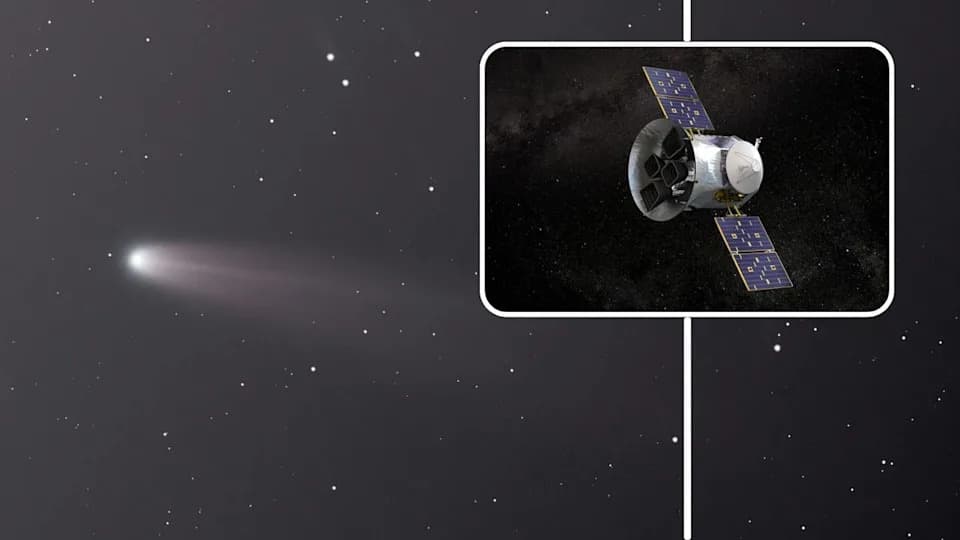
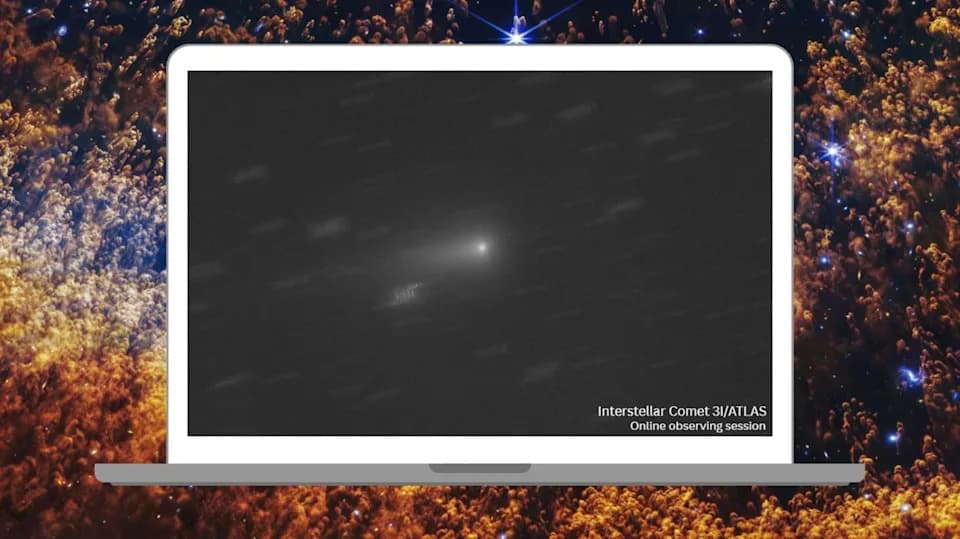
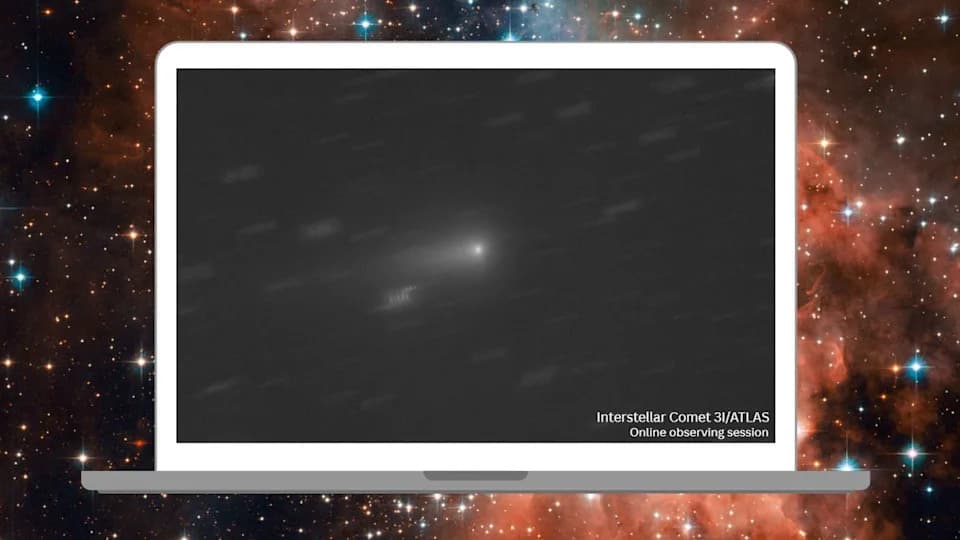
NASA's planet-hunting TESS (Transiting Exoplanet Survey Satellite) spacecraft recently caught a glimpse of interstellar comet 3I/ATLAS. | Credit: TESS insert by NASA/comet background by Enrico Bellodi from Pexels/assembled by Kenna Hughes-Castleberry via Canva pro
NASA's planet-hunting spacecraft TESS recently turned its cameras toward an unexpected target: the interstellar comet 3I/ATLAS. During a monitoring run from Jan. 15–22, the Transiting Exoplanet Survey Satellite captured the visitor as a bright, fast-moving point with a faint tail moving across a dense star field.
Using a subset of early-January frames, Daniel Muthukrishna of MIT compiled the exposures into a 28-hour video that traces the comet's path. The sequence includes a gap when TESS entered "safe mode" after a solar-panel issue, creating a time jump from Jan. 15 to Jan. 18.
Researchers hope the dataset will reveal the comet's activity and rotation. Small, repeating variations in brightness (a light curve) can indicate how vigorously the comet is shedding dust and gas and can help estimate the rotation period of its nucleus. TESS measured 3I/ATLAS at about 11.5 in apparent magnitude — roughly 100 times fainter than the naked-eye limit but easily visible with modest telescopes.
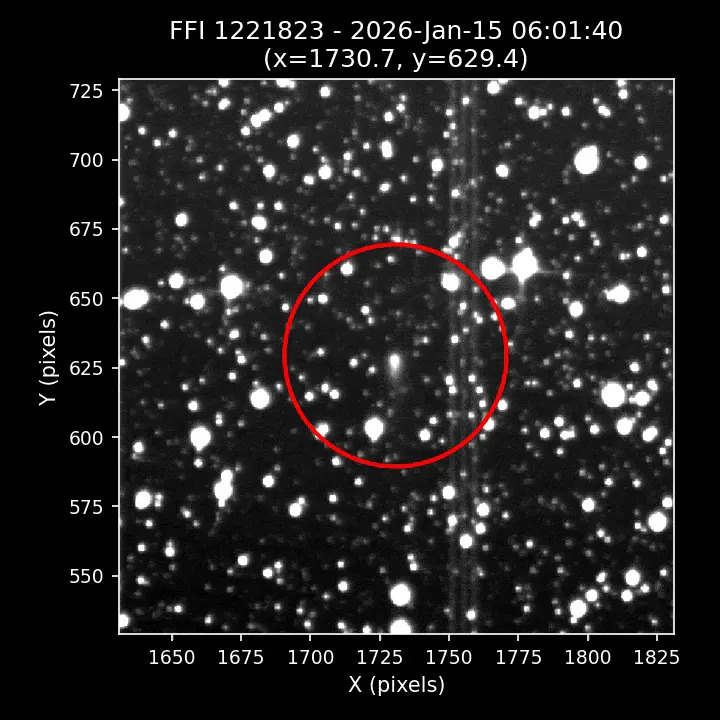
Interstellar comet 3I/ATLAS (circled) is a bright dot with a tail passing through a field of stars in this video from NASA’s TESS (Transiting Exoplanet Survey Satellite). The sequence uses 28 hours of TESS full frame images collected over Jan. 15 and Jan. 18 to 19. The time jump from Jan. 15 to Jan. 18 occurs 11 seconds into the video. | Credit: NASA/Daniel Muthukrishna, MIT
Why This Matters
Interstellar objects like 3I/ATLAS are rare visitors that carry information about other planetary systems. Measuring activity and spin helps astronomers understand the object's structure, how sublimation drives dust production, and how rotation may influence fragmentation or jets. Though the images don't reveal the comet's origin, they provide direct observational clues about its physical behavior as it leaves our Solar System.
TESS was designed to find exoplanets via the transit method, but its wide field of view and continuous monitoring also make it valuable for observing nearer solar-system objects. In fact, TESS recorded a comet in May 2025 — two months before 3I/ATLAS was formally identified — and archival searches and stacked observations helped isolate the interstellar visitor from background noise.
The January TESS observations are publicly available through the Mikulski Archive for Space Telescopes (MAST). Astronomers will comb these hours of coverage for repeating brightness patterns and other signatures that could pin down the comet's rotation rate and activity level.
Note: The "3I" designation indicates this object is identified as an interstellar visitor; previous examples include 1I/'Oumuamua and 2I/Borisov.
Help us improve.