Baek Jin-eon, a research fellow at the Korea Institute for Advanced Study, has posted a 119-page preprint arguing that no rigid planar shape with area greater than about 2.2195 square units can turn a right-angled corridor of unit width. The paper, Optimality of Gerver’s Sofa, contends that Joseph Gerver’s 1992 construction is optimal. The result, named one of Scientific American’s Top 10 Mathematical Breakthroughs of 2025, is currently under peer review.
Moving-Sofa Puzzle May Be Solved: Proof Says Gerver’s Sofa Is Optimal
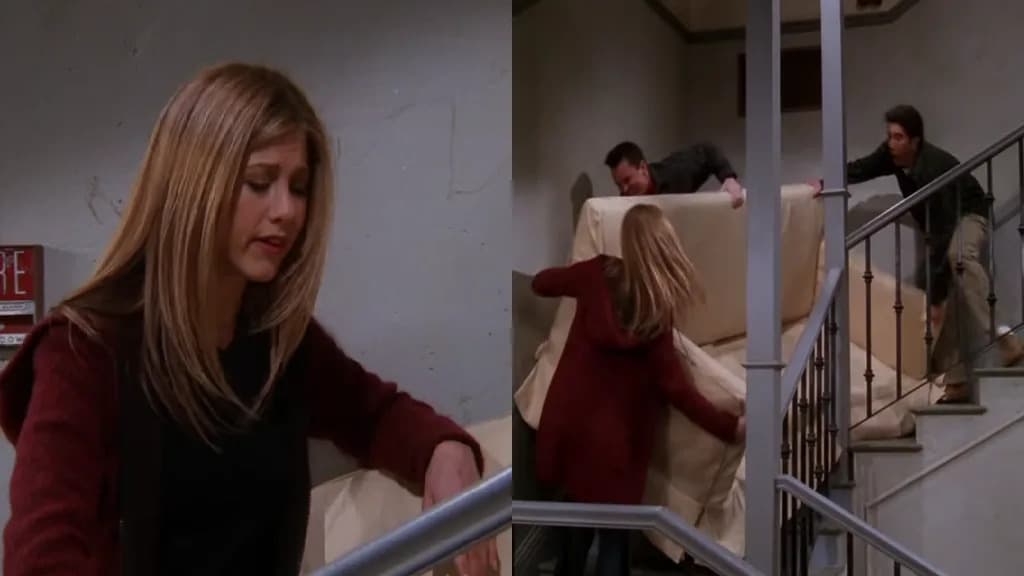
The decades-old "moving sofa problem" — a famously quirky geometry puzzle that mirrors the couch-and-stairwell gag from the TV sitcom Friends — may have a decisive answer. Baek Jin-eon, a 31-year-old research fellow at the Korea Institute for Advanced Study, has posted a 119-page preprint arguing that no rigid planar shape with area greater than about 2.2195 square units (measured for a corridor of unit width) can negotiate a right-angled corner. Scientific American named Baek’s work one of the Top 10 Mathematical Breakthroughs of 2025.
About the Proof
In the preprint titled Optimality of Gerver’s Sofa, released in late 2024, Baek presents a detailed argument that the complicated curved shape introduced by Joseph Gerver in 1992 — commonly called Gerver’s sofa — attains the maximum possible area that can make the turn. The paper shows that any rigid shape exceeding Gerver’s area must, at some stage in the prescribed motion, conflict with the corridor walls or otherwise violate the allowed movement constraints.
“This sofa problem doesn’t have much historical context, and it wasn’t even clear whether there was theory behind it. I tried to connect it to existing ideas and turn it into an optimisation problem, creating tools suited to the question,” Baek wrote, describing his approach.
Background: What Is the Moving Sofa Problem?
First posed by Leo Moser in 1966, the moving sofa problem asks: what is the largest area of a rigid two-dimensional shape that can be translated and rotated around a 90-degree corner inside an L-shaped corridor of constant width? By convention the corridor width is fixed at one unit so candidate shapes are compared on the same area scale. Gerver’s 1992 construction long stood as the best-known candidate, achieving roughly 2.2195 square units.
Significance and Status
Baek’s preprint is the first rigorous argument claiming that no larger rigid planar shape can succeed — in other words, that Gerver’s sofa is optimal. The work is currently undergoing peer review, the standard process for validating major mathematical claims; if the proof withstands scrutiny, it would close a question that has intrigued mathematicians and the public for nearly six decades.
Why it matters: The result resolves a natural and long-standing optimization problem in elementary geometry, combining elegant geometric reasoning with modern analytical tools. It also demonstrates how a playful, popular-culture image — the stuck couch — connects to deep mathematical questions.
Help us improve.