Governments worldwide are tightening rules on children's social media use after Australia moved to block users under 16 from major platforms. Several European countries, including France and Denmark, have proposed minimum ages between 13 and 16, while Norway, Malaysia and parts of India consider similar steps. The EU parliament issued non-binding recommendations and the U.S. relies on COPPA and state-level measures. The debate centers on balancing child safety with enforcement and legal limits.
Global Push To Restrict Kids' Social Media: Australia Leads, Europe Weighs In
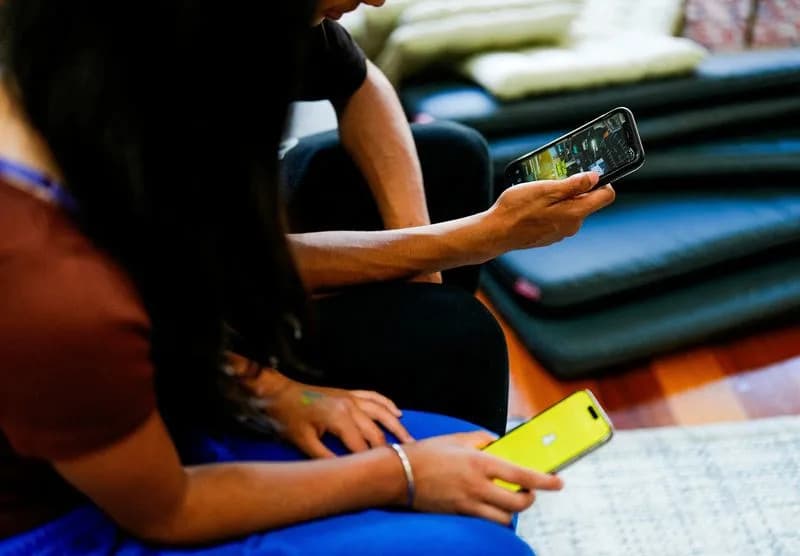
School students are seen with their mobile phones showing social media applications in Melbourne, Australia, November 28, 2024. REUTERS/Asanka Brendon Ratnayake/File Photo
Australia's December decision to bar children under 16 from major social media platforms has intensified an international debate about how best to protect young people online. Governments are proposing a mix of outright bans, higher minimum ages, parental-consent rules and technical safeguards as they balance child safety, free speech and practical enforcement.
Australia
A landmark law passed in November 2024 requires large social media companies to block users younger than 16 from accessing their services from December 10, 2025. Platforms that fail to comply face fines of up to A$49.5 million (about $34.3 million).
Britain
Prime Minister Keir Starmer said on January 20 that Britain is considering measures similar to Australia's, including a possible ban "for children under a certain age," and is reviewing whether the current digital age of consent should be raised.
France
On January 26, France's National Assembly approved legislation to bar children under 15 from social media amid concerns about online bullying and mental health. The bill must still pass the Senate before returning to the lower house for a final vote.
Denmark
Denmark announced plans in November to ban social media for children under 15, while allowing parents to grant exemptions for 13- and 14-year-olds. A parliamentary majority indicated support ahead of a formal vote.
China
China's cyberspace regulator enforces a so-called "minor mode" that applies device-level restrictions and app-specific rules to limit screen time and access based on age.
Germany and Italy
In Germany, minors aged 13 to 16 may use social media only with parental consent, though child welfare groups say current protections are insufficient. In Italy, parental consent is required for children under 14 to register on social platforms.
India (Goa)
The Indian tourist state of Goa is exploring restrictions similar to Australia's, according to the state's information technology minister.
Malaysia
Malaysia announced in November that it will ban social media use for people under 16 starting in 2026.
Norway
Norway proposed raising the age at which children can consent to social media terms from 13 to 15, while allowing parents to provide consent for younger children; the government is also working on legislation to set an absolute minimum age of 15 for social media.
The United States
At the federal level, the Children's Online Privacy Protection Act (COPPA) prevents companies from collecting personal data from children under 13 without parental consent. Several U.S. states have passed laws requiring parental consent for minors to access social media, but some of these laws face court challenges on free-speech grounds.
European Union
The European Parliament in November adopted a non-binding resolution that contains multiple recommendations: it called for protections to ensure "age-appropriate online engagement," proposed higher minimums for certain social media interactions (including a suggested minimum of 16 in some contexts) and urged harmonised age thresholds — including baseline rules around 13 for some services such as video-sharing and emerging "AI companions." The resolution is advisory and not legally binding.
Industry Practices
Major platforms including TikTok, Facebook (Meta) and Snapchat set 13 as the minimum sign-up age. Child-protection advocates say that requirement is widely evaded, and official data in several European countries show many under-13 children maintain accounts.
What This Means
Countries differ on whether to impose absolute age bans, parental-consent schemes or technical restrictions, reflecting political, legal and cultural differences. Enforcement challenges, platform compliance and potential legal challenges (especially around free speech and cross-border jurisdiction) will shape how these policies play out globally.
Note: Currency conversion used in this report: $1 = 1.4434 Australian dollars.
Help us improve.