Thailand's construction sector faces intense scrutiny after a crane collapse that killed two people and a train crash that killed 32, following last year's 33-story State Audit Office tower collapse that killed about 100. Public outrage has centered on Italian-Thai Development (Italthai) and raised questions about lax enforcement, flawed design and conflicts of interest in safety oversight. The government has ordered contract terminations, pledged to use bonds to finish projects, and plans a contractor "scorecard" to be in place by early February.
Deadly Cranes, Collapsed Towers: Why Thailand’s Construction Failures Have Sparked National Outrage
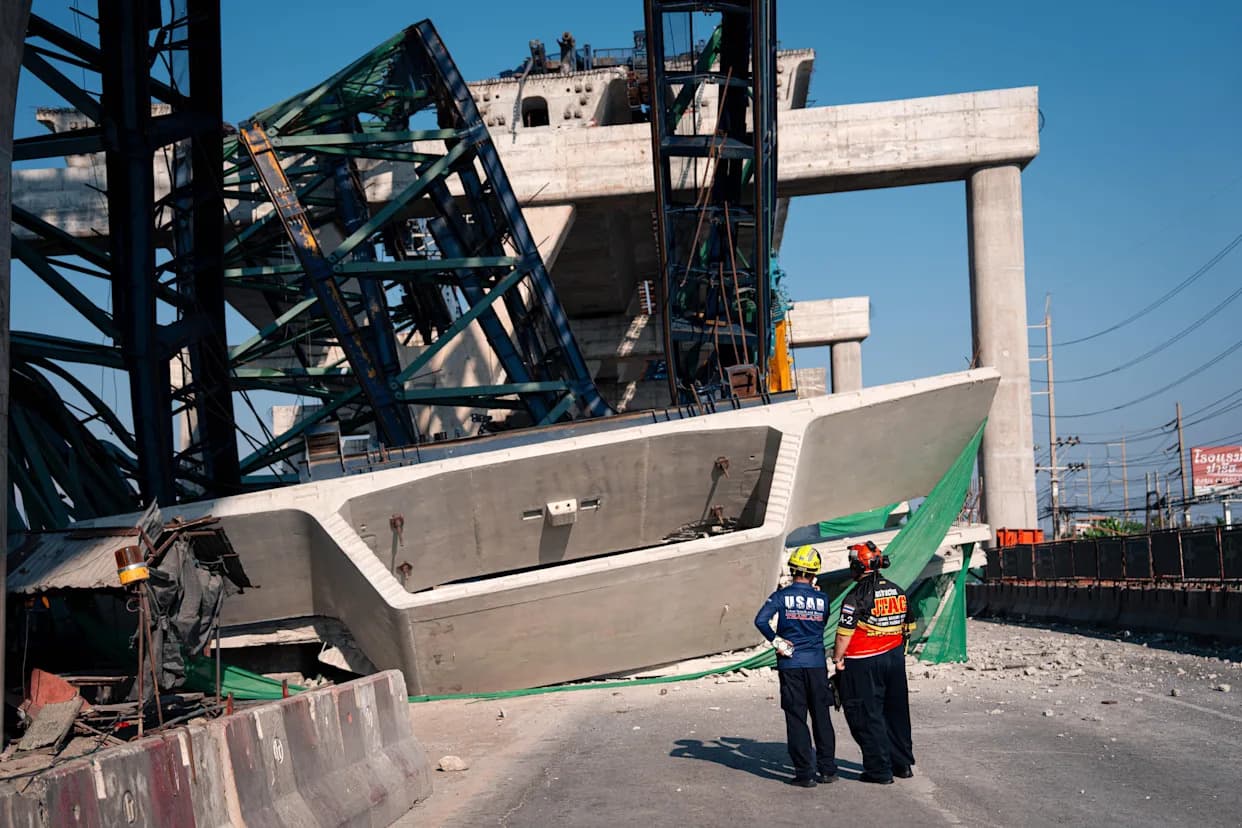
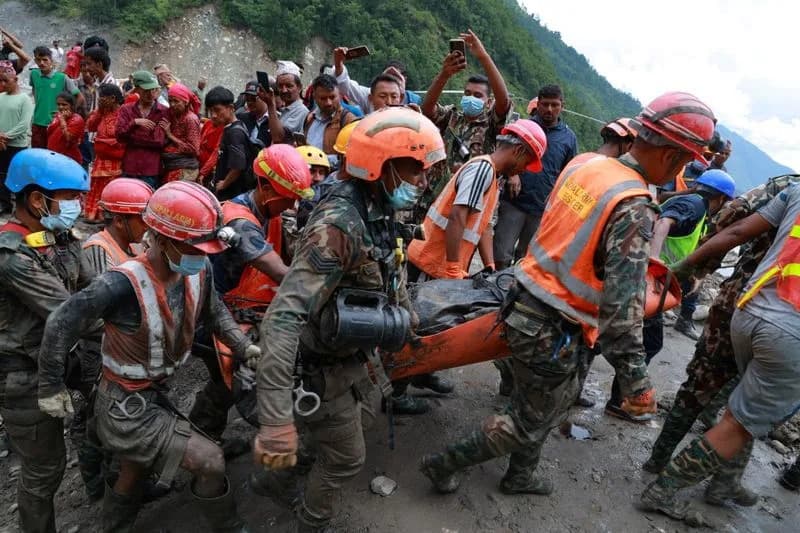
Rescuers look at a construction crane that collapsed on the Rama 2 Road elevated expressway in Samut Sakhon province, Thailand on Thursday, Jan. 15, 2026. (AP Photo/Arnun Chonmahatrakool)(ASSOCIATED PRESS)
BANGKOK — Thailand’s construction industry has come under intense public scrutiny after a string of deadly incidents, including a crane striking a moving passenger train this week and the collapse of an office tower last year that killed nearly 100 workers.
Concern is especially acute in Bangkok, where major road and rail projects have been marred by frequent — and sometimes fatal — accidents. In the most recent episodes, a construction crane collapsed on Thursday, killing two people, just a day after a train accident on the same corridor left 32 dead.
Contractor Has Safety Failure Records
Public anger has focused on Italian-Thai Development (Italthai), the contractor linked to both of the most recent sites. Italthai was also co-lead contractor on the 33-story State Audit Office building that toppled while under construction in March last year, killing about 100 people.
Authorities say that building was the only major Thai structure to collapse after an earthquake whose epicenter was in Myanmar, more than 1,300 kilometers (800 miles) away. Investigators and prosecutors subsequently indicted 23 individuals and companies in the State Audit Office collapse, including Italthai’s president, Premchai Karnasuta, on charges such as professional negligence causing death and document forgery. Italthai has denied wrongdoing in that case as well as in relation to the recent crane incidents.
Government Response: Contracts, Bonds and a Scorecard
Prime Minister Anutin Charnvirakul ordered the Transport Ministry to terminate contracts with, blacklist and pursue prosecution of companies involved in the recent accidents. The government said it will use performance bonds and bank guarantees to fund unfinished projects and reserve the right to sue contractors for extra costs. Officials also aim to implement a contractor "scorecard" to track performance and safety records by early February.
Troubles In The System
While investigators can often identify proximate technical causes — such as human error, poor maintenance or equipment failure — experts warn of deeper, systemic problems. Critics cite lax regulation, weak enforcement, red tape, conflicts of interest among inspectors and corruption as persistent vulnerabilities that undermine construction safety.
"I don't think Thailand fails in terms of the body of knowledge in engineering or even in the technical aspects," said Panudech Chumyen, a civil engineering lecturer at Thammasat University. "I think there's a failure in our system; there are so many gaps that I don't know where we should begin to close them."
Experts say safety gaps include poor coordination among agencies and a shortage of genuinely independent assessors, which can allow performance reports to misrepresent real conditions. A lengthy inquiry into the March collapse concluded that while an earthquake may have triggered the failure, the fundamental causes included flawed structural design and attempts to evade safety regulations.
Concerns Over Chinese Contractors
Attention has also turned to Chinese firms involved in the State Audit Office project and in troubled rail and road work. The train crash occurred on a route that forms part of a Thai-Chinese high-speed rail project linking Bangkok to northeastern Thailand — a line associated with Beijing’s Belt and Road Initiative.
China Railway No. 10 was co-lead contractor with Italthai on the State Audit Office project. Its Bangkok representative, Zhang Chuanling, was charged with violating Thailand’s Foreign Business Act by using Thai nationals as nominee shareholders to conceal Chinese control of the local affiliate. The collapse revived public anger and social-media criticism of so-called "tofu-dreg projects" or "tofu buildings," a derogatory phrase for shoddy, hurried construction that became widely used after the 2008 Sichuan earthquake.
China’s ambassador to Thailand, Zhang Jianwei, said Beijing requires its firms to follow local rules and is willing to "guide Chinese companies to actively cooperate with the Thai authorities' investigation."
What Comes Next
The twin crises have prompted calls for swifter regulatory reform, stronger independent oversight, and greater transparency in awarding and supervising public contracts. Officials promise contract terminations, blacklists and a performance scorecard; civil-society groups and experts say real change will require tackling vested interests and ensuring truly independent audits and enforcement.
— AP researcher Shihuan Chen in Beijing contributed to this report.
Help us improve.