The China Astronaut Research and Training Center completed a month-long subterranean training exercise in Chongqing involving 28 astronauts divided into four teams, each spending nearly a week underground. Participants practiced cave mapping, environmental monitoring, long-range communications and psychological resilience in conditions chosen to resemble the "extreme environment of space." Modeled on ESA’s CAVES program and led in part by veteran astronaut Ye Guangfu, the training emphasized minimal in-cave intervention to strengthen independent decision-making and teamwork.
28 Chinese Astronauts Spend a Month Underground in Space-Like Cave Training for Lunar Missions
@wulei2020 via X
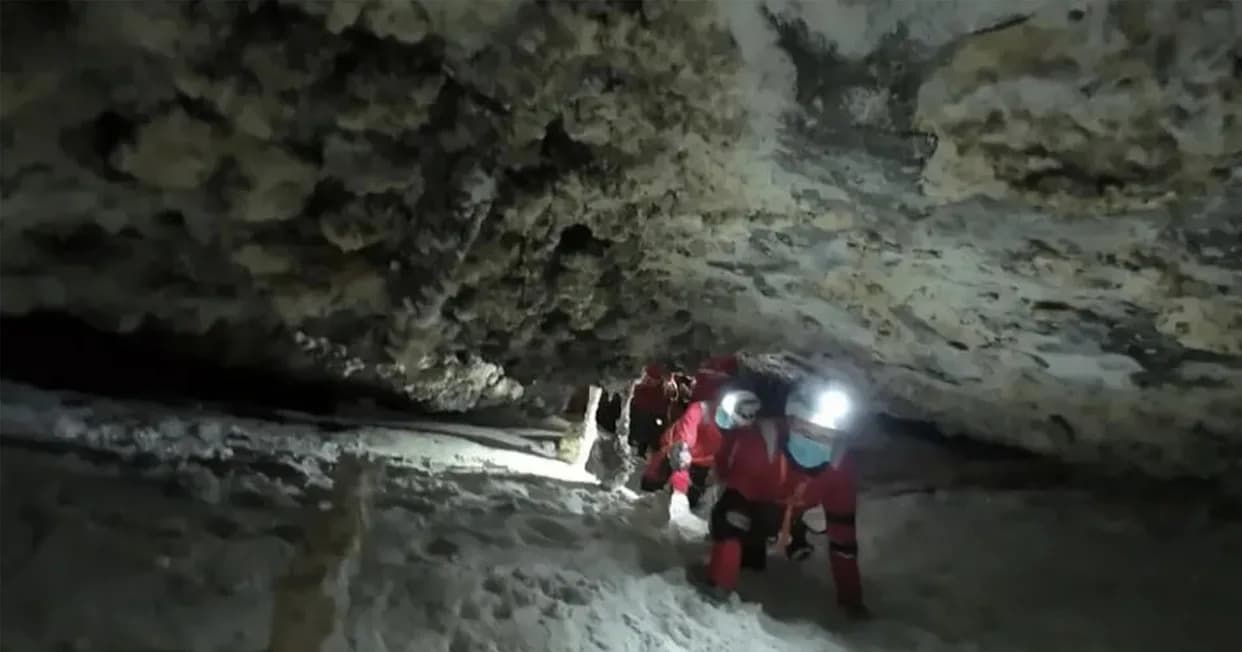
China’s astronaut corps has just completed an intensive month-long training exercise that swapped simulators and vacuum chambers for darkness, damp rock and complete isolation. The China Astronaut Research and Training Center (CARTC) sent 28 astronauts into an underground cavern system in Chongqing’s Wulong District to rehearse skills needed for future lunar landing missions.
Training Objectives and Site Selection
Participants were divided into four teams; each team spent nearly a week in subterranean isolation. According to the China National Space Administration (CNSA) and reporting from SpaceNews, the exercises focused on cave mapping, environmental monitoring, long-distance communications, and psychological and behavioral resilience under extreme sensory deprivation.
CARTC teams have scouted potential caverns since 2016. At least ten alternate sites in Guangxi, Hunan and Guizhou were considered. Administrators chose the Chongqing system — located in the Wulong District, home to karst landmarks such as the Wulong Three Bridges, the Xiaozhai Heavenly Pit and Furong Cave — because its conditions best matched the “extreme environment of space,” CNSA said.
How the Program Worked
The program mirrors the European Space Agency’s CAVES course (Cooperative Adventure for Valuing and Exercising human behavior and performance Skills). One of the Chinese cave-training directors, veteran astronaut Ye Guangfu, previously participated in a 2016 CAVES exercise in Europe. CARTC said its in-cave support intervened as little as possible to encourage independent judgment, teamwork and problem solving under stress.
"Compared with the cave training in Europe, our support team inside the cave intervened as little as possible," Ye told Xinhua. "This approach pushed astronauts to rely on their own judgment, unlocking both individual initiative and their full problem-solving potential."
"It was so dark that I couldn’t see my own hands in front of my face," said Tang Hongbo, commander of the second team and a veteran of Shenzhou-12 and Shenzhou-17. "In that kind of darkness, the mental pressure is overwhelming."
Why It Matters
Subterranean isolation tests skills that are directly relevant to lunar surface operations and long-duration missions: navigation in unfamiliar terrain, maintaining communications over limited links, monitoring hazardous environments, and preserving crew mental health and cohesion when external support is limited. The exercise underlines China’s continued focus on preparing crews for sustained activity on and around the Moon.
Sources: China National Space Administration (CNSA), China Astronaut Research and Training Center (CARTC), SpaceNews, Xinhua.
Help us improve.