Gen Z’s Progressivism Is Uneven. Analysis of the 2024 Cooperative Election Study of more than 60,000 Americans finds Gen Z markedly more progressive on race but not measurably more progressive on gender. Women drive modest reductions in sexist attitudes across younger cohorts, while men remain above average in sexism across generations. These divergent trends matter for political strategy and for whether future policy advances on racial equity will be matched by progress on gender equality.
Gen Z Is More Progressive on Race — But Not on Gender: What the 2024 CES Reveals
Melina Much, Ph.D./2024 Cooperative Election Study
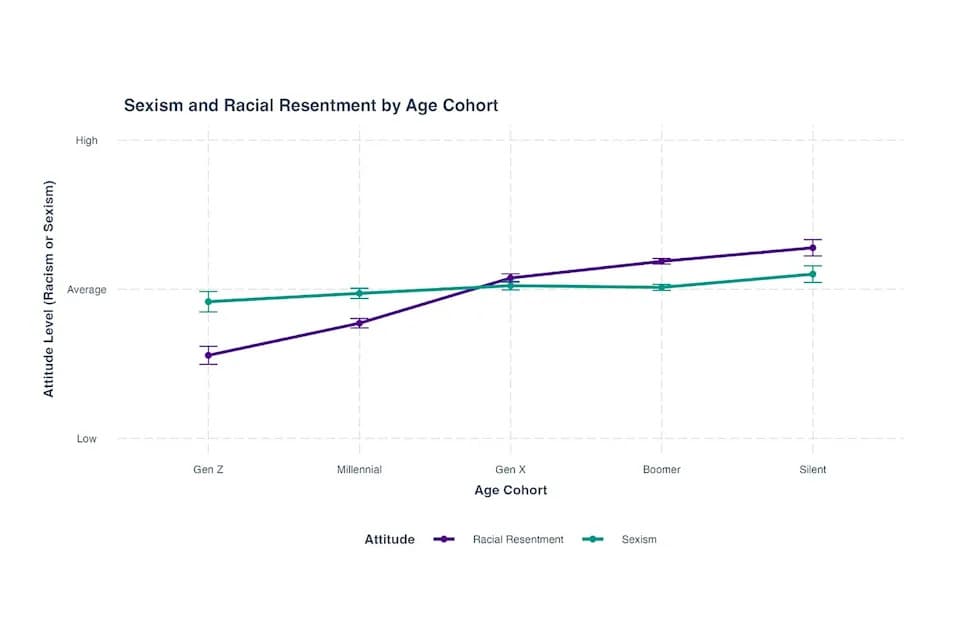
For observers who hoped Generation Z would uniformly remake American politics, the evidence is more mixed than celebratory headlines suggest. Recent analysis of the 2024 Cooperative Election Study (CES), a nationally representative survey of more than 60,000 Americans, shows a clear generational break on race but a stubborn continuity on gender attitudes.
What the Data Shows
The CES includes standard indices used by political scientists to measure attitudes: a racial resentment index (built from items about structural inequality and racial unfairness) and an ambivalent-sexism index (items that gauge hostile or patronizing views of women). Across these measures, Gen Z stands out for its low levels of racial resentment — lower than every older cohort — but not for lower sexism. On gender, Gen Z scores are close to the national average and, in many comparisons, similar to older generations.
Melina Much, Ph.D./2024 Cooperative Election Study
Race Versus Gender: An Uneven Progressivism
Put simply: Gen Z is substantially more progressive on race than its elders, but not decisively more progressive on gender. Where the racial-resentment index shows steady improvement from older to younger cohorts, the sexism index does not exhibit the same generational decline. That produces an uneven profile of social attitudes in a generation often described as uniformly liberal.
Differences by Sex and Party
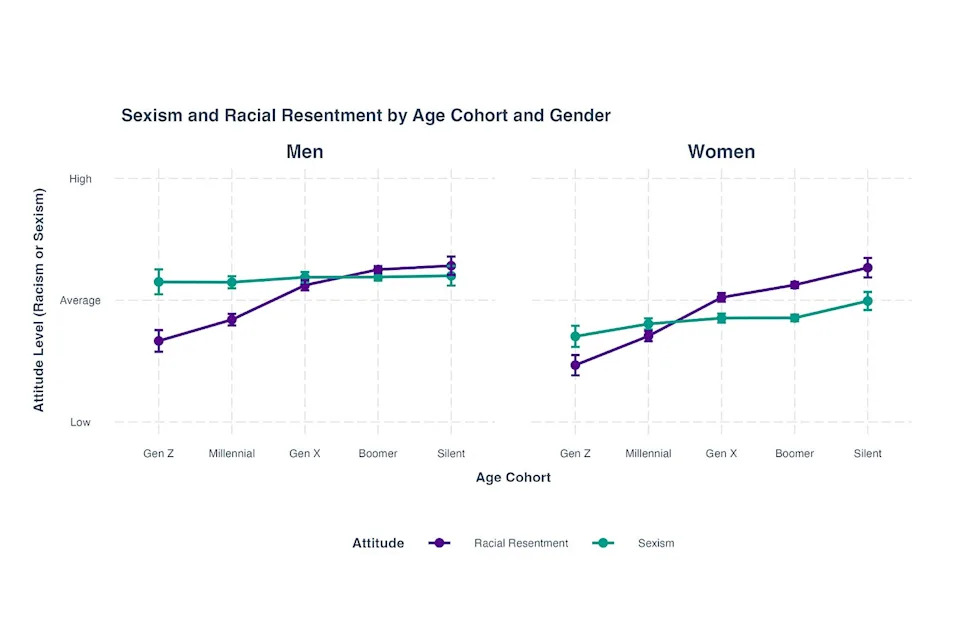
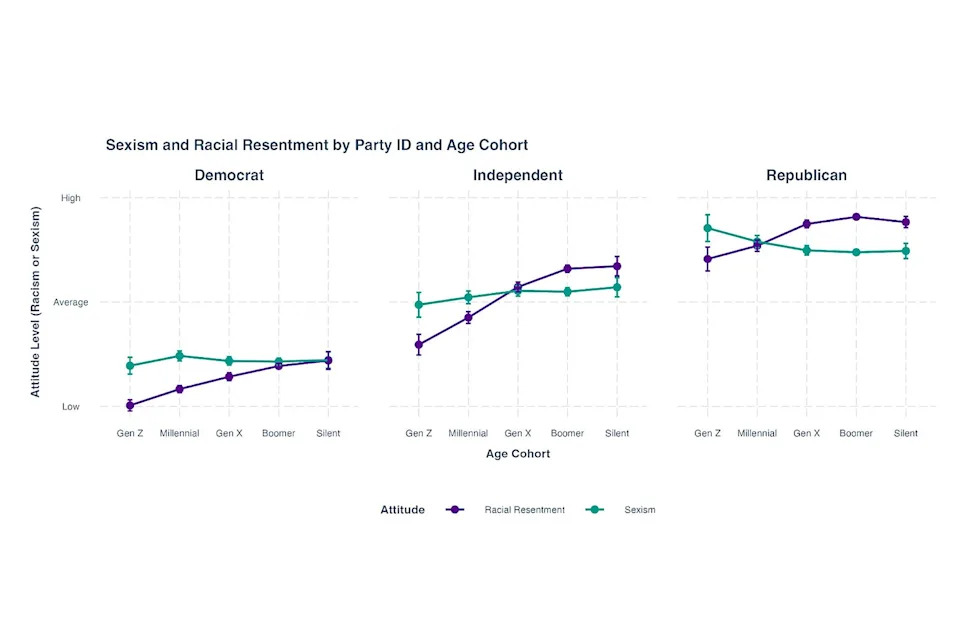
Disaggregating the data by respondents' sex and party identification sharpens the picture. Women in younger cohorts account for most of the modest declines in sexist attitudes; men in every generation remain above average on the ambivalent-sexism measure. Political affiliation also matters: Republicans report higher sexism and racial resentment across cohorts, and younger Republicans in the CES appear, on average, more sexist than older Republicans. Democrats and independents register generational gains on racial progressiveness but not on rejecting sexist statements.
Melina Much, Ph.D./2024 Cooperative Election Study
Why This Matters Politically
These patterns have practical consequences. If a generation is progressive on race but not on gender, policy progress will likely be uneven: gains in racial inclusion may not be matched by advances in gender equality across families, workplaces, and institutions. The data also helps explain political messaging strategies. Scholars and strategists note that appeals to masculinity and anti-feminist tones can resonate with some younger audiences — especially where sexism is not broadly repudiated — and could be an effective bridge for parties seeking new voters.
Context and caveats: The CES is a large, high-quality survey, but survey measures capture reported beliefs and do not fully reveal the causes of those beliefs. References here to the 'manosphere' or red-pill communities reflect plausible mechanisms discussed in academic work and media accounts, but direct causal links between specific online content and aggregate attitude shifts require targeted causal research.
What To Watch
Key areas for follow-up research and public attention include: longitudinal tracking of the same individuals as they age, more granular analysis of online media consumption and communities, and policy-level outcomes where racially progressive but gender-conservative coalitions might produce trade-offs.
In short, Gen Z’s profile is neither uniformly progressive nor uniformly reactionary. The generation’s marked racial progressiveness is real and consequential — but so too is its surprising continuity with older cohorts on gender attitudes, a dynamic with long-term implications for politics, policy, and social equality.
Help us improve.