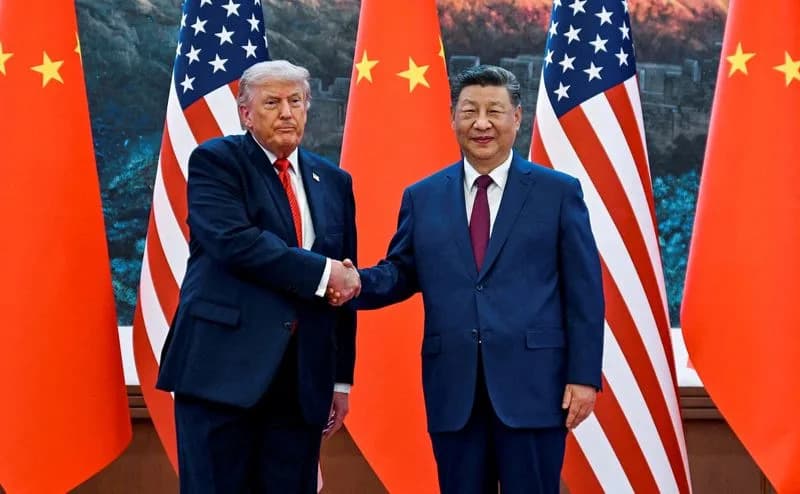
China announced sanctions on 20 U.S. defense companies and 10 executives after the U.S. revealed an arms package to Taiwan valued at more than $10 billion. The measures freeze assets in China and bar Chinese entities from doing business with the named firms; sanctioned individuals are also banned from entering China. Beijing called the arms sales a violation of its core interests, amid rising Chinese military activity around Taiwan and broader tensions with Washington.
China Sanctions 20 U.S. Defense Firms and 10 Executives After $10B Taiwan Arms Announcement

FILE - A low-cost autonomous cruise missile Barracuda 500, jointly manufactured by U.S Anduril and Taiwan''s National Chung-Shan Institute of Science and Technology, isndisplayed during the Taipei Aerospace & Defense Technology Exhibition (TADTE) at Nangang Exhibition Center in Taipei, Taiwan, Sept. 20, 2025. (AP Photo/Chiang Ying-ying, File)
BEIJING (AP) — China on Friday announced sanctions targeting 20 U.S. defense-related companies and 10 individual executives, a response to a recently disclosed U.S. arms package for Taiwan worth more than $10 billion.
According to the Chinese foreign ministry, the measures include freezing the sanctioned companies' assets in China and prohibiting Chinese individuals and organizations from conducting business with them. The named executives are banned from doing business in China and barred from entering the country; their assets in China have also been frozen.
Who Was Targeted
The list of firms includes major U.S. defense contractors such as Northrop Grumman Systems Corporation, L3Harris Maritime Services and Boeing's operations in St. Louis. Among the executives named is Palmer Luckey, founder of defense-technology firm Anduril Industries.
Beijing's Rationale
We stress once again that the Taiwan question is at the very core of China’s core interests and the first red line that must not be crossed in China–U.S. relations. Any company or individual who engages in arms sales to Taiwan will pay the price for the wrongdoing.
The foreign ministry urged the United States to abandon what it called the "dangerous moves of arming Taiwan," saying the arms transfers undermine China’s core interests and violate diplomatic understandings between Beijing and Washington.
Context And Implications
U.S. officials say the proposed package — if approved by the U.S. Congress — would be the largest-ever weapons sale to the self-ruled island. The announcement has sharpened already strained relations between Beijing and Washington over trade, technology, human rights and regional security.
Analysts warn that Taiwan remains a major flashpoint: China's military has increased near-daily drills by warships and fighter jets around the island in recent years. Under U.S. federal law, the United States has obligations to assist Taiwan in maintaining its self-defense, a responsibility that continues to complicate ties with Beijing.
What Comes Next: The practical impact of Beijing’s sanctions will depend on enforcement, how affected companies respond, and whether Congress moves to approve the arms package. The action is likely to further complicate U.S.-China relations and add new commercial and political risks for the targeted firms and individuals.
Help us improve.