
JWST spectra of galaxy GS 3073 reveal an unusually high nitrogen-to-oxygen ratio (N/O ≈ 0.46) that matches models for primordial 'monster stars' of roughly 1,000–10,000 solar masses. The study argues these giants produced and expelled nitrogen through internal mixing, then collapsed directly into massive black holes rather than exploding. GS 3073 also shows an actively accreting central black hole that could be a remnant. Further observations are required to confirm this scenario and its role in forming early supermassive black holes.
James Webb Finds 'Monster Stars' Leaking Nitrogen — Clues to Early Supermassive Black Holes

Ancient stars measuring up to 10,000 times the mass of Earth's sun may be the source of some of the universe's earliest black holes. The inset image shows a simulated black hole forming from one such star. | Credit: James Webb Space Telescope (background), Nandal et al. (boxout)
The James Webb Space Telescope (JWST) has revealed chemical evidence consistent with so-called 'monster stars' in the early universe, offering a new explanation for how some supermassive black holes grew so large within a billion years after the Big Bang. The signal comes from galaxy GS 3073 and is reported in a study published Nov. 12 in Astrophysical Journal Letters, co-led by researchers at the Harvard-Smithsonian Center for Astrophysics and the University of Portsmouth.
What the team found
Spectra of GS 3073 show an unusually high nitrogen-to-oxygen ratio (N/O ≈ 0.46), a chemical fingerprint not normally produced by ordinary stars or typical supernovae. The pattern closely matches theoretical models for primordial, extremely massive stars — each roughly 1,000 to 10,000 times the mass of the Sun — that synthesize and then expel nitrogen into their surroundings.
'Our latest discovery helps solve a 20-year cosmic mystery,' said Daniel Whalen of Portsmouth's Institute of Cosmology and Gravitation. 'These cosmic giants would have burned brilliantly for a brief time, before collapsing into massive black holes, leaving behind the chemical signatures we can detect billions of years later.'
How the nitrogen was made
The researchers describe a multi-step process inside very massive stars: helium burning in the core produces carbon, which is mixed outward into a hydrogen-burning shell. There, interactions between carbon and hydrogen create nitrogen. Convection and other internal mixing then distribute that nitrogen through the star, and strong stellar winds or mass loss put it into the surrounding gas. In GS 3073 this enrichment appears to have persisted over millions of years, producing the observed N/O signature.
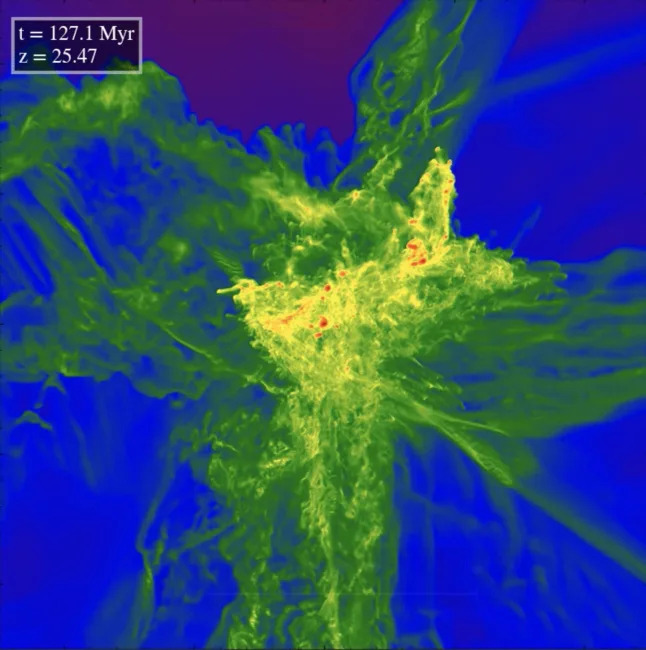
This simulated image from the team's study shows the birth of an ancient quasar, or extremely bright and active black hole, made possible by the collapse of a giant 'monster star'. | Credit: Nadal et al.
According to the models, this distinctive nitrogen signature arises only in a narrow mass window. Stars below about 1,000 solar masses or above roughly 10,000 solar masses do not create the same pattern, suggesting a 'sweet spot' in which internal mixing and nucleosynthesis yield the observed ratio.
Implications for black hole formation
Rather than ending as ordinary supernovae, the models predict these 'monster stars' would directly collapse into massive black holes. GS 3073 itself appears to host an actively accreting central black hole, which could plausibly be the remnant of one of these early giants. If confirmed, that would link the nitrogen enrichment and the early appearance of massive black holes in a single formation pathway.
The origin of the universe's first supermassive black holes remains an open question. Competing ideas include direct collapse of dense gas clouds, exotic processes involving dark matter, or the collapse of extremely massive stars. The authors emphasize that further JWST observations and refined modeling are needed to test whether GS 3073's chemical signature truly tracks a population of primordial monster stars.
Study details: Published Nov. 12 in Astrophysical Journal Letters; co-led by Harvard-Smithsonian Center for Astrophysics and the University of Portsmouth; key authors include Daniel Whalen and Devesh Nandal.


