
The U.S. is increasingly turning to private firms to manage disaster recovery as climate-driven catastrophes rise and public relief systems strain. Companies like Bright Harbor offer concierge services that ease paperwork and logistics but cost hundreds per month and are out of reach for many survivors. Post-Katrina New Orleans and post-Maria Puerto Rico show how privatization reshaped schools, housing, and utilities — often producing mixed results and displacing residents. Experts warn opaque contracts and the growing use of AI to allocate aid could deepen inequities unless public oversight and funding improve.
When Survival Depends on Wealth: The Rise of Private Disaster Recovery in the U.S.

A brush fire ranges through a neighborhood in December in Ventura, California. | Marcus Yam/Los Angeles Times via Getty Images
At the 2025 Oscars, alongside the usual luxury gifts, some attendees received a different kind of perk: a yearlong subscription to Bright Harbor, a white-glove disaster-recovery service that surged in popularity after the wildfires that ripped through Los Angeles in January.
When a home is lost to fire or flood, the immediate urgency of rebuilding or relocating often overwhelms survivors. Under that pressure, navigating Federal Emergency Management Agency (FEMA) rules, documentation requirements, and relief applications can become “a full-time job,” says Bright Harbor’s chief growth officer, Emily Bush. Bright Harbor markets itself as a concierge solution: advising clients on whether to rebuild or move, freezing mortgage payments, applying for FEMA assistance, completing complex forms, and helping secure low-interest small-business loans. Individual plans began at about $300 per month in 2024 before the company shifted to employer-sponsored plans.
“To be clear,” Bush adds, “I think the government should pay for this.” In principle, the government does fund recovery: FEMA allocates money to disaster-relief nonprofits, which hire case managers to guide victims through recovery. But long before recent budget battles and proposals to pare back FEMA, recovery funding and staffing frequently lagged behind demand. Nonprofits report too few case managers, and critics worry that proposals to shift more responsibility to states will widen those gaps.

Costume designer Colleen Atwood’s Oscar statue, after suffering damage from the Palisades fire.|Jon Kopaloff/Getty Images for Vogue
From Katrina to Today: Privatization’s Growing Role
The privatization of recovery work has been noted for years. Naomi Klein’s 2007 book The Shock Doctrine popularized the term “disaster capitalism,” describing how crises can open opportunities for private actors and ideological shifts in policy. Hurricane Katrina in 2005 is often cited as an inflection point: within weeks of the storm, policy discussions — including among conservative think tanks — promoted market-driven approaches to rebuilding, from charter schools to relaxed regulations for contractors.
In New Orleans, the post-Katrina era saw sweeping changes: public housing projects were demolished and largely replaced with mixed-income developments; the public hospital was closed; and the federal government effectively reorganized the public school system around charter models funded in part by private philanthropy. More than 7,000 teachers and staff lost their jobs and many residents were permanently displaced as roughly 70 percent of traditional public housing units were removed, according to multiple reports.
These changes produced mixed outcomes. Private funding and new management boosted some test scores and graduation rates, but the portfolio model of charter management also produced instability, closures, and accusations of uneven services — including a long-running special-education lawsuit that placed the city’s schools under federal oversight for years. Critics argue that some gains reflected an influx of money and attention rather than the private model itself.
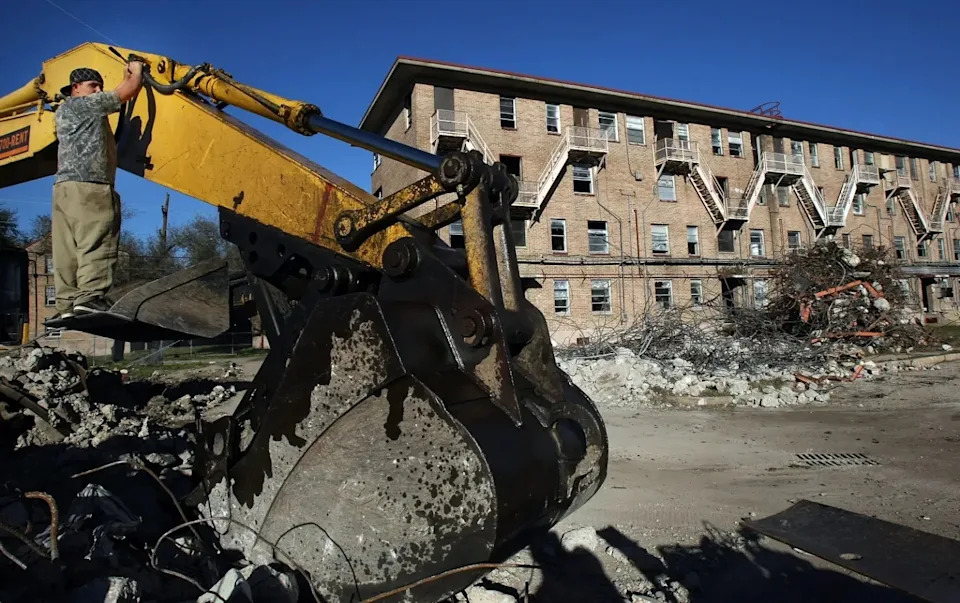
A worker prepares to continue demolition in the B.W. Cooper public housing development in 2008, in New Orleans. | Mario Tama/Getty Images via Grist
Puerto Rico: Grid Failure, Privatization, and Persistent Problems
Two decades later, many of the same dynamics are playing out in Puerto Rico after Hurricane Maria (2017). Maria struck as a Category 4 storm with sustained winds near 155 mph and toppled the territory’s electrical grid, leaving about 80 percent of residents without power and triggering one of the largest blackouts in U.S. history. Restoration took months for many communities.
Investigations later exposed mismanagement and scandals at the Puerto Rico Electric Power Authority (PREPA), including a controversial $300 million contract awarded to a small Montana firm, Whitefish Energy. PREPA declared bankruptcy and faced federal scrutiny. In 2021, the territory transferred transmission and distribution responsibilities to Luma Energy, a private operator that pledged modernization and renewables but has struggled to deliver reliable service. By late 2024, fossil fuels still supplied roughly 93 percent of Puerto Rico’s energy, and customers experienced more frequent and longer outages compared with the previous year.
The broader fiscal context matters: PROMESA, the federal law enacted in 2016 to address Puerto Rico’s debt crisis, created an oversight board that has overseen asset transfers and concessions to private entities. Observers say privatization and constrained public budgets have left residents shouldering costs and risks — higher bills, persistent blackouts, and increased reliance on polluting generators.
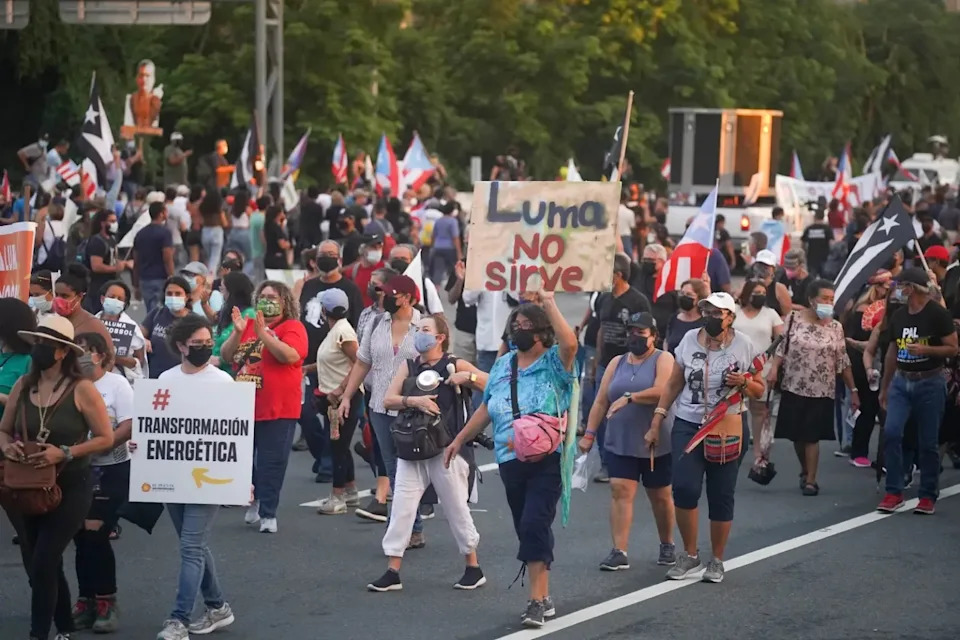
Protesters march against Luma Energy in what organizers called All of Puerto Rico Against Luma on October 15, 2021, in San Juan, Puerto Rico.| Angel Valentin/Getty Images via Grist
Where Privatization Helps — And Where It Fails
Private actors can move fast, mobilizing volunteers, fundraising, and targeted services in ways governments sometimes cannot. But market-driven recovery tends to favor high-value urban and suburban assets. Remote, low-income, or depopulating communities often lack profitable targets for private investment and are left with inadequate protection or slow rebuilding.
For example, rural firefighting shortages in parts of California have prompted private firefighting services hired by insurers or wealthy property owners. Public-safety officials warn such operations can complicate coordinated rescue efforts and strain shared resources like hydrants. During the January Los Angeles wildfires, some wealthy property owners contracted private crews to protect commercial assets while nearby homes burned.
New Risks: Opacity, Accountability, and AI
As more recovery tasks move to private contractors, concerns about transparency and public accountability grow. Contracts can be opaque, oversight thin, and priorities aligned with profitability rather than equitable recovery. Emerging technology adds another layer of risk: companies increasingly plan to use automated decision tools and artificial intelligence to determine eligibility for temporary housing, benefits, or other aid. Advocates warn that poorly designed AI systems could reproduce bias, reduce transparency, and deny vulnerable people access to essential services.
“What are public goods?” asks Shahrzad Habibi of the nonprofit In the Public Interest. “What do we, as a society, think everybody should be entitled to? And when do we, as a society, think you’re on your own?”
The expansion of private disaster recovery is not simply a matter of convenience; it reflects deeper political and fiscal choices about how society shares risk and responsibility. Policymakers, advocates, and communities will need clearer rules, stronger oversight, and sustained public investment to ensure recovery is timely, equitable, and transparent — especially as climate change increases the frequency and severity of disasters.
Image note: Costume designer Colleen Atwood’s Oscar statuette was damaged during the Palisades fire. (Jon Kopaloff/Getty Images for Vogue)


