
The Amazon is trending toward a "hypertropical" climate not seen for millions of years, with models projecting roughly 150 hot-drought days per year by 2100 under high-emissions scenarios. A 30-year study near Manaus found trees close stomata during heat-droughts—halting CO2 uptake—and develop fatal xylem embolisms when soil moisture falls below ~33%. Annual tree mortality could rise from just above 1% to about 1.55% by 2100, favoring slow-growing species and weakening the rainforest's role as a global carbon sink.
Amazon Is Shifting Toward a 'Hypertropical' Climate — Mass Tree Losses Could Follow
09:54 AM, 12/11/2025

More frequent and intense droughts could push the Amazon rainforest into a "hypertropical" regime. | Credit: Alexandre Morin-Laprise/Getty Images
New research published in Nature warns that the Amazon rainforest is shifting toward a "hypertropical" climate regime not seen on Earth for at least 10 million years. The change—driven by warming and an increasing number of extremely hot, dry days—could push the forest beyond the limits that sustain its current tree communities and carbon-absorbing capacity.
What the Study Found
Lead author Jeff Chambers, a geography professor at the University of California, Berkeley, and colleagues analyzed 30 years of local climate and physiological data from a forest site north of Manaus, Brazil. They combined temperature, humidity, soil moisture and sunlight records with sensors that tracked water and sap flow inside tree trunks to observe how trees respond to hotter, drier conditions.
The researchers project that, under high-emissions scenarios, the Amazon could experience roughly 150 days per year of "hot drought" by 2100, with drought conditions extending into what is now the wet season. During these events, evaporation rates rise and soil moisture falls; trees close their stomata to conserve water, which also halts carbon dioxide (CO2) uptake and limits growth and repair.
Physiological Collapse: CO2 Starvation and Xylem Embolism
When droughts become extreme, two processes drive tree mortality. First, stomatal closure prevents CO2 uptake and can lead to effective "CO2 starvation." Second, the team identified a consistent soil moisture threshold: when soil moisture falls below about 33% (only one-third of pore space contains water), trees develop embolisms—air bubbles in xylem vessels—that block water transport. The researchers observed this threshold repeatedly, including during El Niño years 2015 and 2023, and found similar values at another Amazon site.
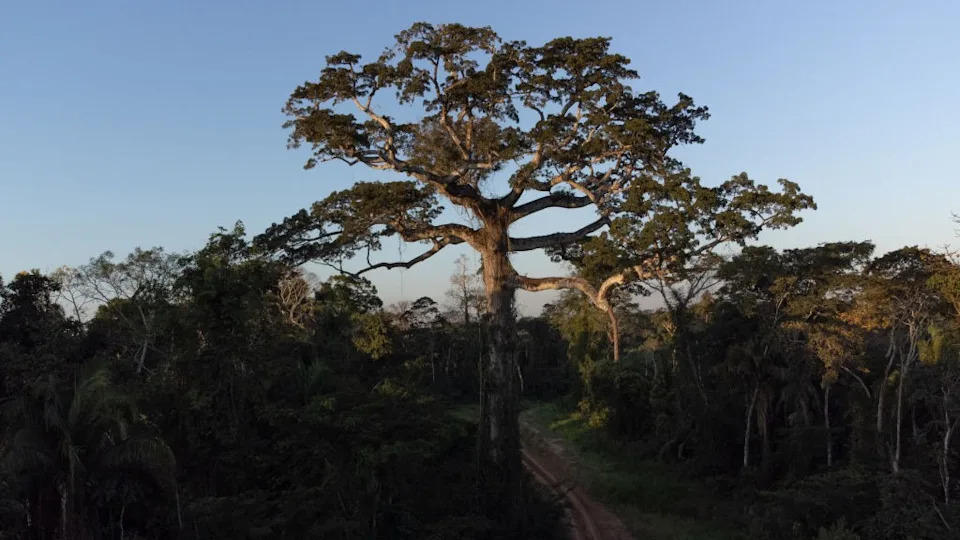
Slow-growing trees like the Shihuahuaco (Dipteryx micrantha) are more resistant to drought conditions than fast-growing trees. | Credit: Angela Ponce for The Washington Post via Getty Images
"If there are enough embolisms, the tree just dies," Chambers said, underscoring how a relatively small change in average conditions can trigger widespread mortality.
Ecological And Climate Implications
Current annual tree mortality in the Amazon is just above 1%; the study estimates it could rise to about 1.55% by 2100 under scenarios with limited reductions in greenhouse-gas emissions. While the percentage increase appears small, the absolute loss across the entire basin would be substantial and would weaken the rainforest's role as a global carbon sink.
Fast-growing species—those that rely on plentiful water and CO2 to sustain rapid growth—were found to be most vulnerable. If those species decline, slower-growing trees such as the yellow ipê (Handroanthus chrysanthus) and shihuahuaco (Dipteryx micrantha) could become relatively more dominant, provided they tolerate intensifying water stress and rapid warming.
The authors note that similar transitions may be underway in other tropical forests, including parts of western Africa and Southeast Asia. Because tropical rainforests absorb large amounts of atmospheric CO2, a regional shift to hypertropical conditions would have major consequences for the global carbon cycle and climate feedbacks.
What Can Change the Outcome?
The study's projections assume limited reductions in CO2 emissions. As Chambers emphasized, the timing and severity of a hypertropical shift depend on future emissions pathways: stronger mitigation could delay or reduce these impacts, while continued high emissions would accelerate them.
Bottom line: Warming-driven increases in the frequency and intensity of hot droughts could push the Amazon into a climate regime that stresses trees physiologically, raising mortality and altering species composition with broad consequences for carbon storage and biodiversity.
Similar Articles

A Wetter, Greener Sahara Could Reshape Global Weather — And Supercharge Hurricane Seasons
New University of Illinois Chicago research finds the Sahara could receive up to 75% more rainfall by 2100, a shift driven by...

Amazon Floodplain Lakes Reached 41.0 °C in 2023 Drought, Killing Hundreds of Dolphins and Thousands of Fish
During the 2023 Amazon drought, floodplain lakes heated to as high as 41.0 °C (105.8 °F) , killing hundreds of dolphins and t...

Scientists Warn: Nature Is Sending Alarming Signals — Climate Disruption Is Escalating
Scientists warn that a suite of environmental signals — from near year‑round wildfires and stronger hurricanes to melting gla...

Study: Extreme Heat Turned Amazon Lakes into 'Steaming Cauldrons,' Killing 150+ River Dolphins
New research in Science shows a late-2023 heatwave and severe drought raised temperatures in some central Amazon lakes to abo...

Africa’s Forests Have Become Net Carbon Emitters — New Study Warns
A new study using satellite data and machine learning finds that since about 2010 Africa’s forests have shifted from a net ca...

Study Finds Extreme Heat Turned Amazon Lakes into 'Steaming Cauldrons,' Killing More Than 150 River Dolphins
A Science study found that a late-2023 heatwave and drought raised temperatures in some Amazon lakes to about 41°C (105.8°F),...

Study: European Summers Could Lengthen By Up To 42 Days By 2100
The study reconstructs 10,000 years of climate from European lake sediments to quantify how Arctic amplification affects seas...

James Hansen: AMOC Could Reach a 'Point of No Return' in 20–30 Years, New Study Warns
James Hansen, who warned Congress of global overheating in 1988, now helps lead a new international paper that finds the Atla...

Bloomberg TikTok Chart Debunks Climate Myths — 78% Of Land Hit Record Heat In The 21st Century
Bloomberg Opinion posted a TikTok using NASA data that shows 78% of land has hit record-high temperatures in the 21st century...

New Sponge Study Suggests 1.5°C Climate Threshold May Already Be Past — But Experts Urge Caution
A University of Western Australia team used Sr/Ca ratios in long-lived Caribbean sclerosponges to reconstruct sea temperature...

Rogue Storms and Climate Chaos: How Unusual Cyclones Triggered Deadly Floods Across South and Southeast Asia
Three unusually timed tropical systems — including a rare equatorial cyclone — struck South and Southeast Asia in late Novemb...

Europe Could See About 42 Extra Days of Summer by 2100, Study Finds
Researchers report that a weakening pole-to-equator temperature gradient (LTG), driven largely by rapid Arctic warming from h...

Human-driven Shift in Pacific Decadal Oscillation Could Extend Southwest Drought for Decades
The U.S. Southwest has experienced about 25 years of exceptional dryness, with Colorado River reservoirs at record lows. A ne...

Climate leaders accept a likely "overshoot" of the 1.5°C limit — and explain what that means
Climate leaders at the U.N. meeting in Belem, Brazil, are increasingly accepting that global temperatures will likely exceed ...

Underwater ‘Storms’ Are Eating the Doomsday Glacier — Short‑Lived Eddies May Accelerate Sea‑Level Rise
The study in Nature Geosciences finds fast‑changing submesoscale eddies — “underwater storms” up to ~6 miles wide — intensify...