
Researchers filming the Clarion-Clipperton Zone recorded an undescribed whiplash squid at roughly 13,450 ft (4,100 m) burying almost its entire body in sediment while hanging upside down. The squid left only its siphon and two long tentacles exposed, apparently mimicking glass sponges either to hide from predators or to lure crustacean prey. This is the first recorded instance of mud-covering burial in an abyssal squid and highlights both the rarity of deep-sea observations and growing conservation concerns as the CCZ faces proposals for mining.
Upside-Down Trick: Unknown Deep-Sea Squid Buries Itself to Mimic Seafloor Life

Credit: Mejía-Saenz et al. 2025
Researchers filming the abyssal Clarion-Clipperton Zone (CCZ) have documented an undescribed whiplash squid burying nearly its entire body in sediment while hanging upside down — a behaviour never before recorded in deep-sea squids. The observation, reported in the journal Ecology on Nov. 25, was made at about 13,450 feet (4,100 meters) during the U.K.-led SMARTEX expedition, which is studying how proposed deep-sea mining could affect life in this region.
What the Team Saw
Video from a remotely operated vehicle (ROV) showed the squid with most of its mantle and body submerged in mud while its siphon and two long tentacles stood rigid above the seafloor. At first the researchers saw only two white projections resembling the stalks of glass sponges or the tubes of large polychaete worms, and only later realized the animal had buried itself.
"The fact that this is a squid and it's covering itself in mud — and upside down — was very novel and very puzzling," said lead author Alejandra Mejía-Saenz of the Scottish Association for Marine Science.
Why It Might Be Doing This
From the footage the team proposes two nonexclusive explanations: the squid may be using masquerade to look like an inedible seafloor object (helping it avoid predators such as beaked whales), or it may be imitating glass sponges to lure crustacean prey and ambush them. In the food-poor abyssal plain, such an energy-efficient ambush strategy could be advantageous compared with active hunting.
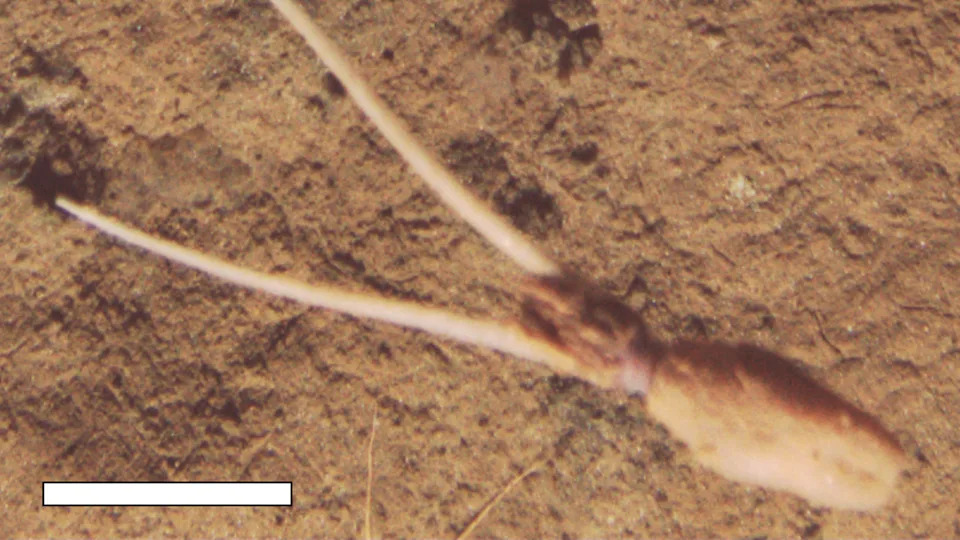
Although octopuses, cuttlefish and some shallow-water squid are known to bury themselves, this unknown deep-sea squid is the first to exhibit this behavior — and upside down, too. | Credit: Mejía-Saenz et al. 2025
Experts not involved in the study noted the resemblance to sponge stalks. Jim Barry of the Monterey Bay Aquarium Research Institute said the behaviour is similar to some seafloor invertebrates and underscored how little is known about mimicking tactics among abyssal organisms.
Rarity And Conservation Concerns
Even in this comparatively well-surveyed region, the team recorded only 33 cephalopod encounters across roughly 3,100 miles (5,000 km) of ROV tracks, highlighting how rare abyssal squid observations are and why new behaviours are still being discovered. The CCZ is also the main target for proposed deep-sea mining of nickel, cobalt and manganese — metals used in batteries — and researchers warn that sediment plumes and habitat disturbance from mining vehicles could harm these fragile communities.
"Disturbance to the seafloor would most likely have negative consequences for these animals," Mejía-Saenz said, adding that the full extent of potential impacts remains unknown. Other scientists, including Bruce Robison (MBARI), emphasise that discoveries like this reveal only a fraction of deep-sea squid behaviour and strengthen the case for more exploration before large-scale industrial activity proceeds.
(Observation reported in Mejía-Saenz et al., Ecology, Nov. 25. Footage and further analysis were collected during the SMARTEX expedition in the Clarion-Clipperton Zone.)


