
Archaeologists have excavated a 4,500-year-old valley temple at Abu Ghurab, about 10 miles southwest of Cairo, revealing it as part of a larger sun-temple complex dedicated to Ra and linked to an upper sanctuary by a causeway. The team uncovered a columned portico, dozens of inscribed and decorated blocks naming Pharaoh Niuserre, and a long carved calendar of religious feasts displayed at the temple entrance. A rooftop staircase suggests the roof was used for sky observations, and later reuse of the building as housing is attested by senet game pieces.
4,500-Year-Old Valley Temple Linked to Niuserre’s Sun Temple of Ra Unearthed Near Cairo

Part of the valley temple at Abu Ghurab, about 10 miles (16 kilometers) southwest of Cairo. | Credit: Courtesy of the Egyptian Ministry of Tourism and Antiquities
Archaeologists have uncovered the remains of a 4,500-year-old valley temple at Abu Ghurab, roughly 10 miles (16 kilometers) southwest of Cairo. The structure is part of a larger sun temple complex commissioned for the sun god Ra during the reign of Pharaoh Niuserre (circa 2420–2389 B.C.), the Egyptian Ministry of Tourism and Antiquities said in a translated statement.
Two-Part Sun Temple Connected by a Causeway
The complex comprises an upper temple, excavated in earlier seasons, and a valley temple—newly worked on by the current team since 2024. The two were linked by a long causeway, with the valley temple positioned near the Nile to serve as an approach or landing point for boats and visitors.
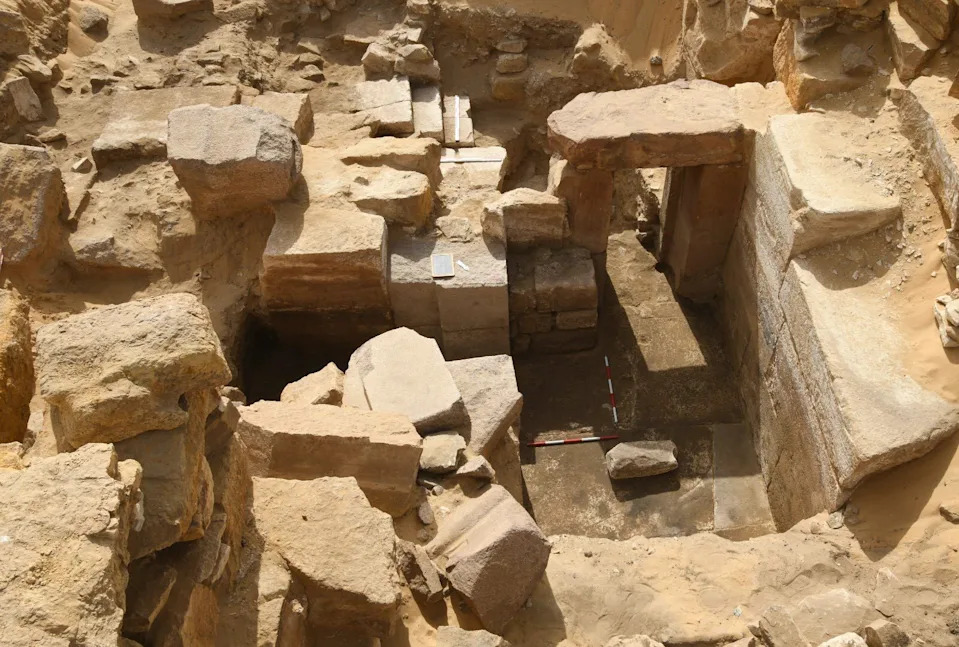
Part of the valley temple from an overhead view. | Credit: Courtesy of the Egyptian Ministry of Tourism and Antiquities
What the Excavation Revealed
Modern excavations have exposed about half of the valley temple so far. Finds include the remains of a columned entrance portico, dozens of decorated stone blocks bearing inscriptions naming Pharaoh Niuserre, and an extended carved calendar of religious feasts. Massimiliano Nuzzolo, co-director of the Italian Archaeological Mission in Egypt, noted that earlier work by German Egyptologist Ludwig Borchardt in 1901 had been halted by high groundwater; lower water levels today have allowed renewed investigation.
"The façade of the temple appears to have been inscribed with this long calendar of feasts, possibly one of the first public calendars known to us," Nuzzolo said.
The calendar entries record festivals such as the feasts of Sokar (a falcon‑headed deity associated with Memphis), the festival of Min (a fertility god), and processions in honor of Ra. The blocks were found in the entrance portico area, suggesting the schedule was meant to be publicly visible to visitors arriving at the temple.
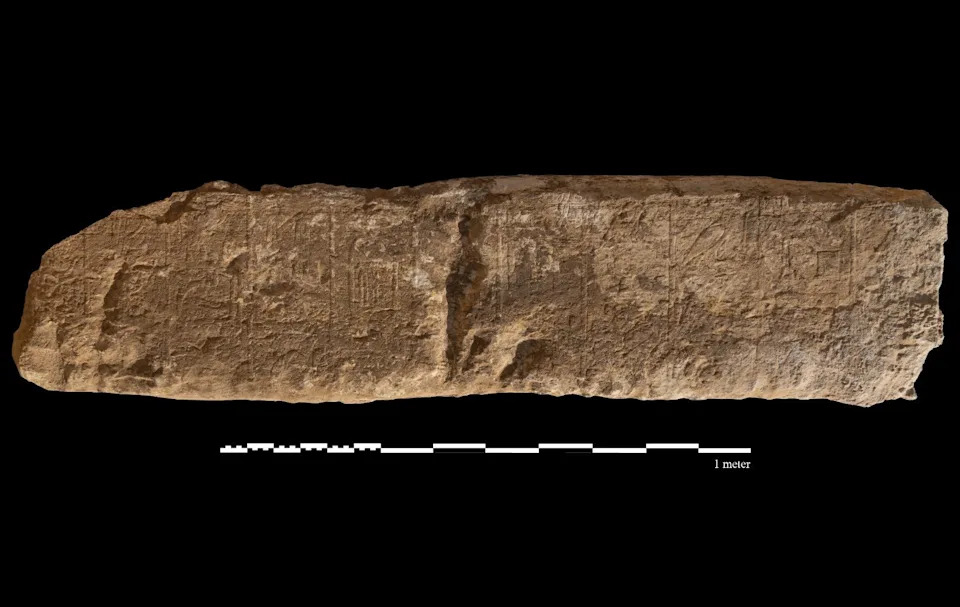
Inscriptions found in the valley temple, which include a "public calendar" telling of religious events. | Credit: Courtesy of the Egyptian Ministry of Tourism and Antiquities
Astronomical Use and Later Reuse
Excavators also uncovered a staircase leading to the temple roof. Archaeologists believe the roof was likely used for observing the sky rather than for holding festival ceremonies—adding to evidence that Old Kingdom temples served multiple ritual and practical functions, including astronomical observation.
After roughly a century of religious use, the valley temple appears to have been converted into a residential area. Among the domestic finds were two wooden pieces used to play the board game senet, a pastime commonly found at Egyptian sites (including Tutankhamun's tomb), though the exact rules remain unclear.
Why This Matters
The discovery is important because it: provides new architectural and inscriptional evidence for Niuserre's reign; adds to our understanding of Old Kingdom temple layout and public ritual life; and may represent one of the earliest examples of a publicly displayed ritual calendar. Continued excavation at Abu Ghurab is likely to yield further insights into ancient Egyptian religion, administration, and astronomy.


