
NASA lost contact with the MAVEN Mars orbiter on Dec. 6, 2025, after the spacecraft passed behind Mars; pre-loss telemetry showed subsystems reporting normally. Flight controllers have been unable to re-establish communications and an investigation is underway. MAVEN — in orbit since Sept. 2014 — has been pivotal in documenting solar-driven atmospheric loss and has also served as a communications relay for surface rovers. If MAVEN cannot be recovered, the twin-spacecraft ESCAPADE mission is scheduled to arrive at Mars in Sept. 2027 to continue related studies.
NASA Loses Contact With Long-Serving MAVEN Mars Orbiter — Investigation Underway

Houston, We Have a Problem: NASA Has Lost Contact With the MAVEN Mars Orbiter
NASA reported that ground teams lost contact with the MAVEN spacecraft (Mars Atmosphere and Volatile EvolutioN) on Dec. 6, 2025. The outage occurred while the orbiter was on a routine pass behind Mars, temporarily cutting direct line-of-sight communications with Earth. Although pre-blackout telemetry indicated all onboard subsystems were operating normally, engineers have so far been unable to re-establish communications.
What Happened
During standard operations the spacecraft swung behind the planet, out of radio contact with ground stations. Controllers normally reacquire signal when the craft returns from the planet’s far side; in this case, the expected recovery did not occur. NASA has opened an official investigation and says it will provide updates as new information becomes available. The precise cause of the signal loss remains unknown.
Mission Background
MAVEN launched in November 2013 and entered Mars orbit in September 2014. For more than a decade it has studied Mars’s upper atmosphere and ionosphere to help scientists understand how solar radiation and the solar wind contributed to long-term atmospheric loss. In addition to its primary science mission, MAVEN has served as a communications relay for surface missions including the Curiosity and Perseverance rovers.
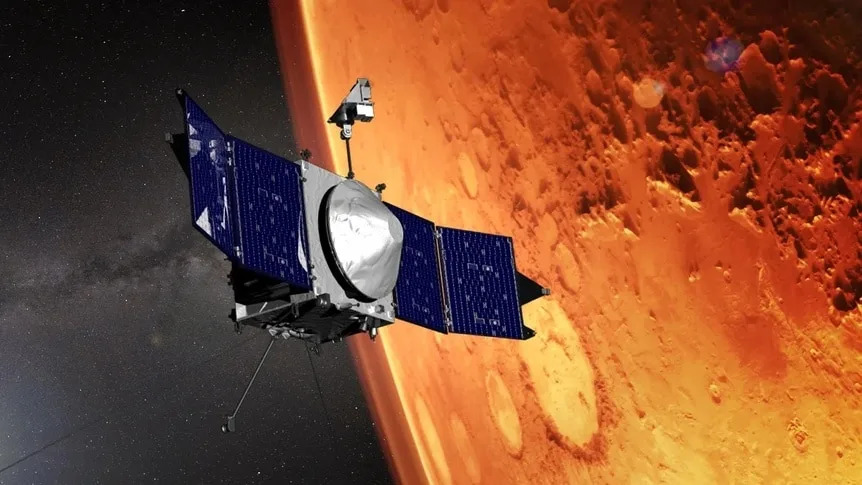
MAVEN
Scientific Contributions
MAVEN’s observations were central to the conclusion that solar-driven processes have stripped light gases from Mars. Solar radiation can dissociate water into hydrogen and oxygen; the lightweight hydrogen migrates upward where the solar wind can remove it — a process Earth largely avoids thanks to its global magnetic field. MAVEN also recorded the first visible-light auroras on Mars and captured images of the interstellar comet 3I/Atlas that helped characterize the object’s composition and water-vapor loss.
Current Fleet And Redundancy
Several other spacecraft remain active at Mars, including NASA’s Mars Reconnaissance Orbiter (MRO) and Mars Odyssey. If MAVEN cannot be recovered, NASA expects upcoming missions to help fill gaps in observations.
Relief Mission: ESCAPADE
NASA’s ESCAPADE (Escape and Plasma Acceleration and Dynamics Explorers) mission, comprising two small spacecraft, launched on Nov. 13, 2025, and is currently in Earth orbit. ESCAPADE will loiter in Earth orbit for roughly a year before performing a trans‑Mars injection burn planned for November 2026, with arrival at Mars expected in September 2027 and science operations beginning in spring 2028. The twin probes will take simultaneous measurements to map how the solar wind affects Mars in real time.
NASA Update: Agency officials say they are actively investigating the loss of contact and will share status updates with the public when available.
For now, the space science community is watching closely. MAVEN’s decade-long record of atmospheric measurements has been invaluable for understanding Mars’s evolution, and teams are working to restore contact while preparing contingency plans to maintain critical science and relay capabilities.


