
NASA has lost communications with the MAVEN orbiter after it passed behind Mars and did not resume contact on re-emergence. Telemetry indicated the spacecraft was functioning normally before the blackout, and teams at NASA and JPL's Deep Space Network are investigating while pinging MAVEN along its predicted orbit. MAVEN, in orbit since Sept. 21, 2014, studies Mars' upper atmosphere and also serves as a relay for surface rovers; it has fuel to operate through at least the end of the decade.
NASA Loses Contact With Long-Running Mars Orbiter MAVEN After Occultation
Dec 11

This artist's concept depicts NASA's Mars Atmosphere and Volatile EvolutioN, or MAVEN, spacecraft near Mars. The spacecraft launched on November 18, 2013, from Cape Canaveral Air Force Station in Florida atop a United Launch Alliance Atlas V rocket. Image by NASA
NASA has lost contact with the Mars Atmosphere and Volatile EvolutioN (MAVEN) orbiter after the spacecraft passed behind Mars and failed to reestablish communications upon re-emergence.
NASA confirmed Tuesday that telemetry showed MAVEN operating normally before it went behind the planet as seen from Earth. When the orbiter returned from Mars' far side on Sunday, ground teams did not receive signals.
The spacecraft and operations teams are investigating the anomaly to address the situation, and more information will be provided when available, NASA said.
Engineers at NASA and operators of the Deep Space Network at the Jet Propulsion Laboratory in California say they can still send pings to MAVEN along its predicted orbit while they work to diagnose the cause and develop a potential fix, according to Space.com.
What MAVEN Does
Since entering Mars orbit on Sept. 21, 2014, after a roughly 442 million-mile (about 711 million km) cruise, MAVEN's primary mission has been to study Mars' upper atmosphere and ionosphere and how the Sun and solar wind strip gases into space. That research helps scientists reconstruct the planet's climate history and assess past habitability.
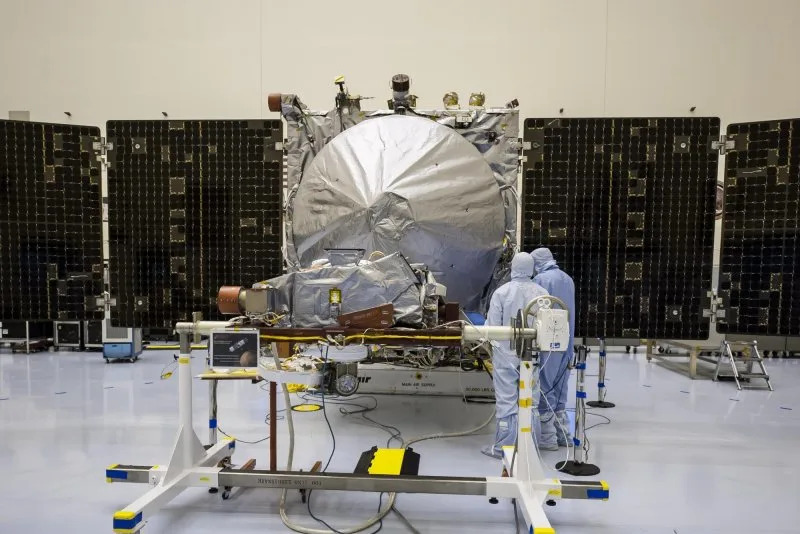
The MAVEN spacecraft undergoes final preparations at the Kennedy Space Center, Florida on September 27, 2013. File Photo by Joe Marino/UPI
Communications Role
MAVEN also serves as an important communications relay for surface missions, including NASA's Curiosity (landed Aug. 6, 2012) and Perseverance (landed Feb. 2021) rovers. Other U.S. relay orbiters include Mars Odyssey (in orbit since Oct. 24, 2001) and the Mars Reconnaissance Orbiter (since March 10, 2006).
Orbiter Status and History
MAVEN launched from Cape Canaveral on Nov. 18, 2013, aboard a United Launch Alliance Atlas V rocket. The spacecraft had a launch mass of about 5,410 lb (2,454 kg) and a dry mass near 1,784 lb (809 kg). Mars' lower gravity means objects weigh roughly 38% of their Earth weight on the planet.
In 2022, the mission reconfigured MAVEN to an "all-stellar" navigation mode, reducing reliance on its inertial measurement units. NASA reports MAVEN has sufficient propellant to remain in orbit through at least the end of the decade and is operating well beyond its prime mission. Operating costs were approximately $22.6 million in 2024.
Context: Other Mars Orbiters and Upcoming Missions
Several other orbiters—both U.S. and international—are currently at Mars: ESA's Mars Express and ExoMars Trace Gas Orbiter (ESA–Roscosmos), the United Arab Emirates' Hope, and China's Tianwen-1. Separately, on Nov. 13 Blue Origin's New Glenn launched two NASA ESCAPADE smallsats destined for Mars in September 2027 on a longer, less direct trajectory.
NASA and partner teams continue active telemetry checks and recovery attempts. Further updates will be provided as the investigation yields new information.


