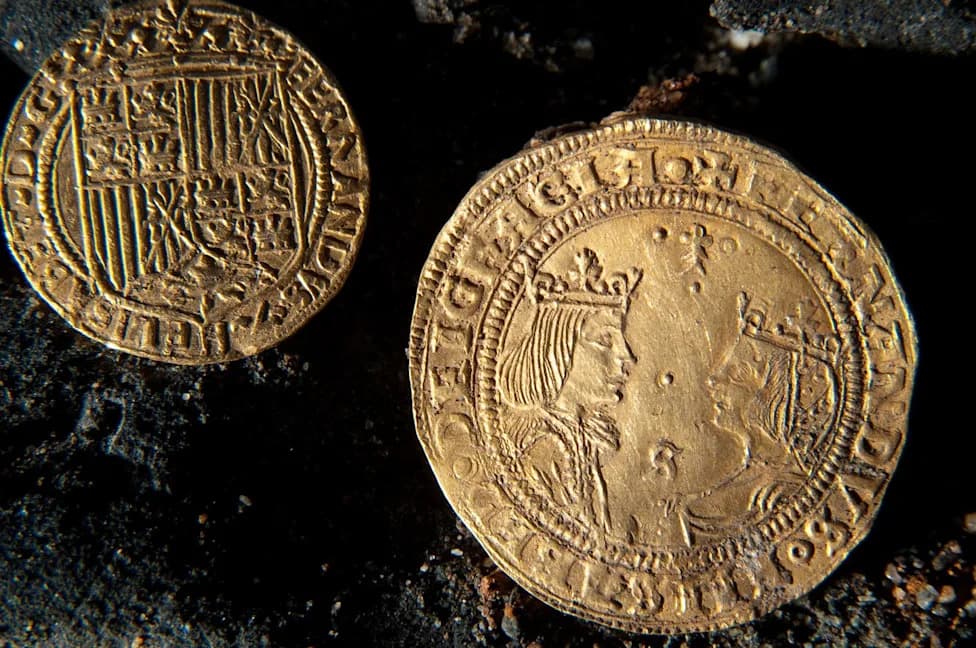
The Colombian government has begun a second-phase recovery of artifacts from the Spanish galleon San José, which sank in 1708 carrying an estimated 200 tons of treasure. Early recoveries include a bronze cannon, two intact porcelain cups, three coins and related debris; items were retrieved by ROVs from about 2,000 feet (600 m) deep. Conservation teams will stabilise and conserve the finds with the goal of eventually displaying them in a museum.
First Treasures Recovered from the 'Holy Grail' Shipwreck San José After 300 Years

Valuable artifacts from the Spanish galleon San José — long billed as the "Holy Grail of shipwrecks" — have been raised to the surface as part of Colombia's ongoing salvage and conservation effort. The newly recovered objects include a bronze cannon, two intact porcelain cups, multiple porcelain fragments, three coins and rope, wood and metal debris associated with the cannon.
What was recovered and how
Robotic equipment and remotely operated vehicles (ROVs) were used to extract the items from the seabed about 2,000 feet (600 meters) below the surface, south of Cartagena. The cannon was placed in a refrigerated container aboard the support vessel to stabilise it, while the coins were kept in salt water to minimise deterioration before conservation treatment. Conservation teams from the Colombian Institute of Anthropology and History (ICANH) and the Ministry of Culture will continue stabilisation and analysis ashore.
Historical context
The San José was a 62-gun Spanish galleon that sank in June 1708 while leading a convoy of 18 treasure ships from South America to Europe. Contemporary accounts and later researchers disagree about whether the galleon exploded during the battle with British warships, but roughly 600 crew and passengers were lost. The ship reportedly carried an estimated 200 tons (180 metric tonnes) of gold, silver and precious gems — a cargo described in 2018 as having a notional value of about $18 billion.
Discovery and legal disputes
Researchers located the wreck in 2015. Its discovery triggered competing claims from several parties, including Spain, a U.S. company and the Indigenous Bolivian Qhara Qhara nation. The Colombian government has maintained that shipwrecks within its territorial waters are state property and has proceeded with documentation, surveys and phased recovery operations.
Significance and next steps
Officials say the current recoveries represent the beginning of a careful, multi-year program to retrieve, conserve and study artifacts so they can be displayed to the public. "The recovery opens the possibility for citizens to approach, through material testimony, the history of the San José galleon," said Alhena Caicedo Fernández, director of ICANH, in a translated statement. Authorities plan to ultimately exhibit the conserved items in a museum to share the ship's story and its broader historical context.
Note: Conservation of deep-water archaeological finds is complex and time-consuming. Stabilisation, desalination and controlled drying are standard first steps before long-term preservation and exhibition.
Help us improve.