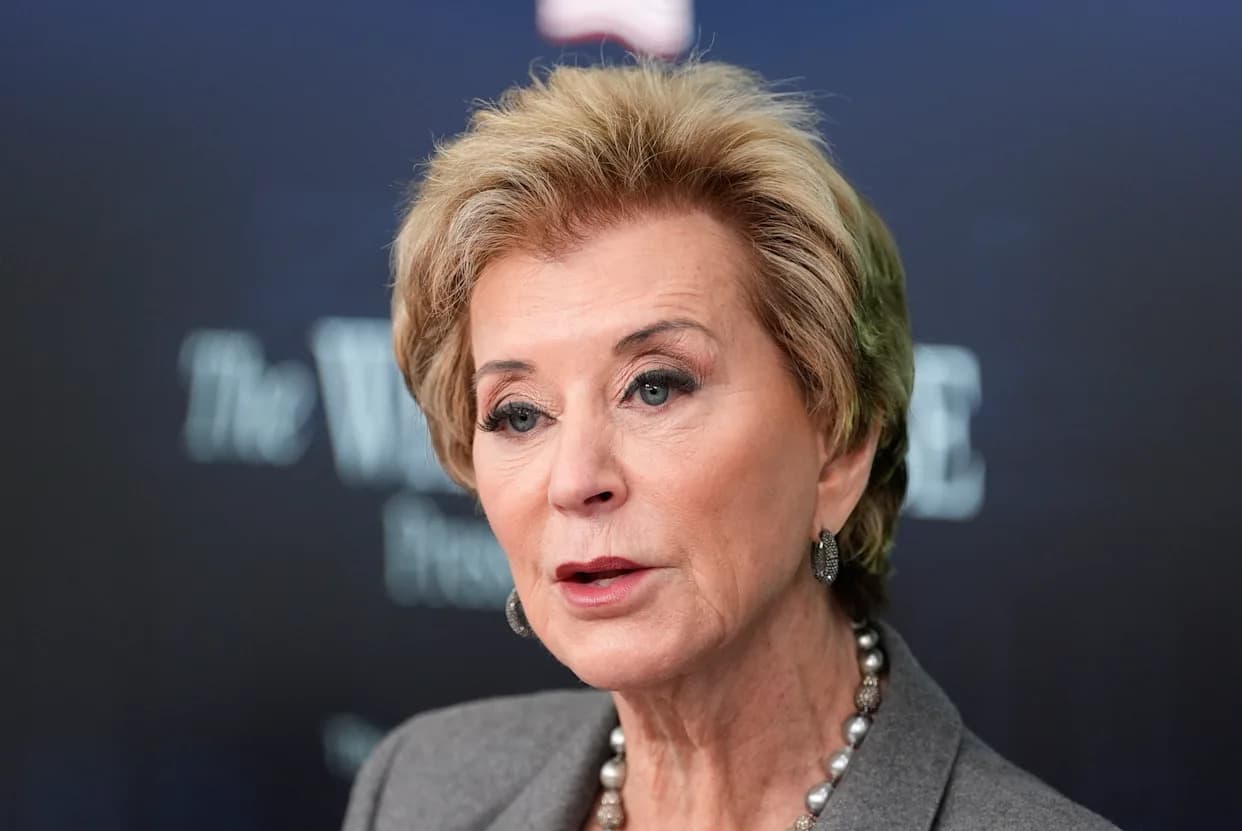
Skye Perryman leads Democracy Forward, a rapidly growing legal advocacy group that has filed hundreds of lawsuits challenging the Trump administration. The organization has built a 650+ group coalition called Democracy 2025, expanded staff and fundraising, and combined courtroom strategy with public affairs work. While the group has won many lower-court rulings, the conservative Supreme Court has often allowed the administration to proceed. Perryman argues aggressive, coordinated legal resistance is essential to defending democratic institutions.
“No One Will Get Through This Moment Intact”: Inside Democracy Forward’s High-Stakes Legal Fight
Near the White House, in an unmarked office, Skye Perryman recently gathered a team of veteran litigators to wrestle with complex questions arising from a wave of lawsuits aimed at blocking the Trump administration’s most consequential moves.
Those lawyers work at Democracy Forward, the progressive legal advocacy organization Perryman leads. The group has spent the past year litigating repeatedly against the administration, and midway through that meeting the team received a stark reminder of two persistent obstacles: an unrelenting tempo of executive actions and the administration’s frequent effort to push cases quickly to a receptive Supreme Court.
Democracy Forward had won a lower-court ruling in September that temporarily blocked a senior executive-branch removal — this time involving the director of the U.S. Copyright Office. But while on the call the team learned the administration had asked the Supreme Court to stay that order and allow the firing to proceed.
Scaling Up a Legal Front
Perryman and her colleagues are positioning Democracy Forward as more than a single-issue shop: the group files numerous complex cases, has expanded staff and fundraising rapidly, and has publicly cast itself as a central challenger to the administration’s actions in court. Under a coalition banner called Democracy 2025, the organization says it has brought together more than 650 partner groups — including prominent civil-rights and policy organizations — to coordinate strategy, share resources and align litigation efforts.
Perryman joined shortly after the organization’s founding and, after the events of Jan. 6, its board asked her to lead an expansion. She now directs about 150 employees — roughly half lawyers — who have filed hundreds of suits since the administration returned to power. The group reported $18 million in contributions in 2023 and has set an ambitious fundraising goal for the year ahead.
Operations, Security and Criticism
Rapid growth has brought trade-offs. Following independent security advice, Democracy Forward keeps its office address private, employs on-site security and uses traveling protection as needed. The organization has moved into more office space and is converting areas into conference rooms and a moot courtroom for oral-argument preparation.
Some attorneys in the broader anti-administration legal community have privately questioned whether Democracy Forward’s fast expansion and broad litigation agenda — covering spending, immigration, civil-service removals and other subjects — may be drawing a disproportionate share of donor funds and limiting space for other groups to emerge. Such strategic disagreements have historical precedent: new organizations have sometimes formed when advocates diverged on tactics and priorities.
Perryman rejects the criticism. “Fighting an autocratic threat is not a training exercise, and you cannot fight autocracy by the spoonful,” she told colleagues. “We welcome a big tent of people of all sizes.”
Lawyering in a Media-Driven Moment
Day-to-day work at Democracy Forward is largely unglamorous: focused, deadline-driven and detail-oriented. Perryman described an early-morning routine of meditating and then logging on to work; she travels frequently to court hearings and events. Unlike many law firms, the organization invests heavily in media strategy and public affairs. Perryman and the group’s head of public affairs hold daily briefing calls to shape press outreach, and Perryman regularly appears in media to frame litigation as part of a larger civic and political strategy.
That public-facing approach complements — and sometimes competes with — the core mission of courtroom advocacy. Whether that balance is optimal remains an open question among observers, but Democracy Forward’s leaders argue that litigation without public engagement will have limited impact on wider institutional stakes.
The Supreme Court as a Pressure Point
Many of Democracy Forward’s victories have come in lower courts, but the Supreme Court has repeatedly posed major obstacles. The conservative majority on the high court has on several occasions allowed the administration to continue actions while litigation proceeds, effectively permitting changes that could be difficult or impossible to unwind even if lower courts later rule for the challengers.
Perryman described one of the most difficult features of the current landscape: an administration that regularly seeks emergency relief from the Supreme Court — and a court majority that has often been willing to grant stays. That tactic strains the normal litigation timetable and raises the stakes for litigants and their clients.
Even so, Perryman and others emphasize that stays and emergency orders are not final adjudications on the merits. “History’s eyes are on the Supreme Court,” she said. “This court will have to decide: is it going to be the court that puts an end to American democracy as we know it, or is it going to be a court that operates in a way that preserves some semblance of our democratic institutions and of our Constitution?”
What’s at Stake
Public confidence in the Supreme Court is at historic lows, and many Americans favor reforms. For Democracy Forward and similar litigators, the stakes are existential: they argue that unchecked expansion of executive power — if left unchallenged — could reshape the balance of authority among branches of government for years to come.
Whether through coordinated litigation, public advocacy or both, Perryman’s argument is straightforward: staying silent will not protect democratic norms. “This is a new paradigm,” she said. “No one’s going to get through this moment intact by keeping their head down.”
Help us improve.