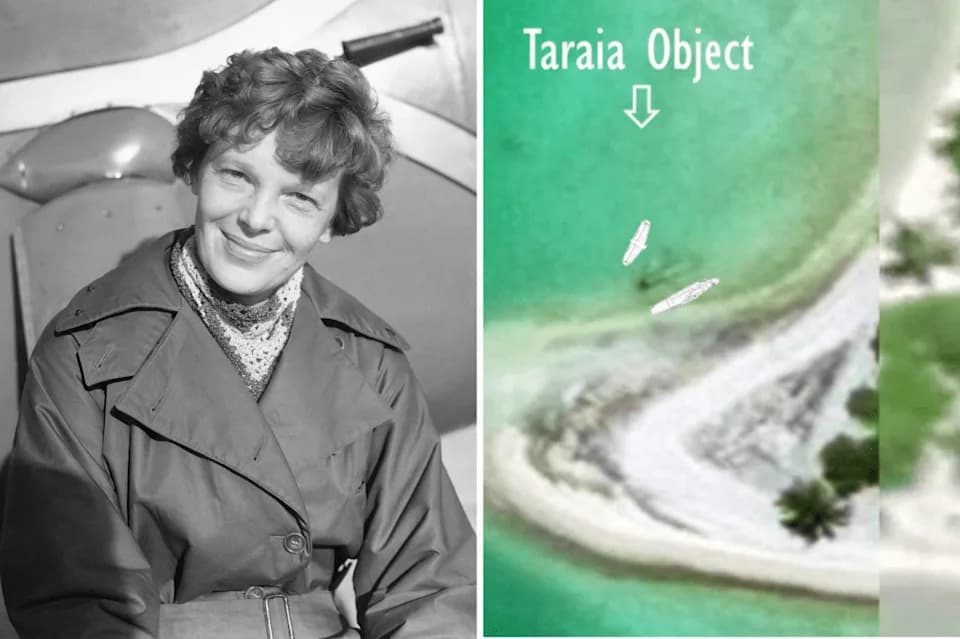
The Taraia Object Expedition, led by Purdue University and partners, departs Oct. 7 to inspect a "visual anomaly" in a lagoon east of the Tatiman Passage near Nikumaroro. The feature appears in a 2015 satellite image and was first widely noticed on Apple Maps in 2020; investigators report similar imagery dating back to 1938. Using video, remote sensing and sonar, the team will determine whether underwater wreckage might be part of Amelia Earhart's Lockheed Electra. If confirmed, a larger mission would be planned to document and potentially recover artifacts.
Could This Finally Solve the Amelia Earhart Mystery? Expedition Heads to Nikumaroro to Investigate Underwater Anomaly

Image by Tekniska museet, CC BY 2.0.
Ninety years after Amelia Earhart vanished, a new expedition led by researchers from Purdue University, the Purdue Research Foundation and the Archaeological Legacy Institute will set out to investigate an underwater "visual anomaly" near Nikumaroro in the central Pacific. The object was captured in satellite imagery dated 2015 and was first widely noticed after appearing on Apple Maps in 2020; investigators report similar features at the same coordinates in other satellite images, drone footage and aerial photographs dating back to 1938.
Background
Amelia Earhart, a pioneering aviator and the first woman to fly solo across the Atlantic, disappeared on July 2, 1937, with navigator Fred Noonan while attempting a global circumnavigation in a Lockheed Electra. The pair had completed roughly 22,000 miles of their planned 29,000-mile route and were en route to Howland Island when they vanished. One long-standing hypothesis suggests Earhart and Noonan may have reached nearby Nikumaroro after failing to locate Howland Island; Nikumaroro lies roughly 400 miles from Howland, making the theory plausible though unproven.
About the Expedition
Dubbed the Taraia Object Expedition, the team is scheduled to depart on October 7 to survey a lagoon east of the Tatiman Passage where the anomaly has been identified. On site, investigators will first document the area with video and still photography. They will then perform remote sensing surveys followed by sonar mapping and other underwater archaeological methods to characterize the submerged object.
Next Steps If Wreckage Is Found
If the submerged object is determined to be aircraft debris consistent with Earhart's Lockheed Electra, the team says a follow-up expedition would be planned to more thoroughly document and, if feasible and ethically appropriate, recover artifacts. The organizers emphasize caution: this is not the first time expeditions have believed they located Earhart’s plane, and conclusive identification requires careful archaeological and forensic work.
Dr. Richard Pettigrew, executive director of the expedition, said: "I feel truly lucky to be in a position to possibly solve one of the greatest mysteries of all time, whether or not that happens."
The investigation aims to combine modern remote sensing and maritime archaeology with historical records to clarify whether the anomaly is related to Earhart’s disappearance or has another natural or human explanation.
Help us improve.