Key Findings: Building a spore and later reviving it requires nearly 10 billion ATP molecules. Most of that cost is opportunity cost, and dormant spores carry almost no ready fuel—about five orders of magnitude too little to complete revival on their own. Germination is quick (≈15 minutes), but outgrowth takes 3–4 hours and consumes about 88% of revival energy, creating a vulnerable window that can be exploited to eliminate spores on skin and hospital surfaces.
Spore-Forming Bacteria Are Exceptionally Tough — Their High Energy Cost Is the Weakness
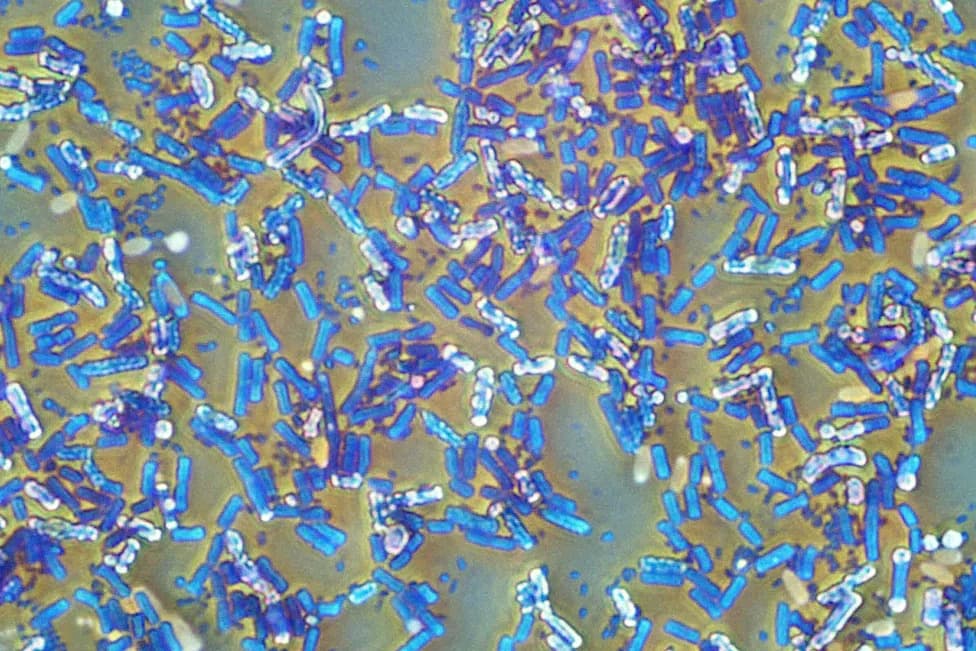
_Bacillus subtilis_ produces near-indestructible spores.Doc. RNDr. Josef Reischig, CSc./Wikimedia Commons,CC BY-SA
A spore is a bacterium's extreme survival form: essentially dried and hardened, sheathed in protective proteins, with most chemical activity suspended. When conditions turn hostile, some bacteria enter this hibernation state and produce a structure so robust it can resist boiling, severe drying, radiation and even the vacuum of space. In one notable experiment, NASA attached Bacillus spores to a satellite and left them in orbit for nearly six years; those sheltered from sunlight were able to revive after returning to Earth.
In soil communities, the ability to form spores has been conserved for roughly 3 billion years. Yet in laboratory strains kept in nutrient-rich flasks, descendants commonly lose the capacity to sporulate within just a few thousand generations. That apparent paradox has long puzzled microbiologists.
In our work, my colleagues Jay Lennon, William Shoemaker and I show the explanation is largely energetic. We estimated the ATP cost for a cell to construct a spore and then to revive from it, and found the bill is large enough that natural selection can favor deletion of the sporulation machinery when it is rarely needed.
How We Counted the Cost
Cells use adenosine triphosphate (ATP) as their energy currency. Because nearly every cellular task is paid for with ATP, we compiled published data for Bacillus subtilis on which genes switch on at each hour of sporulation and how many copies of each protein a cell carries. Proteins are the main energy sink in cells, so tracking them lets us convert molecular steps—DNA replication, transcription, translation, membrane assembly—into an overall ATP price tag for both forming and reviving a spore.
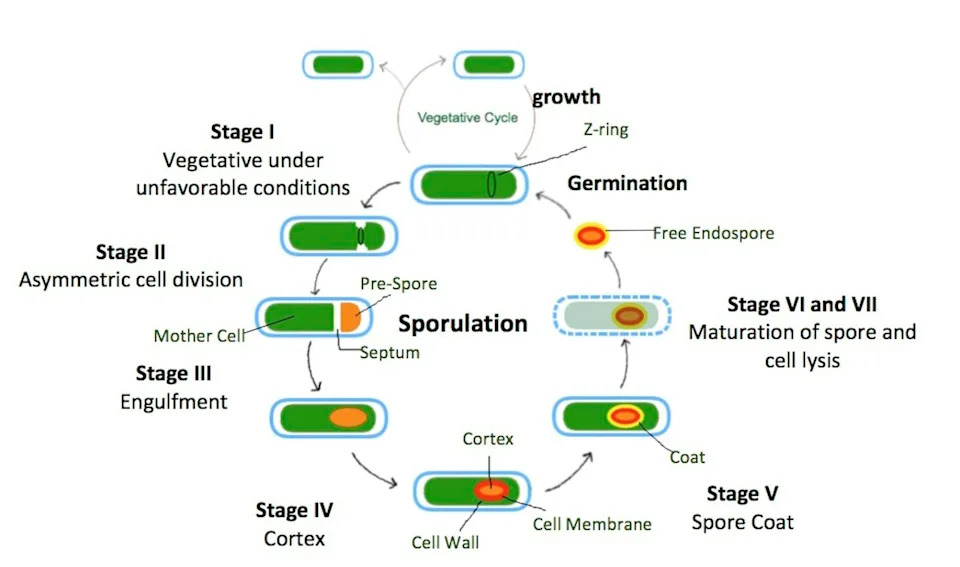
Sporulation is a multistep process.Daniellemaclean144/Wikimedia Commons,CC BY-SA
Putting those numbers into a mathematical model of starving Bacillus populations, we asked whether the energy and opportunity costs of sporulation would affect lineage success. Would a bacterium that quietly deletes its spore-making genes leave more descendants than one that keeps them?
Big Bill, Big Consequences
The full cycle—forming a spore and later reviving it—adds up to nearly 10 billion ATP molecules, making sporulation one of the most expensive processes a bacterium performs. By contrast, building a flagellum and swimming toward food costs only a fraction of that amount.
Much of that cost is an opportunity cost: raw building blocks that could have formed new cells are instead invested into the spore's protective proteins and structures. A cell that commits to sporulation not only spends ATP but also forgoes immediate reproduction while neighbors continue dividing. When life is easy and resources abundant, these sporulation genes sit unused but are still copied each time the cell divides—copying DNA itself consumes ATP—so retaining them can be selectively disadvantageous.
What a Spore Carries—and What It Doesn't
We also uncovered a surprising vulnerability: a dormant spore carries almost no ready-made fuel—nearly five orders of magnitude less than it would require to complete revival on internal reserves alone. Instead, spores pack short proteins around their DNA and store small carbon compounds that can be scavenged and metabolized within minutes of rehydration. Think of it as a sparse pantry that supports the earliest minutes of germination but not the entire return to active growth.
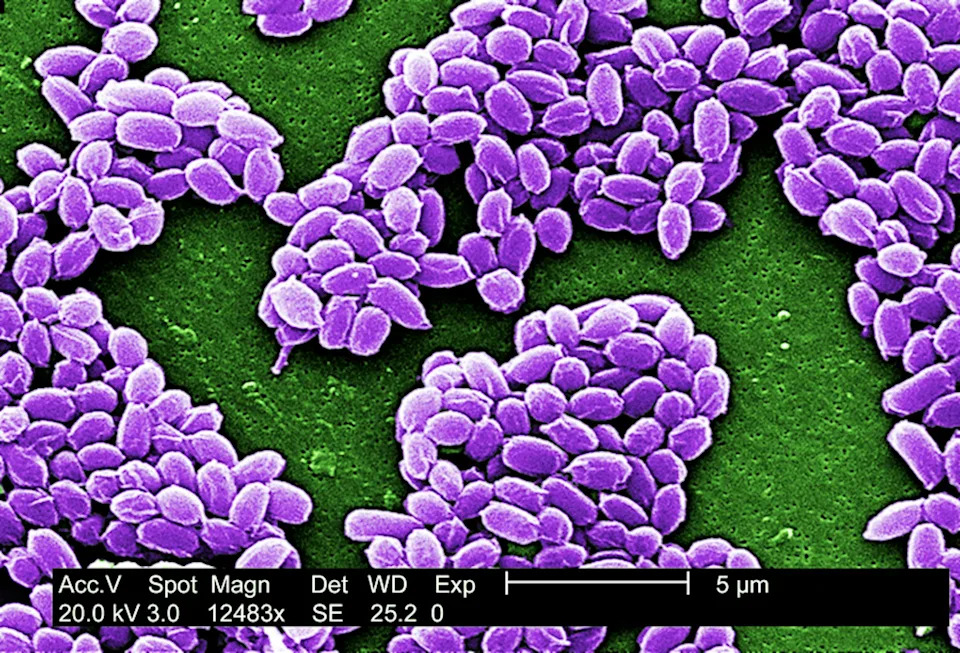
Anthrax spores can persist for years.J.H. Carr/Centers for Disease Control and Prevention/National Institute of Standards and Technology via Wikimedia Commons
Assembly costs are unevenly distributed: the mother cell building the spore supplies roughly 87% of the materials through a narrow channel and then lyses, releasing the mature spore. Even so, the spore must locate external nutrients to complete waking.
A Vulnerable Window: Germination Followed by Outgrowth
Revival occurs in two phases. First is germination, a rapid event of roughly 15 minutes when the spore rehydrates and sheds its external armor. Second is outgrowth, a three- to four-hour period in which the cell rebuilds proteins and machinery necessary for growth. Outgrowth consumes about 88% of the total ATP required for revival—so a spore that germinates where no nutrients are available sheds its protection without being able to finish the job.
That energetic gap is actionable. Researchers have triggered spores to germinate on skin and hospital surfaces and then killed them before outgrowth completes. Our accounting explains why this strategy works: blocking nutrient access during the outgrowth window exploits the spore's lack of internal fuel and creates a lethal bottleneck.
Clinical and Ecological Implications
Spore formation matters beyond soil ecology. Clinically important bacteria such as Clostridioides difficile (which causes severe diarrhea and colitis), and the agents of anthrax and botulism, use spores to survive harsh conditions and to spread in hospitals and communities. The coat that protects a spore from drought also helps it resist some disinfectants and alcohol-based hand gels; for routine hand hygiene, plain soap and water are effective because they remove spores mechanically.
Our results also connect to broader evolutionary ideas. Mathematician Alfred Lotka argued that evolution favors strategies that capture and use energy efficiently, and biologist Christopher Kempes extended the arithmetic to show how these costs scale with cell size. Larger bacteria recover the cost of a spore more quickly than smaller ones, implying a lower size limit below which making a spore would never pay off—an untested prediction worth future study.
Funding: This research was supported by the NSF, NASA and the U.S. Army Research Office.
Help us improve.