Researchers used AI and museum skeletons to trace 45 million years of passerine evolution. An analysis of over 170,000 measurements from 2,057 species finds that body-shape change happened in rare, rapid bursts—most notably around 35 million years ago during global cooling—rather than at a steady pace. Modern higher-latitude bird communities also show faster average rates of morphological evolution, linking ancient events to present-day geographic patterns.
Climate Shifts Drove Rare, Rapid Bursts of Bird Body-Shape Evolution

AI analysis of 2,057 bird species links rare bursts of body-shape evolution with periods of major climate instability. (CREDIT: Shutterstock)
A new analysis of more than 170,000 skeletal measurements from 2,057 passerine species suggests that passerine body shapes changed in rare, rapid bursts rather than at a steady, gradual pace. These pulses of morphological evolution often align with periods of climatic instability — most notably a major acceleration around 35 million years ago during the Eocene–Oligocene cooling — though the study stops short of proving direct causation.

Passerines are the largest order of living birds, with more than 6,500 species worldwide. They include familiar birds such as sparrows, finches, crows, swallows, wrens and robins. (CREDIT: Shutterstock)
Methods: Leveraging Museums, AI and a New Model
The research team combined large museum collections with machine learning and a custom statistical approach. Using Skelevision, a computer-vision system developed by labs at the University of Michigan and New York University, researchers scanned over 15,000 museum specimens (mostly from the U-M Museum of Zoology) to produce roughly 170,000 measurements across about a dozen bones per skeleton. Each scan takes about 45 seconds, enabling high-throughput measurement of anatomical traits that would otherwise be impractical at this scale.
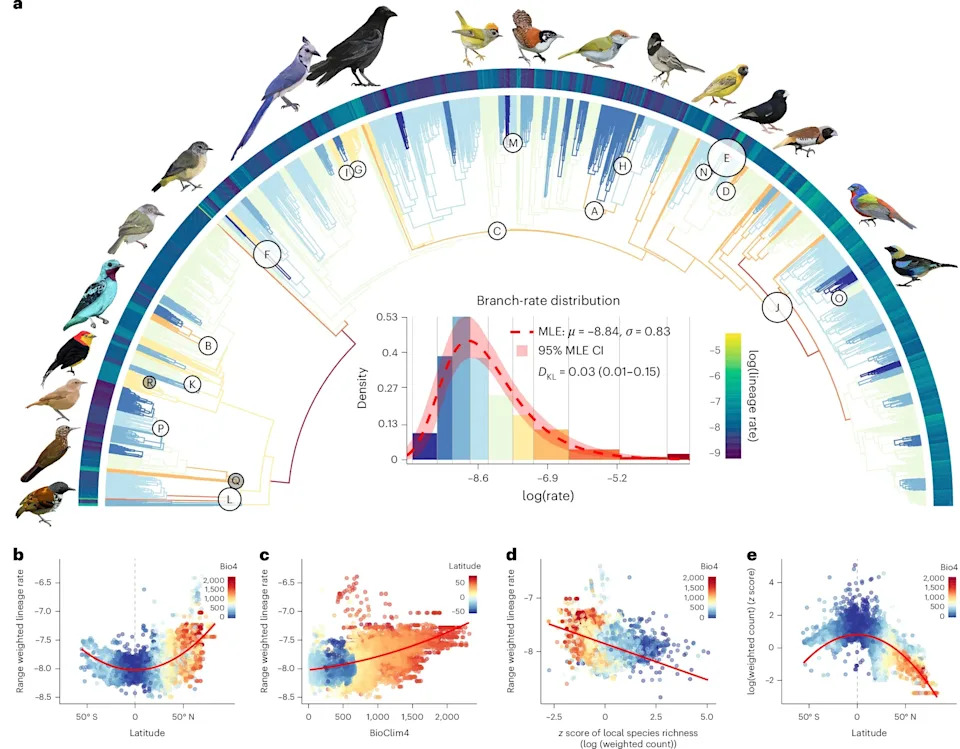
Phylogenetic and spatial patterns of passerine body plan evolution. (CREDIT: Nature Ecology & Evolution)
To analyze whole-body morphological change rather than single traits, lead author Jake Berv developed bifrost, a statistical model that reconstructs multivariate body-shape evolution across a phylogeny. The model was used to infer roughly 45 million years of passerine morphological history and to detect changes in the rate of evolution through time.
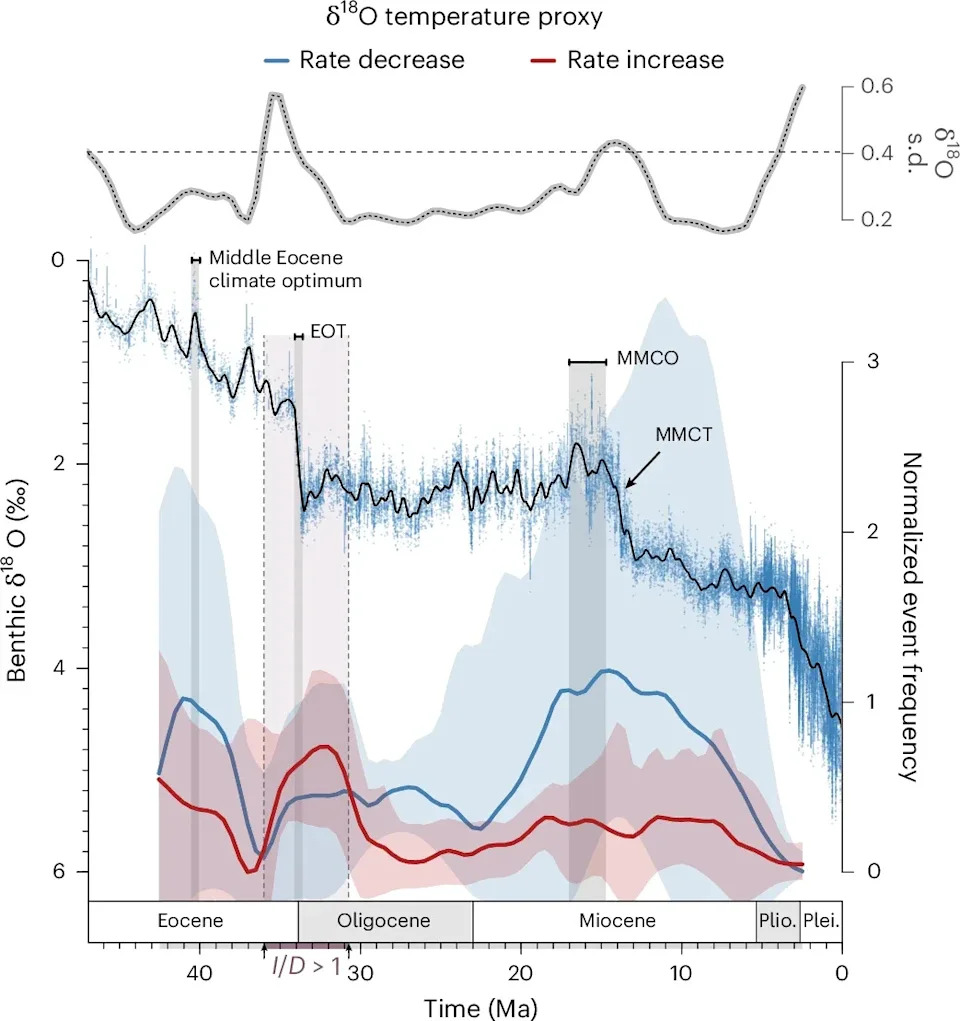
Climatic variability and temporal clustering of evolutionary rate shifts. (CREDIT: Nature Ecology & Evolution)
Key Findings
The reconstruction reveals a punctuated pattern of change: long periods of relative stasis punctuated by infrequent but pronounced increases in evolutionary rate. The most notable burst occurred around 35 million years ago and coincides with the Eocene–Oligocene global cooling and widespread ecosystem reorganization. The authors propose that climate-driven habitat shifts, dispersal to new regions, or resulting ecological opportunities could have precipitated rapid morphological diversification in some lineages.
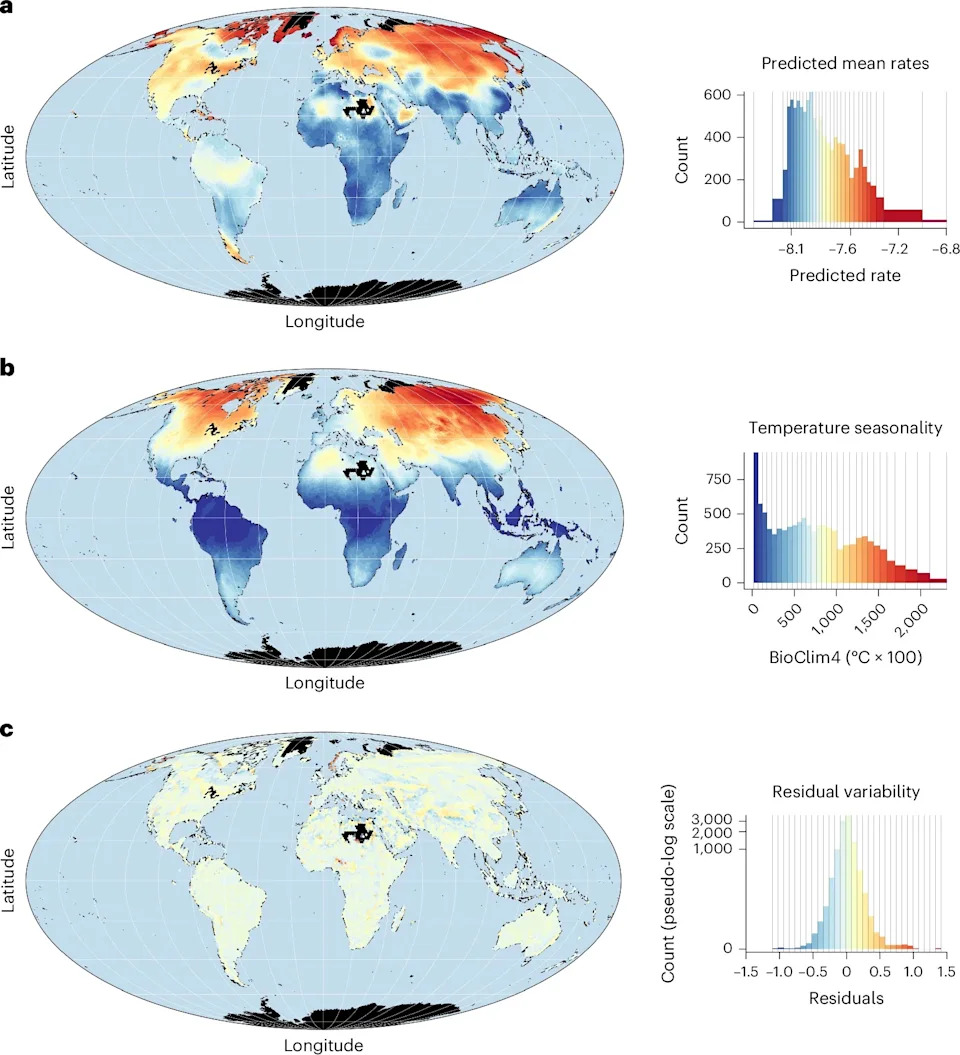
Spatial predictors of phenotypic evolution across global assemblages. (CREDIT: Nature Ecology & Evolution)
The analysis also identified a cluster of evolutionary slowdowns near 15 million years ago, suggesting that once ecological roles became occupied, the tempo of morphological innovation declined.
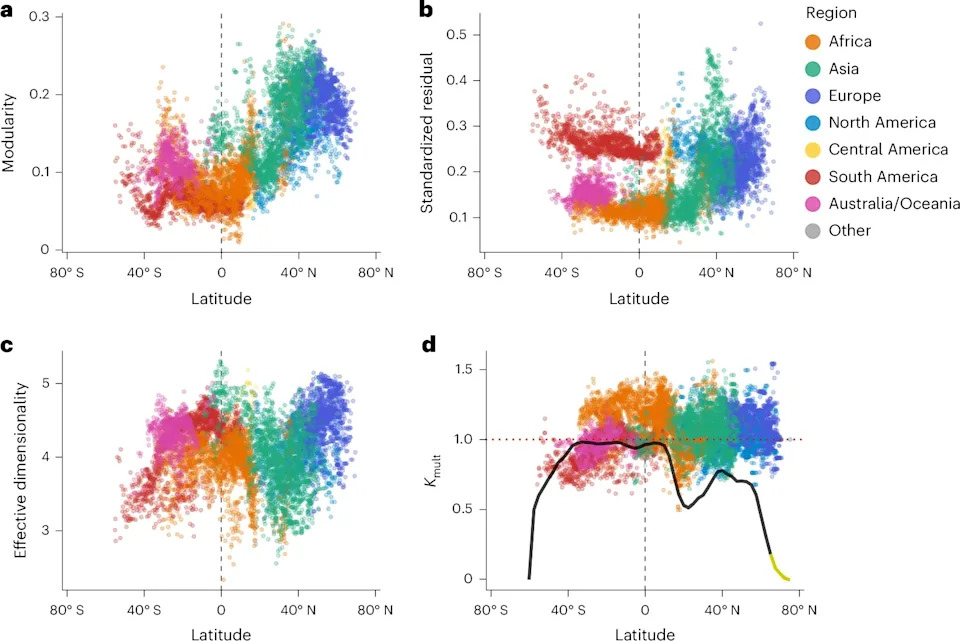
Latitudinal variation in phenotypic structure. (CREDIT: Nature Ecology & Evolution)
Geographic Patterns: Faster Change at Higher Latitudes
Beyond deep time, the study links these historical dynamics to modern geography. Assemblages at higher latitudes tend to consist of species with faster average rates of body-shape evolution, while equatorial communities — where climates are generally more stable — show slower rates. The authors note this latitudinal gradient in evolutionary tempo adds nuance to classic patterns of biodiversity, which are typically richest near the equator.
Implications and Caveats
These results support the idea that adaptive radiations and episodic evolutionary bursts have shaped major portions of avian diversity. However, the authors emphasize that correlation with climatic events does not establish direct causation; multiple ecological and biogeographic processes could contribute to rate shifts.
Although the study illuminates long-term links between climate and morphological change, it does not predict how modern birds will respond to contemporary, rapidly unfolding climate change. Past environmental shifts generally occurred over much longer timescales than today's warming, making direct comparisons difficult. Still, the findings underscore a general lesson: rapid environmental change can drive rapid evolutionary responses in some lineages, while others may decline if they cannot adapt quickly enough.
Museum Science and the Power of AI
The project highlights how modern AI tools can unlock the scientific value of natural-history collections. High-throughput skeleton scanning combined with phylogenetic models enabled a global-scale analysis that would be impossible for individual field collectors. As Brian Weeks observed, specimens collected generations ago can now answer questions their collectors never imagined.
Related Resources
The authors released companion datasets and highlighted related work that contextualizes their findings: a dataset of 14,419 museum skeletons for 2,057 passerine species (Scientific Data, 2025); studies linking recent bill-shape changes to climate in Australian passerines (Communications Biology, 2025); large avian phylogenies and genomic analyses revealing pulses of radiation (Current Biology, 2025; Nature, 2024); and the original Skelevision methods paper (Methods in Ecology and Evolution, 2023). The study itself is published in Nature Ecology & Evolution.
Note: While climatic events coincide with many rate shifts detected here, the authors caution against simple cause-and-effect conclusions: evolutionary responses are shaped by a complex mix of ecological, geographic and historical factors.
Help us improve.