Summary: Tighter immigration enforcement and federal research-funding cuts tied to policies from the Trump administration are limiting scholars' ability to present research and slowing academic inquiry, the Academy of Management reports. AOM president Peter Bamberger says foreign Ph.D. students based in the U.S. often decline to attend overseas conferences for fear they will not be allowed to return, and that cuts to DEI-targeted grants have halted projects — including studies that critique DEI policies. These developments, he warns, are damaging scholarly exchange and the production of knowledge.
Visa Crackdowns and Funding Cuts Are Chilling U.S. Academia, AOM Warns

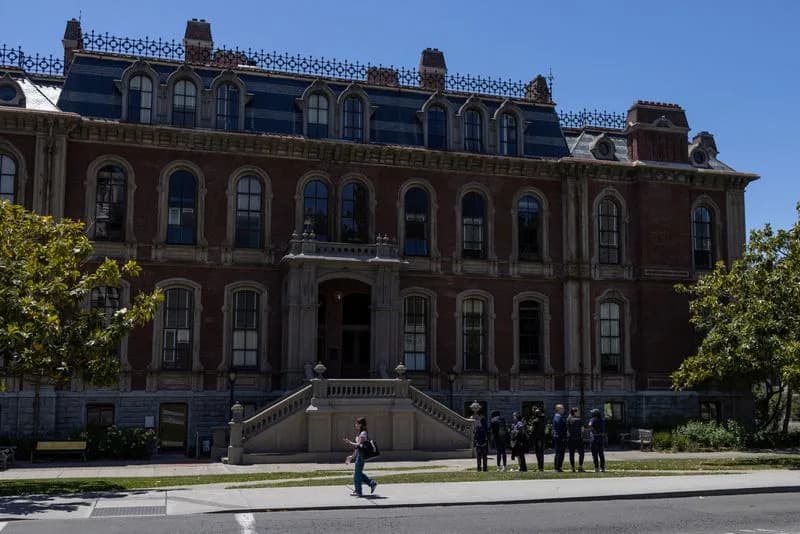
Brick buildings at Harvard University covered in snow
By Paul Friedman
Tighter immigration enforcement and reductions in federal research funding tied to policies from the Trump administration are having a chilling effect on academic work, attendance at international conferences, and the production of new scholarship, the Academy of Management (AOM) says.
Impact on Conferences and Participation
Peter Bamberger, president of the AOM and a professor at Tel Aviv University, says the effects were visible at the association's recent Annual Meetings in Copenhagen (2025) and Philadelphia (2026), with the 2027 meeting planned for Vienna. He singled out concerns about how visas held by foreign students and faculty are being handled by authorities such as U.S. Immigration and Customs Enforcement (ICE).
"A good number of the research papers that were accepted for presentation in Copenhagen came from non-U.S. citizens studying for the doctorate in the United States," Bamberger said. "Some of these opted not to attend the meeting and present their research due to fears that they would not be allowed to re-enter the U.S."
Bamberger said the same anxiety affects meetings held outside the United States generally: many U.S.-based foreign Ph.D. students avoid exiting the country to present at overseas conferences because they fear they might not be permitted to return. He called it "deleterious to our science," noting that innovative papers and important findings went unpresented at the 2025 conference for that reason.
Visa and border-control policies similarly depressed attendance at the 2026 meeting in Philadelphia, with some non-U.S.-based members deciding to stay home because they expected difficulty navigating immigration procedures.
Funding Cuts and the Stalling of Research
Bamberger also confirmed that some AOM scholars have been directly affected by federal funding cuts. Grants for projects labeled as diversity, equity, and inclusion (DEI) have been reduced or eliminated, he said, halting research and disrupting careers.
"Those individuals who had grant money to study diversity, equity, and inclusion—that's all gone," Bamberger said. "Those individuals don't have the grants anymore and as a result, the research stops."
He acknowledged that governments set funding priorities and that electoral outcomes influence those decisions, but stressed the practical harm: interrupted projects, lost opportunities to test policy, and fewer venues for scholarly exchange.
Unintended Consequences
Bamberger pointed out an ironical outcome of broadly targeted funding cuts: not all DEI-related research is uniformly affirmative of current DEI policies. He cited his own work on gender and racial pay equity, which finds that some policy approaches can produce unintended negative consequences such as compensation compression.
"So when you cut off the funding for all research that mentions certain keywords assumed to be related to DEI, you're cutting off the funding of people doing research that indicates problems with DEI policy," he said. "That can silence important critiques and evidence that would inform better policy."
Bamberger said he is not aware of AOM members whose students have been deported, but emphasized that visa anxiety and funding shifts are already harming the production and exchange of academic knowledge.
What This Means for Scholarship
Leaders at professional associations warn that reduced international mobility and shrinking research budgets threaten collaboration, slow the dissemination of new findings, and may bias which questions are investigated. For associations and the broader higher-education sector, the result is fewer voices at conferences, interrupted research agendas, and lost opportunities to evaluate and improve public policy.
Help us improve.