U.S. District Judge F. Dennis Saylor IV has paused enforcement of DHS rules that would cap most student visas at four years and press visas at 240 days, calling the agency's justification "arbitrary and capricious." The court found DHS failed to quantify broader economic costs, neglected reasonable alternatives, and did not adequately respond to public comments. The judge warned the rule could damage U.S. higher education, innovation, and press freedom while noting the national-security rationale relied on weak anecdotes.
Judge Blocks DHS Visa Time Limits, Calls National-Security Rationale 'Absurd'
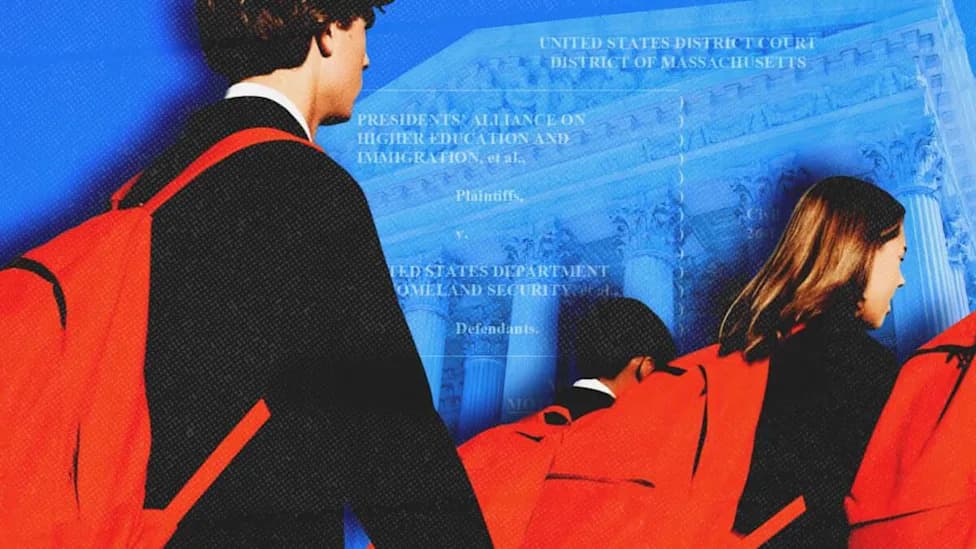
U.S. District Court for the District of Massachusettes/Gerald Mothes/Dreamstime/Midjourney
About a year ago, the Department of Homeland Security (DHS) finalized new limits on visas for international students and foreign journalists—generally capping students at four years and journalists at 240 days unless given a discretionary extension. DHS framed the limits as tools to combat visa fraud and protect national security. Hundreds of public comments argued the rulemaking rested on weak reasoning and would have significant downsides for U.S. higher education, research, the economy, and press freedom.
Court Halts Enforcement
In July, DHS published the rule. This week, a federal judge in Massachusetts issued a preliminary injunction blocking enforcement while a lawsuit proceeds, finding the rule "arbitrary and capricious" under the Administrative Procedure Act. U.S. District Judge F. Dennis Saylor IV concluded that DHS failed to offer a plausible justification, neglected to consider reasonable alternatives, did not estimate predictable costs, and did not meaningfully respond to significant public comments.
Judge’s Key Findings
"The damage to the higher education system and to the economy of the United States is likely to be catastrophic," Judge Saylor wrote, while noting the government's rationales were "exceptionally weak" and the connection between the rule and its stated goals was "exceptionally attenuated."
Although DHS estimated first-year compliance costs at about $250 million, the court observed that this figure ignored major, predictable economic losses tied to reduced international enrollment, diminished research output, and lost innovation. Under prior policy, international students could remain in the U.S. until they completed their programs, including authorized post-completion practical training—an arrangement that often exceeds four years for advanced degrees.
Plaintiffs—organizations representing universities, educators and journalists—argued that international students power research and economic growth. Judge Saylor cited foreign-student shares at major universities (for example, roughly 40% at MIT, 38% at Harvard, 57% at Northeastern, and 28% at Boston University) and noted their outsized contribution to startups, patents, and Nobel Prize-winning work.
Economic And Enrollment Risks
A 2025 Institute for Progress survey cited by plaintiffs found that 49% of current international students said they would not have enrolled under the proposed policy; 16% of prospective students said they would be less likely to apply. Even a conservative 10% decline in international students, plaintiffs argued, could cost the U.S. economy tens of billions of dollars annually—Michael Clemens of George Mason estimated potential eventual losses up to $145 billion per year.
Discretionary Extensions And Press Concerns
Judge Saylor emphasized the rule gives DHS discretionary, unappealable power to grant or deny extensions. "Any decision by DHS to deny a request for an extension is entirely discretionary and unappealable, even within DHS itself," he wrote. That uncertainty, the court said, could deter students and researchers and leave enrolled students vulnerable to abrupt removal—for example, someone a credit short of graduation might be forced to leave without recourse.
Commenters also warned the policy could chill journalism: press-visa renewals might be denied in retaliation for unfavorable reporting, empowering government officials to punish critical coverage. DHS said it did not intend such effects but acknowledged it had no data to quantify any chilling impact.
Weak National-Security Justification
Judge Saylor called DHS’s national-security argument "border[ing] on the absurd," noting it relied on a handful of anecdotes that the four-year cap would not prevent—three incidents involving attempts to photograph military installations, one overstay, and one case of a fraudulently obtained visa. The court found DHS made little effort to explain how time limits would deter these behaviors, or how a four-year cap would reduce visa fraud or overstays compared with existing rules.
Conclusion
The judge did not rule on whether the policy would be wise, only that DHS failed to satisfy the legal standards for reasoned rulemaking. He found DHS did not perform a reasoned cost-benefit analysis, neglected to meaningfully consider alternatives, and offered insufficient responses to key public comments—leaving the agency without a rational connection between the Final Rule and its stated objectives.
Originally published by Reason Magazine; this version clarifies the court's findings and highlights major implications for higher education, the economy, and press freedom.
Help us improve.