German courts in Bochum and Osnabrück upheld bans on certain plug‑in solar battery systems after finding they lacked required circuit‑overload protection and failed to meet VDE safety standards. Indielux argued that systems above 960 W of PV capacity require independent overload protection; nearly 250,000 such systems were registered in Germany in the year before Sept. 21, 2026. Consumers should request written proof of compliance or consult a licensed electrician if protections are unclear.
German Courts Uphold Bans On Plug‑In Solar Batteries Over Overload Risk — What Consumers Should Know
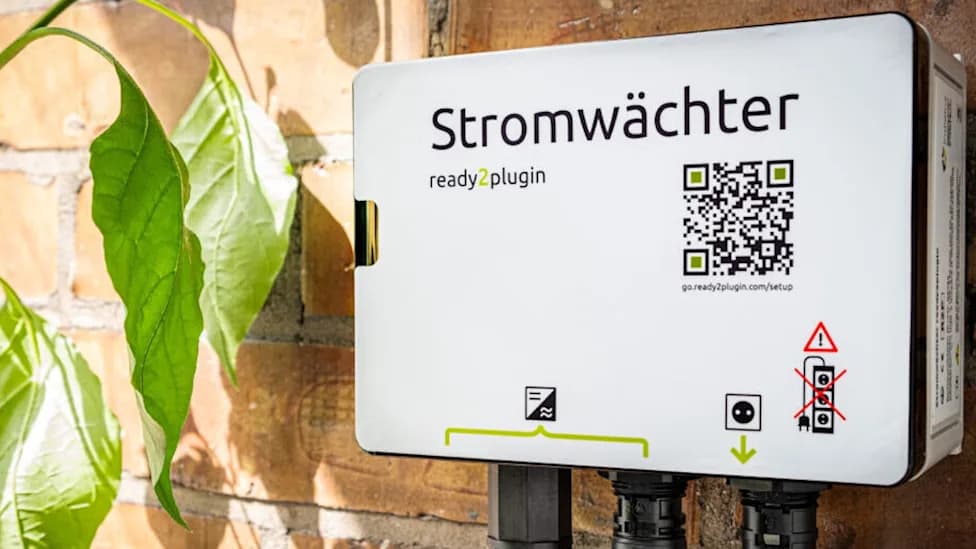
Photo Credit: ready2plugin
Two recent German court rulings have reinforced that so‑called “plug‑in” solar battery systems that connect to a standard household wall socket must still prove they meet safety requirements before they can be sold and marketed as “plug & play.” The decisions aim to close a potential safety gap that could allow excess current to overheat home wiring.
What the rulings say
Court benches in Bochum and Osnabrück left in place sales bans on specific plug‑in solar battery products after finding they lacked required circuit overload protection and did not comply with applicable VDE standards. One of the bans is already legally effective; violations can carry fines of up to €250,000 (about $286,920), according to reporting by PV Magazine Deutschland via ESS News.
Who brought the cases and why it matters
Berlin‑based company Indielux brought the legal challenges. Indielux argues that when photovoltaic (PV) systems feed electricity back into household wiring via a normal wall socket, a household fuse may not reliably protect the wiring from overheating. The company says systems connected to more than 960 watts of PV module capacity require an independent technical overload‑protection measure to be safe and compliant.
Indielux also reported that only one manufacturer so far has demonstrated that its plug‑in solar battery includes the necessary circuit‑overload protection. In the devices at the center of the court cases, feed‑in power could reportedly be set at up to 1.5 times the limit specified by the relevant standard.
Scale and market impact
Plug‑in solar battery systems have become a lower‑cost, lower‑commitment entry point for households seeking cleaner electricity—especially renters and apartment dwellers. Indielux told PV Magazine Deutschland that nearly 250,000 plug‑in systems with more than 960 W of PV capacity were registered in Germany’s Market Master Data Register in the 12 months before Sept. 21, 2026. Including unregistered units, the company estimates the potentially affected market at roughly €500 million (about $572.3 million).
Safety consequences and consumer steps
If wiring overheats or household protective devices fail, the consequences can include property damage and an increased fire risk. Consumers should not treat marketing claims like “installable without an electrician” as proof of safety or compliance.
Practical advice: If you own or plan to buy a plug‑in solar battery or panel, ask the seller or manufacturer for written documentation showing independent conformity with the relevant VDE standards and explicit circuit‑overload protection, especially when the system exceeds 960 W. If documentation is unclear or unavailable, consult a licensed electrician to inspect the setup and recommend modifications or retrofits.
Policy context
The rulings do not reject home solar broadly; they clarify where safety lines must be drawn for plug‑in systems. The decisions arrive amid a broader debate in Germany and abroad over how quickly plug‑in solar should expand while technical standards and market surveillance evolve. Examples include strong growth in balcony solar installations in Germany, discussions in New York about allowing plug‑in panels on windows and balconies, and state‑level moves in places like Colorado to ease access for residents without rooftop options.
Clearer labeling, third‑party safety verification, retrofit options for overload protection, and firm guidance from market‑surveillance authorities could reduce consumer risk while preserving the accessibility benefits of plug‑in systems.
Help us improve.