Thailand's Cabinet approved a bill to restrict cannabis to medical use, reversing many freedoms created by 2022 decriminalisation. The draft requires three-year licences for flowers and extracts, allows certain plant parts to be sold without licences only for medical treatment, bans advertising, and raises criminal penalties for illegal trade. Existing shops may operate until 2028 but must meet new rules to renew licences. The bill now proceeds to the House for review.
Thailand Moves To Restrict Cannabis To Medical Use After 2022 Decriminalisation
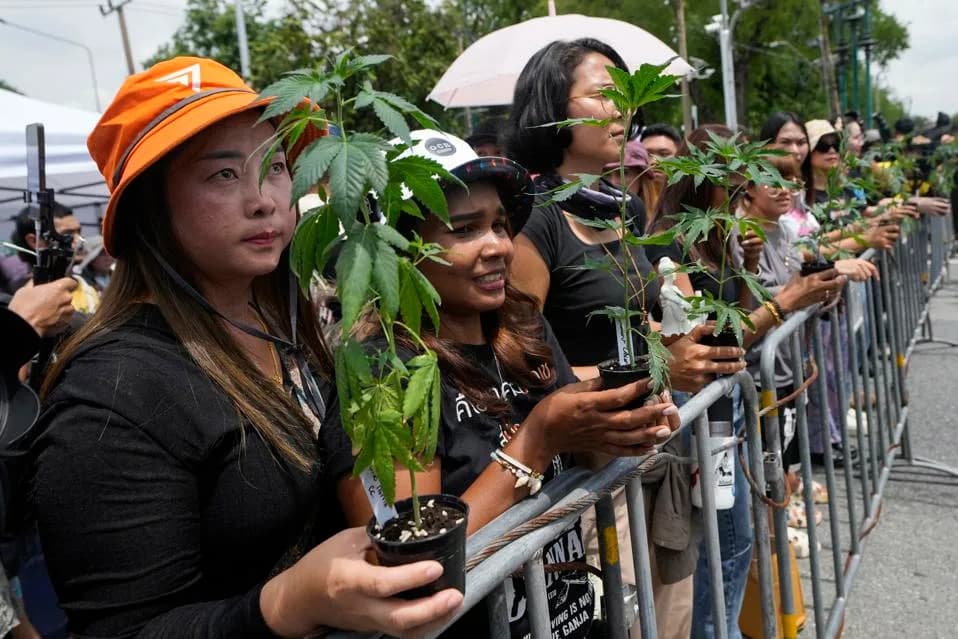
Cannabis activists and entrepreneurs, hold cannabis plant in front of Government House in Bangkok, Thailand, Monday, July 8, 2024. Two years after marijuana was decriminalized in Thailand, nearly a hundred of its advocates marched to the prime minister's office Monday to protest a possible ban on general use. (AP Photo/Sakchai Lalit)Copyright 2024 The Associated Press. All rights reserved.
Thailand's Cabinet has approved a bill to limit cannabis use to medical purposes, rolling back the broad freedoms that followed the plant's decriminalisation for recreational use in 2022. The measure tightens rules on cultivation, sales and advertising while creating a transition pathway for existing dispensaries.
What the Bill Would Do
The approved draft would require three-year licences for the cultivation, production, sale, import and export of cannabis flowers and extracts. By contrast, roots, stems, branches, leaves and seeds could be sold without a licence only when they are intended solely for medical treatment.
The law would permit cannabis products to be supplied to adults over 20 only for medical treatment by licensed practitioners or for authorised medical research. Cultivators would be required to register growing sites so authorities can track production and distribution.
Advertising, Enforcement And Penalties
The bill bans advertising and promotional activity for cannabis and related paraphernalia. It creates criminal penalties and fines for illegal production, import, export and sale, while classifying consumers deemed to be cannabis abusers as subject to fines rather than criminal prosecution.
Transition For Existing Dispensaries
Dispensaries may continue to operate under current licences until 2028. When those licences expire, outlets that are not medical facilities must meet the new legal requirements to qualify for renewal. Officials say inspections will be stepped up and unregistered premises will be treated as operating illegally.
Numbers And Economic Context
Public Health Minister Pattana Promphat said more than 10,000 cannabis shops and cultivation sites have been entered into a government tracking system. Separate government data recorded 18,433 cannabis outlets nationwide by late December 2025.
In the first year after decriminalisation, the industry generated an estimated 28 billion Thai baht (about $865 million), reflecting a rapid expansion of a largely unregulated market that sprang up after cannabis was removed from the country's narcotics list.
Political Background And Next Steps
At the time of decriminalisation, then-Health Minister Anutin Charnvirakul — now prime minister — championed the policy through his Bhumjaithai Party, making Thailand the first Southeast Asian country to decriminalise cannabis in 2022. Since then, the party and subsequent administrations have moved to reintroduce stricter rules to confine use largely to medical purposes.
The bill now moves to the House of Representatives for consideration. If passed in its current form, it would significantly scale back the recreational market that emerged after 2022 while keeping a regulated medical framework in place.
Significance: The proposal marks a major regulatory pivot intended to curb recreational access while retaining medical and research pathways — and to bring the previously fast-growing cannabis sector under formal oversight.
Originally published on Forbes.com
Help us improve.