The world needs to add more than 6 TW of renewable power across the next five years to meet the COP28-aligned target of tripling capacity by 2030. Last year saw a record 693 GW of new clean power, well below the roughly 1,200 GW per year needed through 2030. The report says an extra $8.6 trillion in investment is required for 2026–2030, and grid spending must rise to about $1 trillion annually, up from $525 billion in 2025.
Renewables Shortfall: Over 6 TW Needed in Five Years to Triple Global Capacity by 2030
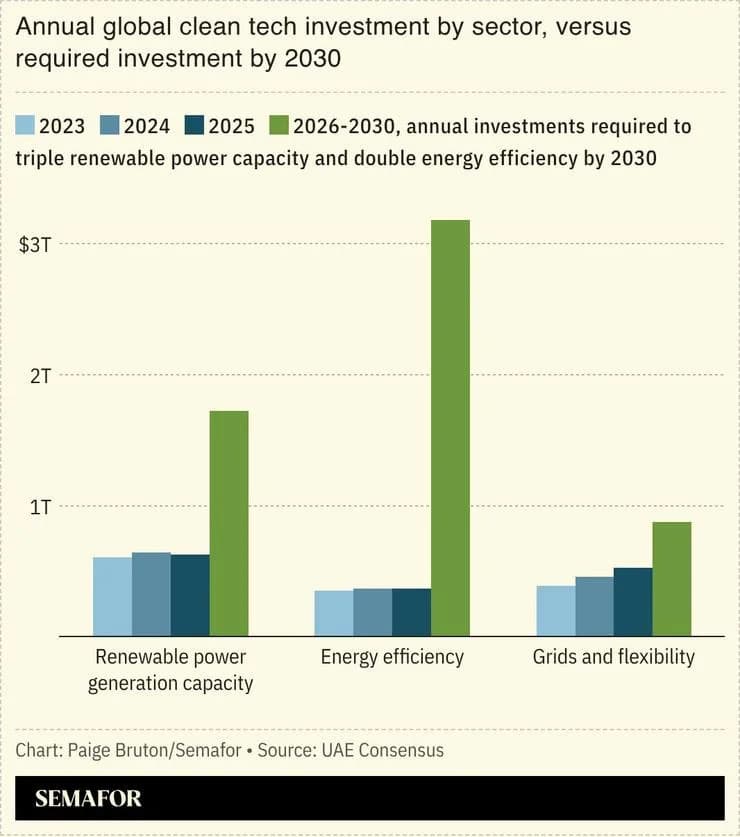
A chart of annual global clean tech investment by sector, versus required investment by 2030.
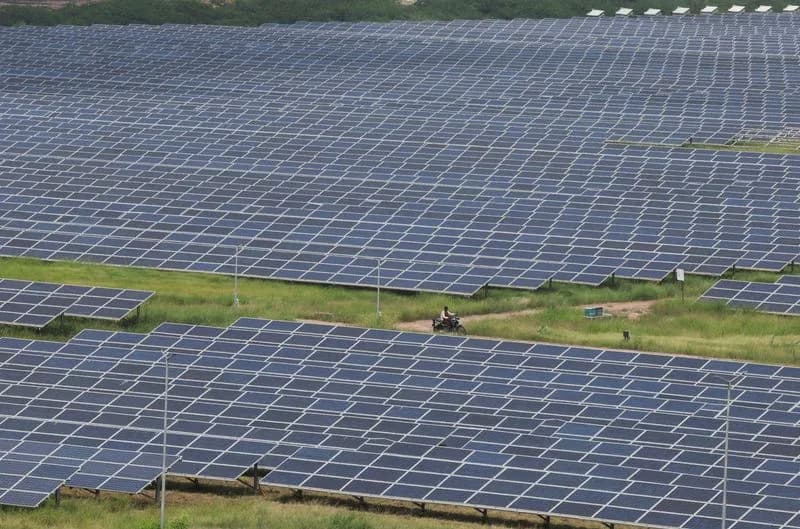
The world must deploy more than 6 terawatts (TW) of additional renewable power capacity in the next five years — a volume greater than all previous annual installations combined — to stay on track to triple global renewable capacity by 2030, a new joint report warns.
Key Findings
The COP28 commitment sets a collective target of 11.2 TW of installed renewable capacity by 2030. Last year saw a record 693 gigawatts (GW) of new clean power added, but that falls far short of the roughly 1,200 GW per year that must be built on average through 2030 to reach the goal. The analysis was produced by the International Renewable Energy Agency (IRENA), the Global Renewables Alliance and the COP31 Presidency.
Investment Challenge
Delivering the additional renewable capacity will require roughly an extra $8.6 trillion in investment over 2026–2030. Crucially, bringing this new generation online demands much larger electricity system investments: grid expansion, modernization and flexibility must ramp up to average as much as $1 trillion a year — nearly double the $525 billion estimated for 2025.
What’s at stake: accelerating deployment and upgrading power systems are both essential. Without rapid increases in build rates and grid investment, the world risks missing the COP28-aligned target to triple renewable capacity by 2030.
The report stresses that meeting the target will require coordinated policy support, faster permitting and financing reforms, plus incentives that target both generation and the grid infrastructure needed to integrate it. Stakeholders — governments, investors, utilities and developers — must act now to close the gap.
Reporting by Chloé Farand; analysis by IRENA, the Global Renewables Alliance and the COP31 Presidency.
Help us improve.