The renewables sector warns the pace of clean power deployment must more than double to meet the COP28 pledge to triple capacity by 2030, despite record additions of just over 690 GW in 2025. Global installed renewable capacity reached 5.15 TW at the end of 2025, well short of the 11.2 TW target. Energy efficiency gains are below target and nearly $1 trillion a year in grid investment will be needed through 2030. Officials urge urgent expansion of grids, storage and electrification ahead of COP talks in Turkey.
Renewables Must More Than Double By 2030 To Meet COP28 Pledge, Report Warns
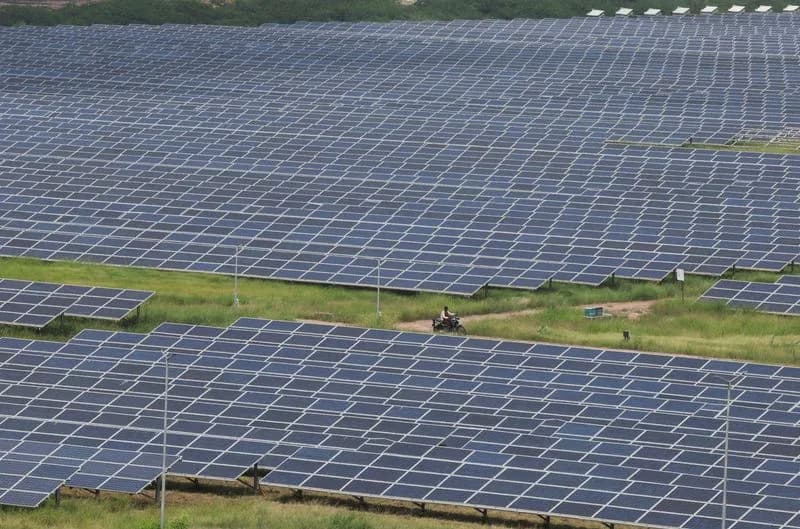
FILE PHOTO: A man rides a motorcycle along the solar panels in Gujarat Solar Park also called Charanka Solar Park at Patan district in Gujarat, India September 12, 2024. REUTERS/Amit Dave/File Photo
LONDON, Sept 21 (Reuters) — The global rollout of renewable power must more than double to meet the COP28 pledge to triple renewable capacity by 2030, a report compiled by the International Renewable Energy Agency (IRENA), the COP31 Presidency and the Global Renewables Alliance says. That warning comes despite a record year for new clean-energy additions in 2025.
Key Findings
- The world added just over 690 gigawatts (GW) of renewable power capacity in 2025 — a record annual increase.
- To meet the COP28 commitment, annual installations must accelerate to roughly 1,200 GW on average each year through 2030.
- Total global installed renewable capacity stood at 5.15 terawatts (TW) at the end of 2025 — still under half the 11.2 TW needed to fulfil the tripling pledge.
- Energy efficiency progress is lagging: energy intensity improved by about 2% in 2025, below the roughly 4% annual improvement required to meet efficiency-doubling commitments.
- The report estimates nearly $1 trillion a year on average will be needed for grid investment from 2026–2030, up from $525 billion in 2025.
"Renewables can still close the gap towards 2030, but energy efficiency is falling behind, electricity demand is rising faster than expected, and the grid infrastructure has failed to keep pace," said Francesco La Camera, Director-General of the International Renewable Energy Agency.
What Governments And Industry Must Do
Report authors and industry leaders say rapid, coordinated action is required: expand and modernise transmission and distribution networks, accelerate deployment of energy storage, and scale up electrification in homes, transport and industry. Ben Backwell, Chair of the Global Renewables Alliance, urged governments to make renewables a national economic priority and to back policies and investment that remove bottlenecks to faster deployment.
Looking Ahead
This year’s COP climate talks in Turkey (November) are expected to focus on electrifying more sectors and pushing for a new target: electricity supplying 35% of global final energy consumption by 2035. Meeting that ambition will require both far faster renewable capacity build-out and stronger gains in energy efficiency to rein in rising electricity demand.
Reporting by Susanna Twidale; editing by Barbara Lewis.
Help us improve.