Human activity alters wildlife behaviour in unexpected ways. New field recordings from Malaysia suggest that it is the persistent roar of highway traffic — not the presence of hikers — that most suppresses the distinctive morning songs of white-handed gibbons (Hylobates lar).
Who Are the White-Handed Gibbons?
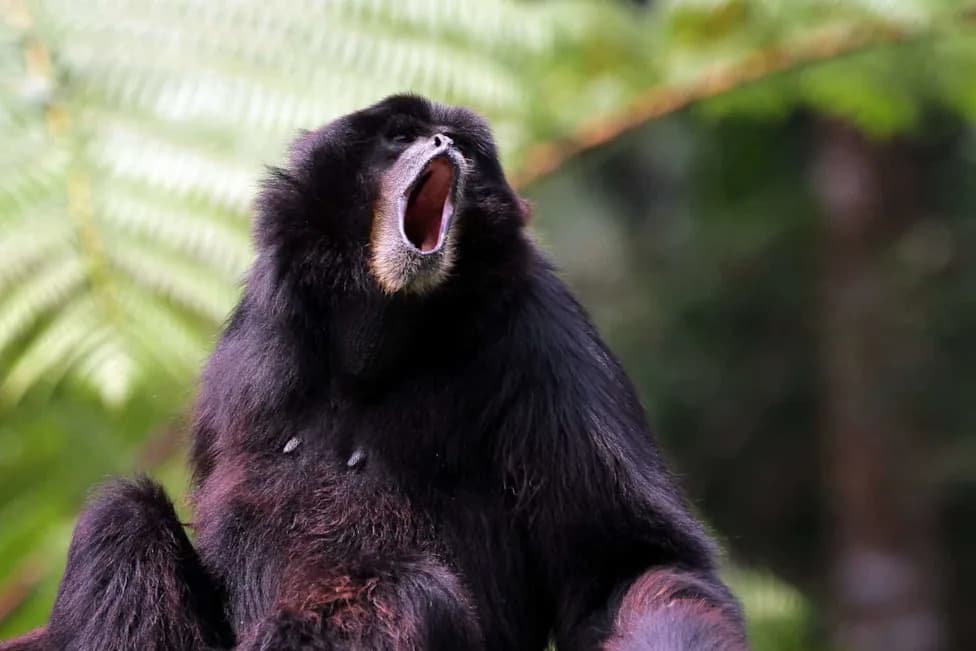
White-handed gibbons are small, tailless apes native to Southeast Asia. Agile brachiators, they spend their lives in the forest canopy and move by swinging hand over hand between branches. Their fur ranges from dark brown or black to sandy or blonde tones, typically with conspicuously pale hands and feet.
Once widespread, these gibbons now face mounting threats from deforestation, the illegal wildlife trade and habitat fragmentation. The International Union for Conservation of Nature currently lists H. lar as Endangered.
White-handed gibbons are small, agile primates native to the tropical rainforests of Southeast Asia.©Elen Marlen/Shutterstock.com
The Study
Final-year PhD student Benjamin Galea, supervised by associate professor Nadine Ruppert at Universiti Sains Malaysia, recorded gibbon dawn calls at three sites that differed in ambient sound: adjacent to a highway, along a popular hiking trail, and at a relatively quiet beachfront. Recordings were collected for a week in both the wet and dry seasons during 2023 and 2024. Observers typically began setup at 6:00 a.m., although some groups were already mid-call by that time.
Key Findings
The analysis revealed a clear pattern: groups closest to the highway produced the fewest morning calls. Measured as the proportion of observations in which groups vocalized, the highway site recorded calls in 36% of observations, compared with 71.4% at the seaside site and 84.6% at the hiking trail.
When gibbons near the highway did vocalise, recordings showed a higher incidence of solitary songs rather than coordinated group duets. The researchers also observed changes in vocal bandwidth — an acoustic adjustment that may help calls carry through low-frequency vehicle noise but may not fully restore normal communication.
Researchers found that white-handed gibbons living close to the highway produced the least amount of morning calls.©BaLL LunLa/Shutterstock.com
Interpretation and Caveats
The authors emphasise that the study is correlational and has not yet been peer-reviewed. Several caveats remain: the hiking-trail site recorded the most calls despite regular human visitors, possibly because it lay close to a neighbouring gibbon group and required more territorial reinforcement. Conversely, highway-adjacent gibbons might be shifting the timing of their calls earlier than observers’ start time, which could partially account for lower recorded rates.
"Their songs are not just background noise or a way of announcing their presence. They play an important role in communication between groups, territorial interactions and social relationships."
— Nadine Ruppert, study supervisor
Why It Matters
Gibbon dawn songs coordinate group life, help defend territory, attract mates and warn of predators. Persistent traffic noise that reduces coordinated singing or forces acoustic changes could therefore degrade social and reproductive behaviours, compounding other threats to this endangered species.
The study adds to growing evidence that habitat quality must include acoustic dimensions, not just area and connectivity. In practice, conservation planning should consider noise mitigation — for example, by routing traffic away from key habitats, creating sound-buffer zones, or implementing quieter road surfaces — to preserve the ecological functions of animal vocalizations.
Note: This research is preliminary and has not yet been peer-reviewed. Further studies with longer monitoring periods and finer temporal resolution (including earlier pre-dawn recordings) would help confirm and clarify these results.