Joseph L. Locke demonstrates that Texas's evangelical-conservative identity was built, not foreordained. Early Texas had minimal religious infrastructure and a robustly secular frontier culture. Key turning points — prohibition, World War I nationalism, and the Ku Klux Klan — pulled evangelicals into politics, while oil wealth and elite alliances pushed denominations toward pro-market conservatism. Locke's book shows this order was constructed and therefore can be challenged.
Made, Not Predestined: How Texas Became An Evangelical Conservative Stronghold
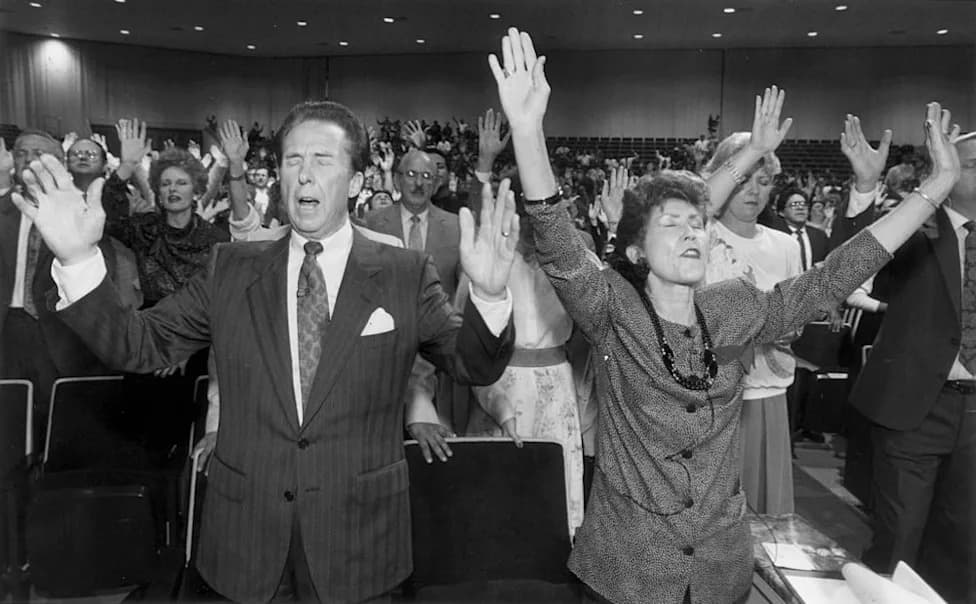
Texas's political culture is firmly identified with a megachurch-and-televangelist style of Christianity. But a new book shows that another kind of political religion existed in Texas before the 20th century, and another Texas is still possible. (Kerwin Plevka /Houston Chroniclevia Getty Images)
Joseph L. Locke argues in his new book that the dominant strain of conservative evangelical Christianity in contemporary Texas — and the political power it projects nationally — was not an inevitable outcome of religious tradition but the product of specific historical forces.
Texas Wasn't Always a Religious Powerhouse
Early observers often called Texas "godless." Christianity arrived slowly and unevenly: Spanish missions were thinly populated, Mexico supplied few priests, and many Anglo settlers practiced a fluid frontier Protestantism sustained by circuit riders and camp meetings rather than settled clergy and institutional churches. In daily life many children went unbaptized, marriages went unregistered, and burials were often secular affairs. As one contemporary Presbyterian put it, Texans sometimes behaved as if crossing into Texas meant crossing "the line of spiritual accountability."
Politics, Prohibition, War, And The Klan
Locke traces how religion moved from the margins into the center of Texas politics. Three powerful catalysts were prohibition, the jingoism of World War I, and a resurgent Ku Klux Klan. The fight over alcohol became a gateway: though Governor Oscar Colquitt warned that "the place of a preacher is in the pulpit and not in politics," prohibitionists soon discovered politics was an effective tool for moral reform. Wartime loyalty campaigns further fused patriotism and religious conformity, while the Klan mobilized broad swaths of Texans around nativist and Protestant identity.
J. Frank Norris And The Rise Of Combative Evangelical Leadership
One religious figure who captured and amplified these trends was J. Frank Norris, a preacher who anticipated the megachurch leader-political operator. Norris preached a combative, conspiratorial Christianity, attacked modernist professors for teaching evolution, allied with the Klan, and used radio and print to expand his influence. His blend of moral panic, partisan rhetoric, and personal charisma helped normalize religious intervention in politics.
Religion, Class, And Co-optation
Locke places this religious transformation alongside two waves of working-class mobilization: the populist uprisings that united white and Black farmers and laborers, and later socialist-leaning tenant movements. Both drew on religious language and Methodist-style organizational methods. Yet as Texas grew wealthier — especially after the oil boom — religious institutions and leaders were increasingly pulled toward pro-market politics. Locke shows how some preachers and church networks were funded or influenced by business interests to undercut labor organizing and redirect moral concerns away from structural economic issues.
John B. Rayner's trajectory — from preaching Christian-inflected populism to accepting support from lumber magnate John Henry Kirby and promoting self-help themes — illustrates how religion could be repurposed to stabilize class relations. Locke documents the persistent tension between a slaveholding, paternalistic Christianity and a Black Christianity rooted in liberation, and shows how those conflicts shaped denominational politics through Reconstruction and beyond.
The Long Alliance With The Right
Over the twentieth century the alliance between evangelical religion and conservative, free-market politics became explicit. Televangelists and megachurch leaders, new media technologies, and political operatives worked together to erase many of the old barriers between pulpit and policy. Locke points to a defining moment in 1980 when Ronald Reagan told evangelical leaders in Dallas, "I want you to know that I endorse you," signaling a political partnership that would reshape both religion and Republican politics.
What This Means Today
Contemporary Texas reflects this long-term project: state politics now feature strong religious influence, recent laws have installed public displays of the Ten Commandments in some schools, and there are strict abortion restrictions across much of the state. Locke's central contribution is to show that this alignment was deliberately constructed through political battles, economic shifts, and cultural campaigns — which means it can be contested and changed.
Bottom line: Texas's evangelical-conservative identity is the result of historical choices and power struggles, not a natural inevitability.
Help us improve.