Firefighters in Marrero, Louisiana, discovered an African serval illegally confined in a small backyard enclosure while investigating a minor house fire. JPaws officials subdued the cat, removed it from a roughly 9 ft-by-9 ft pen and transported it to their Harvey facility while seeking a long-term refuge. The agency warned that servals are not suitable as typical pets due to space, behavioral and dietary needs, and noted the case reflects a rising interest in servals driven partly by social media.
Louisiana Firefighters Find Illegally Kept African Serval While Responding to House Fire
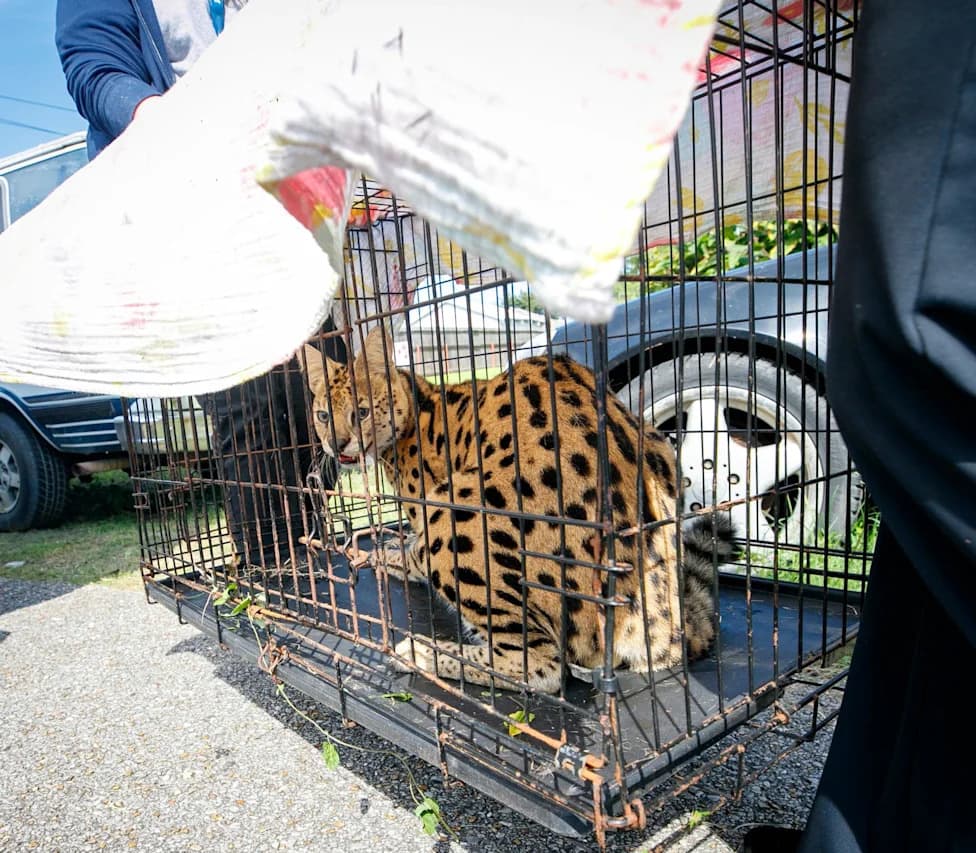
An African serval in a transport carrier after being found in the back yard of a home by firefighters in New Orleans.Photograph: John McCusker, JPaws
Firefighters responding to a minor house fire in Marrero, a suburb of New Orleans, discovered an African serval — a wildcat native to sub-Saharan Africa — confined in a cramped backyard enclosure. Jefferson Protection and Animal Welfare Services (JPaws) officials secured the animal and transported it to their Harvey facility while searching for a suitable long-term refuge.
What Happened
Crews investigating a small blaze noticed the serval inside a chain-link pen behind the home. JPaws said director Michelle Brignac and humane department supervisor Victoria Clark joined firefighters at the scene. Local law requires an exotic-animal permit to keep a serval; the homeowner did not have one, JPaws spokesman John McCusker told reporters.
Officials described the enclosure as roughly 9 ft by 9 ft (about 7.5 sq meters), comparable to a cramped batting-cage or "dog kennel." Brignac and Clark, according to JPaws, "subdued the hissing serval and wrangled it" into a transport carrier and brought it to JPaws' Harvey facility, which posted photos of the wildcat.
Animal Care and Next Steps
Because servals can become highly stressed in captivity, JPaws isolated the animal in a single room to reduce anxiety while staff sought an appropriate refuge. The agency said the serval was born in captivity but that its natural habitat is African grasslands. Servals are noted for their slender bodies, black spots, distinctive facial markings and remarkable leaping ability — they can jump as high as about 7 ft (2 meters).
JPaws explored temporarily placing the serval at the Audubon Nature Institute in New Orleans, but a zoo spokesperson said the institution did not plan to accept the animal. JPaws is searching for another suitable placement and has not released further details.
Why Servals Are Poor Household Pets
Although servals exhibit some cat-like behaviors — grooming, purring and stalking — JPaws warned they are not well suited to typical home life. Captive servals often lack adequate space and environmental stimulation, which can lead to chronic stress and behavior problems. The agency and experts note that servals:
- Mark territory and may become aggressive as they mature.
- Are difficult or impossible to fully house-train and can damage furniture or even breach walls and doors.
- Require specialized diets and veterinary care beyond that of domestic cats.
Context — Growing Popularity and High-Profile Cases
Interest in servals as exotic pets has risen in part because of social media videos. Several high-profile North American incidents have drawn public attention: in 2023 authorities in the Cincinnati area captured a serval named Amiry that later tested positive for cocaine; in late 2025 a serval that escaped a Pennsylvania wildlife center was fatally struck by a vehicle during the search; and there have been recent reports of escaped servals in other cities.
JPaws emphasized that servals require long-term, specialized care and urged anyone considering an exotic pet to check local laws and think carefully about the animal's needs before acquiring one.
Help us improve.