Francis Fukuyama told Bloomberg’s Odd Lots that AI threatens the social recognition embedded in paychecks — the implicit message that your work has value. He argued that neither universal basic income nor market gains can replace that dignity. Watch entry-level white-collar wages and job listings — such as paralegals, junior analysts and first-year coders — as early warning signs. Fukuyama also linked this recognition crisis to broader geopolitical shifts driven by AI.
Fukuyama Warns AI Could Erase the Dignity of Paychecks — And Trigger Political Upheaval
24/7 Wall St.
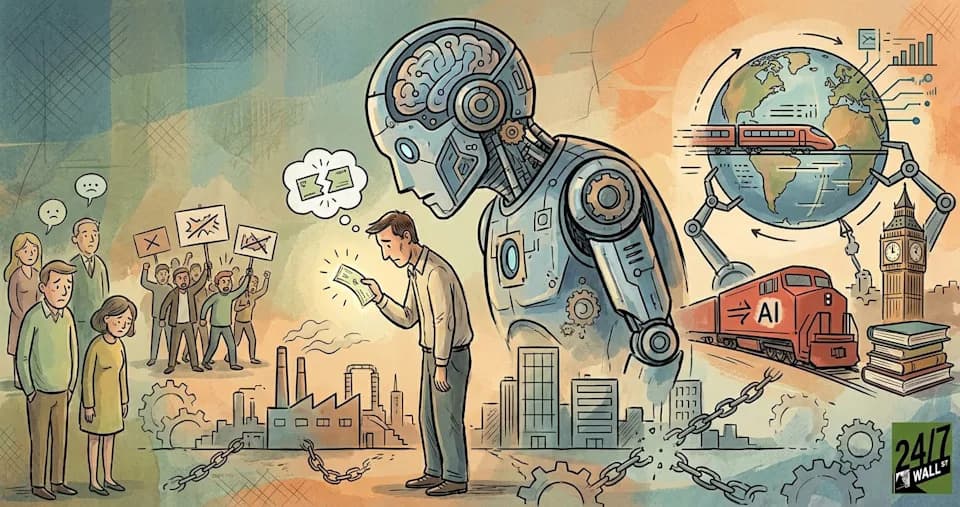
Stanford political philosopher Francis Fukuyama warned on Bloomberg’s Odd Lots that artificial intelligence threatens more than jobs and unemployment statistics: it risks removing the social recognition embedded in a paycheck — the implicit message that someone values your work.
“A lot of our dignity comes from the work we do. The fact that you are paid to do a job means somebody thinks what you do is valuable,”he said. He argued that AI’s ability to substitute for human labor could strip that message away and leave many people feeling unmoored.
Why Money Alone Won’t Fix It
Fukuyama emphasized that financial remedies — including universal basic income, cheaper goods produced by productivity gains, or wealth accumulated through investments — cannot fully replace the social recognition a paycheck conveys. A wage is both compensation and a signal that your contribution matters; when the transaction disappears, so does that signal.
Social And Political Consequences
That private loss of dignity can have public consequences. Fukuyama warned of two possible outcomes: a population that becomes "perpetually lonely and unhappy" or one that rebels, producing significant political turmoil. He suggested that this social distress could appear before headline unemployment numbers move, because people who still hold jobs may perceive their work as meaningless or provisional.
Early Warning Signs To Watch
Fukuyama recommended monitoring pay and hiring trends for entry-level white-collar roles as early bellwethers of this recognition crisis. Paralegals, junior analysts and first-year coders are likely to be among the first roles where stagnant wages and shrinking job listings indicate the payoff signal is weakening. Those shifts may show up long before national unemployment statistics or layoff trackers register a broader labor-market change.
Geopolitics And The Larger Context
He also linked this domestic risk to international dynamics. Criticizing China’s post-2012 economic strategy, Fukuyama argued that heavy reliance on export-led high-tech growth instead of stronger social services and pensions has hollowed out manufacturing bases abroad and contributed to backlash where dignity-carrying jobs disappeared.
Finally, he warned that AI will reshape global power relationships: "The geopolitics of AI is really going to hit us like a freight train," he said, comparing its potential strategic impact to that of nuclear weapons in a previous generation.
If Fukuyama’s diagnosis is correct, policymakers should prioritize not only income support but also measures that preserve meaningful work and social recognition. Monitoring entry-level wages and job openings in white-collar categories can provide an early signal of a deeper social problem.
Source: Bloomberg’s Odd Lots interview with Francis Fukuyama. For questions or corrections, contact [email protected].
Help us improve.