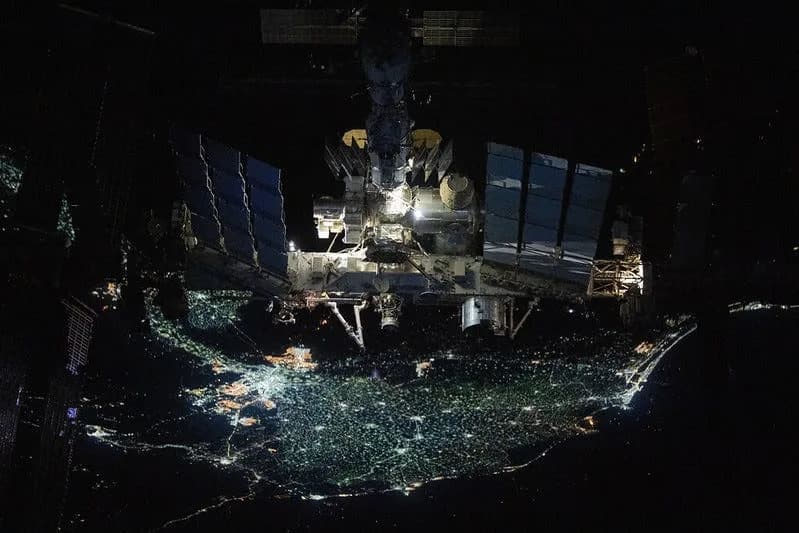
The International Space Station orbits Earth roughly every 90 minutes at about 17,000 mph, completing around 16 orbits per day and producing 16 sunrises and sunsets for the crew. The station spans nearly a U.S. football field and has a mass of roughly 925,335 pounds (≈420,000 kg). It orbits at about 200–250 nautical miles and requires periodic reboosts due to atmospheric drag and to avoid orbital debris; in 2022 it performed emergency maneuvers to dodge fragments from a 2021 anti‑satellite test. Under clear conditions the ISS can be seen as a bright, fast-moving point of light, while precise transits across the Sun or Moon require specialized timing and optics.
Why the ISS Orbits Earth Every 90 Minutes — What That Means for Crew, Speed and Space Debris
NASA
NASA reports that the International Space Station (ISS) completes a full circuit of Earth roughly every 90 minutes. To do this it travels at orbital speeds of about 17,000 mph (≈4.8 miles per second or ≈7.7 km/s), fast enough to circle the planet approximately 16 times a day. As a result, crew aboard the station see about 16 sunrises and 16 sunsets during each Earth day, and in that time the station covers a distance comparable to a round trip from Earth to the Moon.
Size, Mass and Onboard Space
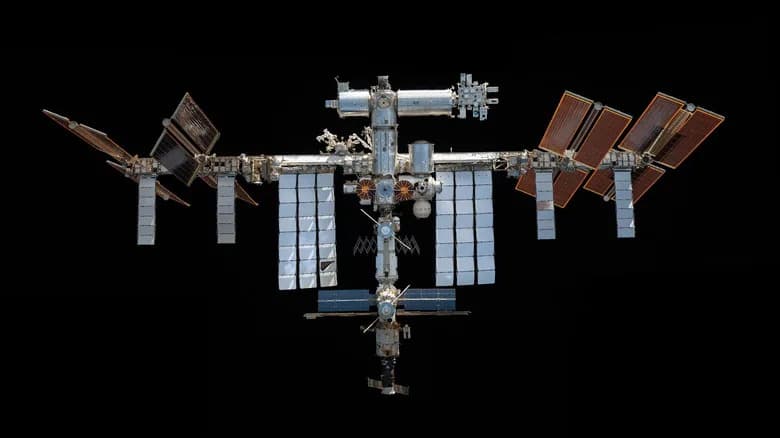
Beyond its speed, the ISS is enormous relative to most objects humans have put into space. While the Hubble Space Telescope is roughly the size of a school bus, the ISS stretches nearly the length of a U.S. football field. NASA lists the station’s end-to-end length at about 356 feet — roughly three feet short of a full football field including end zones — and the pressurized modules together are roughly the size of a Boeing 747 passenger cabin. The assembled complex has a mass of about 925,335 pounds (≈420,000 kg).
Self-made by the uploader - Self-made using PreviSat program, http://astropedia.free.fr/, GPLv3,
Orbit, Altitude and Reboosts
The ISS orbits in low Earth orbit at an altitude typically between about 200 and 250 nautical miles (≈230–287 statute miles or ≈370–460 km). That orbit is not a perfect circle and, because the station does not continuously fire rockets, it gradually loses altitude due to residual atmospheric drag. To maintain a safe operating altitude the station receives periodic reboosts — provided by visiting spacecraft or by attached propulsion modules — that raise and stabilize its orbit.
Collision Risk and Avoidance
Collision avoidance is another frequent reason to change the station’s orbit. NASA tracks thousands of pieces of orbital debris; about 19,000 man-made objects in orbit are estimated to be 2 inches (≈5 cm) or larger. This tally includes active satellites but is dominated by defunct satellites, spent rocket stages and fragments. In 2022 the ISS executed avoidance maneuvers to steer clear of debris created by a 2021 anti-satellite test that shattered a satellite and produced thousands of hazardous fragments.
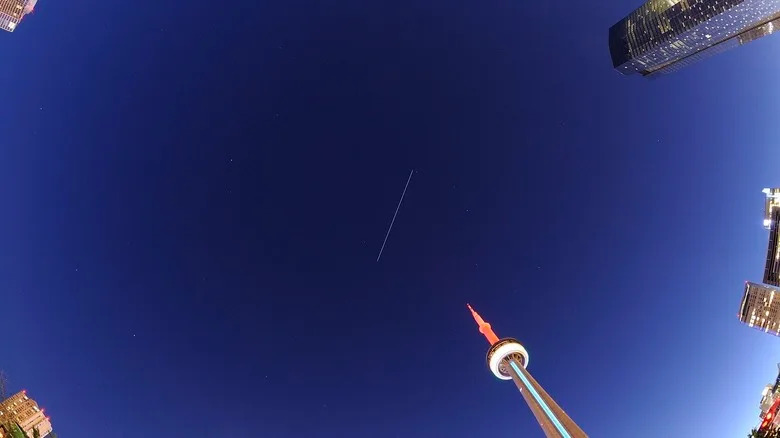
MichaelALearmonth - Self-photographed, CC BY-SA 4.0,
Orbit Inclination and Coverage
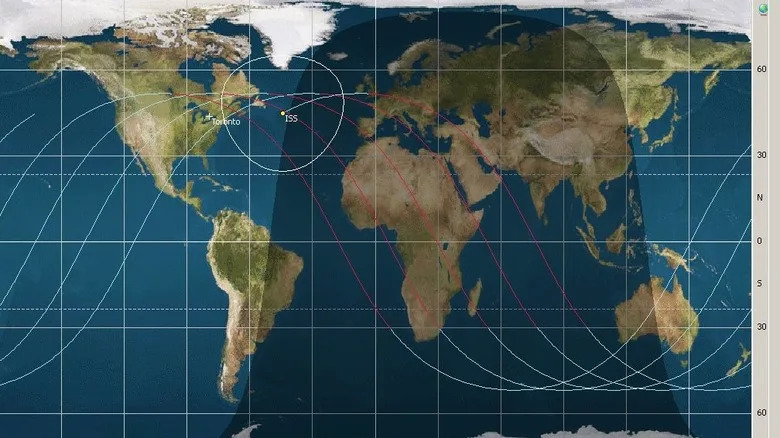
The ISS does not pass over the same point on Earth on every orbit. Its orbital plane is inclined roughly 51.5° to the Equator (often rounded to 51.6° in official sources). That inclination was chosen partly to accommodate efficient launches from the Baikonur Cosmodrome in Kazakhstan and to give the station broader coverage of Earth than the lower-inclination launches commonly flown from Kennedy Space Center in Florida.
How to See the ISS
Under favorable conditions the ISS can be seen without optical aid as a bright, fast-moving point of light crossing the sky. Visibility depends on the observer’s location, timing, weather and local sky brightness from moonlight or city lights. Binoculars or a small telescope improve the experience, and online prediction services let observers enter coordinates to find precise pass times. For photographers and enthusiasts, very brief ISS transits across the Sun or Moon offer spectacular images, but they require precise timing and properly filtered optics — especially for solar transits, where eye protection and a well-filtered telescope are essential.
Bottom line: The ISS is a large, fast-moving laboratory in low Earth orbit that must be actively managed — through periodic reboosts and occasional avoidance maneuvers — to stay aloft and safe in a crowded orbital environment.
Help us improve.