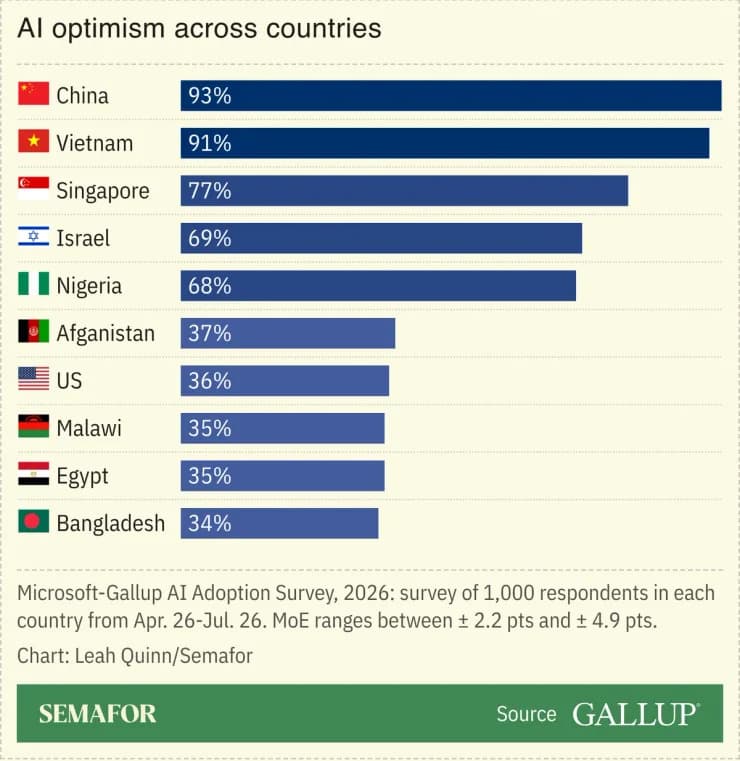
Global opinion on AI is sharply divided: Asia and Latin America show broad enthusiasm for AI products, while North Americans are more anxious about environmental costs and job losses. Large AI data centres can use up to 5 million gallons of water per day, prompting moratoria and local bans in North America. Studies from the World Bank and Stanford suggest lower automation risk in developing countries and only modest job losses so far. The result is a new digital divide: some nations embrace AI for growth, others hesitate over environmental and labour concerns.
The New Digital Divide: How AI Is Splitting Global Opinion Over Jobs, Water and Politics
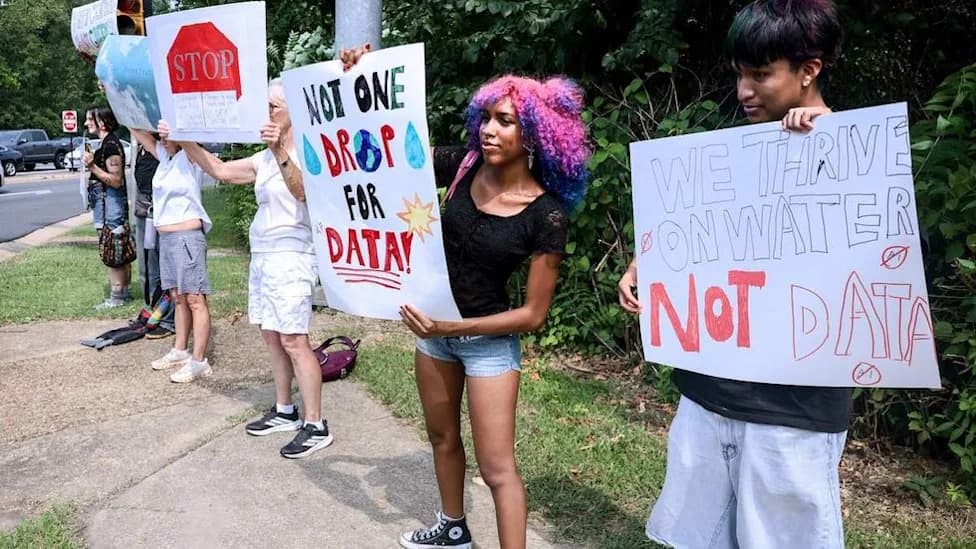
Demonstrators participate in a nationwide protest against data centers, in Fredericksburg, Virginia, U.S., July 18, 2026.
A sweeping survey of more than 18,000 people across 15 countries finds the world increasingly divided over artificial intelligence. Over one-third of respondents ranked AI development among their top concerns for the next five years — ahead of immigration, energy security and geopolitical rivalry — even as enthusiasm for AI remains strong in parts of Asia and Latin America.
Regional Divide: Enthusiasm Versus Anxiety
Polling shows sharp regional differences. In the Asia-Pacific region, 64% of respondents say AI products and services excite them; in Latin America that figure is 56%. By contrast, just 29% of North Americans report excitement, while anxiety and skepticism about AI are far more common there.
North America: Environment, Jobs and Local Politics
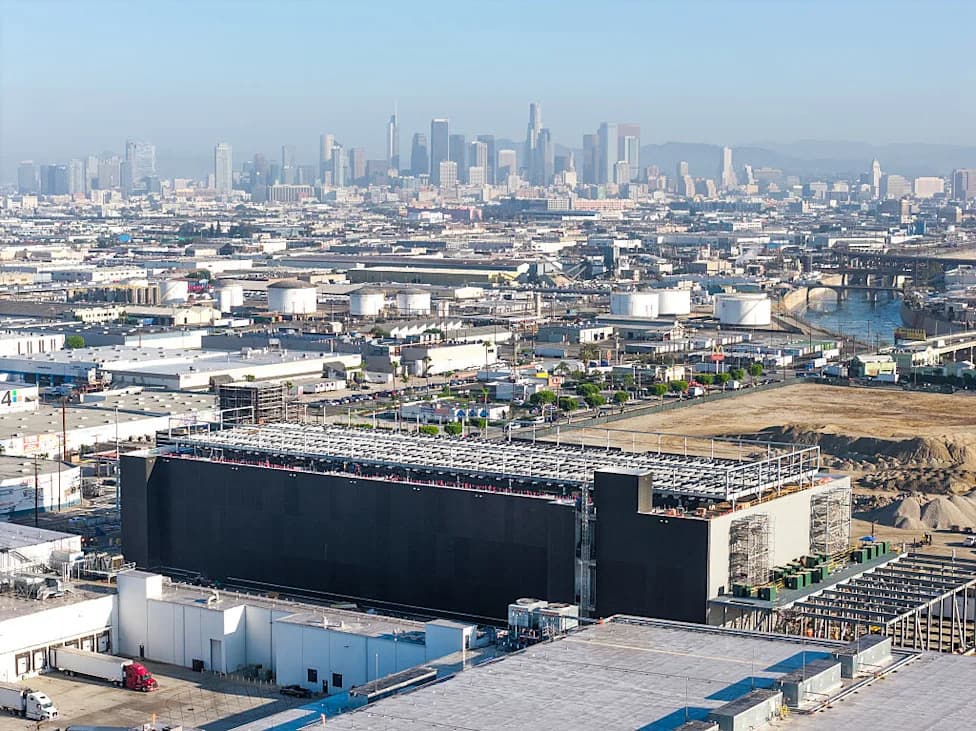
In North America, much of the backlash centers on environmental costs and the local impacts of AI infrastructure. Large AI data centres can consume up to 5 million gallons of water a day for cooling — roughly the daily needs of a town of 10,000–50,000 people — and require vast amounts of electricity. Public resistance has translated into politics: a Canadian survey found 68% of respondents would oppose a large AI data centre near their home, and seven in ten Americans express similar worries.
Municipal and state responses have ranged from temporary pauses to outright bans. Mississauga, Ontario, voted to pause new AI data-centre construction; New York State imposed a one-year moratorium on permits for large data centres; and Monterey Park, California, approved a local ban. Data-centre plans have become a campaign issue in U.S. midterm races, with multiple candidates pledging restrictions.
Youth attitudes are shifting as well: a recent Gallup survey found that among Americans aged 14–29, excitement about AI dropped to 22% (down 14 points year over year), while anger rose to 31% (up nine points). Concerns are driven by two forces: the prospect of white-collar job disruption in sectors such as law, finance and media, and heightened visibility because many leading AI companies are U.S.-based.
Measured Job Impact So Far
Despite high concern, measured employment impacts to date appear modest. Stanford research showed employment in occupations most exposed to AI fell by about 0.2% year-over-year in June 2026, while employment in least-exposed occupations rose by 0.6% over the same period.
Asia, Latin America And The Global South: Opportunity And Pragmatism
In many low- and middle-income countries, AI is seen more as an opportunity than a threat. A World Bank analysis estimates generative AI threatens roughly 4.5% of jobs in low- and middle-income countries versus more than 14% in advanced economies, because fewer workers in developing countries are employed in knowledge-intensive professional services.
Consequently, many developing nations welcome data centres as engines of investment and growth. Even where environmental concerns exist—Thailand and Indonesia report 69% and 65% of citizens, respectively, believing AI's benefits outweigh its environmental costs—public support often remains strong. In India, 71% hold that view even as local activists protested Google’s planned $15 billion AI data-centre complex in Visakhapatnam under the slogan "We cannot drink DATA," warning of pressure on fragile water supplies.
China: Strong Public Support and Faster Adoption
China stands out for particularly strong public optimism: about 80% of respondents say they are excited about AI, and 77% believe its societal benefits outweigh environmental costs. Structural factors — decades of rapid tech-driven growth, strong domestic chip and electronics industries and a political system that limits organized local opposition — help explain the difference. China also currently reports far fewer data centres than the United States (approximately 449 versus 5,427), meaning fewer citizens have direct experience of local environmental impacts.
Conclusion: A Divide Over Impact, Not Technology
The divide over AI is driven less by the technology itself than by differing judgements about its local impacts. In North America, fears of job displacement and environmental harm have spawned political pushback and local restrictions. In China and many parts of the Global South, AI is widely seen as a path to productivity gains and economic growth. The central question now is whether countries that view AI as an opportunity can overcome implementation challenges — and whether those with capacity to scale AI will choose to move forward or to pause.
Help us improve.