U.S. schools still grapple with high chronic absenteeism and lack a shared way to count attendance. Districts use three main methods — any part of day, half-day, or period/minute tracking — and inconsistent definitions prevent reliable comparisons. Some states (like Iowa) now require per-minute counts, and others are moving toward more granular data, but experts urge states to standardize definitions while weighing the costs and benefits of detailed systems.
Why Schools Can’t Even Agree How To Count Absences — And Why It Matters
It is 2026: satellites connect to our phones, artificial intelligence steers cars and reads scans, and even Homer’s ancient epic inspired a summer blockbuster. Yet amid these technological advances, public schools remain stymied by a more prosaic but consequential issue — how to agree on when a student is absent. With chronic absenteeism still elevated since Covid-era closures, disagreement over measurement complicates efforts to identify, compare and fix the problem.
Why Definitions Matter
Different methods for counting attendance can produce very different pictures of how many students are missing school. That became clear after Iowa’s 2024 attendance review found districts were using incompatible counting rules, making statewide comparisons unreliable. The state responded by requiring a uniform per-minute attendance method beginning in the 2025–26 school year.
Three Common Methods
- Any-Part-Of-Day: A student is counted present if they attend any portion of the school day.
- Half-Day Rule: A student must be present for at least half the school day to be marked present.
- Period/Minute Tracking: Attendance is logged by class period or minute, producing highly granular data.
"The lack of a common definition of a day of attendance continues to make it difficult to interpret and compare data within and across states," Attendance Works wrote in a 2025 report.
Policy Context And A Short History
Tracking attendance is not new: the United States’ first school law dates to the 1642 General School Law of the Massachusetts Bay Colony, and observers such as Horace Mann complained in 1838 about the difficulty of collecting basic attendance information. By 1918 every state had compulsory attendance laws. Federal attention intensified after No Child Left Behind (2001) required states to report truancy, and the Every Student Succeeds Act (2015) elevated chronic absenteeism — which counts both excused and unexcused absences — as a key indicator. As part of that shift, 36 states and D.C. included chronic absenteeism in their accountability frameworks.
How Attendance Data Is Used
Attendance serves multiple functions. In six states daily attendance affects funding; most states instead use enrollment snapshots taken once or twice yearly. Within schools, different systems can coexist: for example, Ponus Ridge STEAM Academy in Norwalk, Connecticut, reports homeroom attendance to the district and state while using period-level attendance internally to monitor students.
What The Data Show
Before the pandemic, roughly 15% of students were chronically absent — missing 10% or more of the school year (about 18 days). After schools reopened post-Covid, that share nearly doubled, according to Nat Malkus at the American Enterprise Institute. Research links missed days to lower academic achievement; experts describe the relationship as largely linear — each missed day corresponds to some decline in student performance. A recent NWEA report found chronic absenteeism was a major factor in students’ failure to reach pre-pandemic academic levels and recommended making attendance improvement part of academic recovery strategies.
Trends Toward Greater Granularity — And Trade-Offs
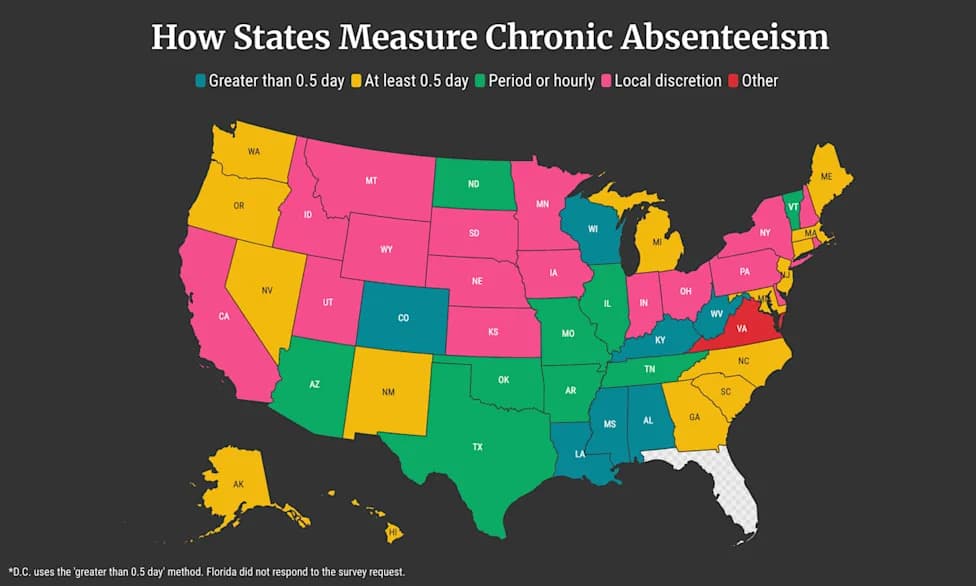
There is no conclusive research showing one counting method is superior. An Attendance Works brief (2026) found only eight states require per-minute attendance calculations, 24 states use the half-day rule, and 16 states leave the decision to districts. Still, more districts and states are moving toward period- or minute-level tracking: Arkansas and Oklahoma shifted to period-based attendance in 2025–26, while Ohio and Iowa adopted more granular approaches this school year.
Proponents say finer data can reveal specific patterns — for example, a student who is repeatedly late to a particular class — enabling targeted interventions. Des Moines’ district staff report that per-minute data help focus conversations with families and tailor supports. Ohio is using per-minute data as part of an effort to predict and prevent chronic absenteeism, with a statewide Attendance Dashboard that posts weekly updates on students who are chronically absent or at risk.
But granular systems have costs and risks. They are harder to implement consistently at the local level, can increase administrative burden, and may produce information overload for staff who must translate the data into action.
What Experts Recommend
Most researchers and policy specialists stop short of endorsing a single national method. Instead, they urge states to adopt a clear, consistent definition so that districts can be compared and supported equitably. Key priorities include:
- Standardize the definition of a day of attendance within each state.
- Balance the value of granular data with the implementation capacity of districts.
- Use attendance data proactively — to predict and prevent chronic absence — not only reactively.
With clearer definitions and smart use of data, schools will be better positioned to identify students who need help and to deploy supports that keep them in class.
Help us improve.