The University of Kentucky team found that microglia — brain immune cells — appear to drive sleep loss in an Alzheimer’s mouse model, with amyloid plaques acting as a trigger for inflammatory activation. Mice lost about 1.5–2 hours of sleep once plaques emerged at six months, a deficit that did not worsen by 18 months. Drugs that dampened microglial activation restored roughly two hours of nightly restorative sleep without reducing plaque levels. These are preclinical results, but they point to microglial modulation and home EEG monitoring as promising avenues for future research.
Calming Microglia Restores About Two Hours of Sleep in Alzheimer’s Mice, Study Finds

(Ktsimage/iStock/Getty Images Plus)
A new study from the University of Kentucky, published in Alzheimer's & Dementia, identifies brain immune cells called microglia as likely drivers of sleep loss in an Alzheimer’s mouse model. The work suggests that amyloid‑beta plaques may trigger a microglial inflammatory response that keeps the brain in a more alert state, rather than plaques directly causing the sleep disruption.
Key Findings
Researchers compared mice engineered to develop amyloid‑beta plaques with healthy controls and measured sleep patterns, cortical EEG activity and plaque accumulation at two stages: six months (when plaques first appear) and 18 months (advanced pathology). The study found that the appearance of plaques was associated with an immediate loss of about 1.5–2 hours of sleep per night at six months, a deficit that did not worsen by 18 months despite a substantially increased plaque burden.
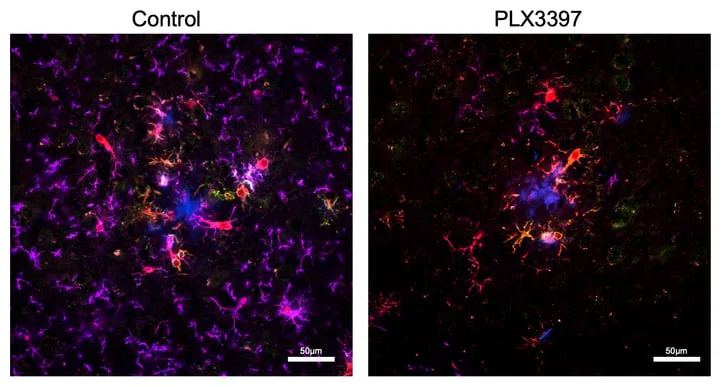
Brain tissue scans, showing the effects of immune cells being turned off (right) on microglia and amyloid plaques. (Nicholas Constantino)
“Basically, we showed that it is not the plaques themselves, or solely dysfunctional neurons, that cause sleep loss but actually microglia,” said Shannon Macauley, a physiologist at the University of Kentucky. “Microglia are immune cells that, when they respond to plaques, kick off this elaborate cascade of inflammation, as if the microglia are partying all night, and keeping the brain awake.”
Microglia Blockade Restores Sleep
In a follow‑up experiment, the team administered a drug that dampens microglial activation to a separate cohort of Alzheimer’s model mice. Treated mice regained roughly two hours of nightly sleep and showed longer periods of restorative sleep on EEG, even though amyloid‑beta plaque levels remained unchanged. Neuroscientist Nicholas Constantino commented that sleep and EEG disturbances that appeared at six months did not worsen by 18 months, suggesting the microglial response rather than plaque load per se is the proximal cause of early sleep loss.
Implications and Cautions
The findings point to microglia modulation — not wholesale elimination — as a potential strategy to protect restorative sleep in Alzheimer’s. Restorative sleep supports physical repair, memory consolidation and clearance of metabolic waste from the brain, so preserving it may help slow disease progression. However, these results are preclinical and were obtained in mice; translating them to humans will require extensive additional research. The authors also note that broadly removing microglia would be unsafe, so therapeutics would likely aim to calm or modulate microglial activity.

Subscribe to ScienceAlert's free fact-checked newsletter
Early Detection Possibility
The study’s longitudinal approach detected sleep and EEG changes as early as the first appearance of plaques, suggesting similar signatures might be detectable in humans. The researchers propose that portable EEG systems could eventually enable noninvasive home monitoring to screen for early Alzheimer’s‑related changes, complementing existing diagnostic tools.
Bottom line: In this mouse model, amyloid plaques appear to trigger a microglial inflammatory response that costs animals roughly 1.5–2 hours of sleep; suppressing microglial activation restored about two hours of restorative sleep without altering plaque levels. These findings highlight microglia as a promising target for protecting sleep in Alzheimer’s, while underscoring the need for caution and further research before human application.
Study: University of Kentucky; Journal: Alzheimer's & Dementia.
Help us improve.