Summary: This quiz-driven article shows how many contemporary U.S. policies no longer fit tidy partisan labels. Examples range from Republican proposals to limit corporate power and Democratic tariffs on Chinese electric vehicles to bipartisan votes on criminal justice reform, farmland restrictions and nuclear energy. The piece argues that while parties still disagree on core cultural and policy issues, economic nationalism, industrial policy and antitrust concerns now cut across the political divide.
Think You Know Which Side Backed These Ideas? A Quiz That Shows How U.S. Politics Has Shifted
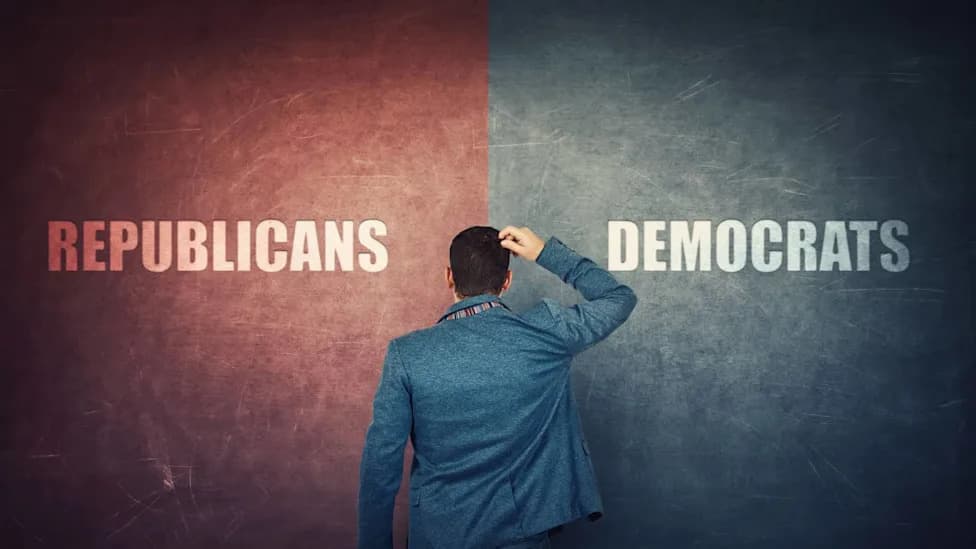
democrats-vs-republicans
American politics is often presented as a straightforward red-versus-blue divide: Republicans favor smaller government, lower taxes and a strong military; Democrats back a larger social safety net, stronger regulation and action on health and the environment. But in recent years that tidy picture has frayed.
Economic populism, industrial policy and concerns about corporate power have produced surprising crossovers. This quiz-style article highlights several real proposals and votes that show how ideas once considered partisan now attract support from both sides.
How the Quiz Works
The original piece presented a multiple-choice quiz asking readers to identify which party or politician proposed a range of policies. Below are the clearer explanations and context for each example highlighted in the quiz.
1. A $15 Minimum For Giant Corporations (Not Bernie Sanders)
In 2021, Republican Senator Josh Hawley proposed requiring corporations with at least $1 billion in annual revenue to pay employees a minimum of $15 an hour. Hawley framed the policy to target very large firms while exempting smaller businesses—an illustration of how economic populism can emerge on the right as well as the left.
2. A 100% Tariff On Chinese Electric Vehicles (Biden Administration)
In 2024, President Joe Biden ordered steep tariff increases on a set of strategically important Chinese products. The tariff on electric vehicles from China was raised to 100%, with higher duties also applied to batteries, semiconductors, solar products and other items. The Biden administration also maintained much of the tariff structure put in place during the Trump years, though with a more targeted industrial-strategy emphasis.
3. Breaking Up Big Tech: Warren And Hawley
Breaking up or restricting the power of major technology platforms has been championed by progressive leaders such as Elizabeth Warren, who proposed structural changes and rollbacks of acquisitions. But Republican Senator Josh Hawley also introduced bills—like the Bust Up Big Tech Act and the Trust-Busting for the Twenty-First Century Act—that would curb mergers and separate platforms from businesses that operate on them. Different rationales, similar targets.
4. The First Step Act: Bipartisan Criminal Justice Reform
The First Step Act, signed by President Donald Trump in 2018, revised some federal sentencing rules and expanded earned-time credits and reentry programs. It passed the Senate 87–12, demonstrating unusually broad bipartisan support for criminal justice reform.

Photo credit: Noppol Mahawanjam via Canva.
5. Restrictions On Foreign Purchases Of U.S. Farmland
Legislation and amendments aimed at blocking acquisitions of U.S. farmland by entities tied to China, Russia, Iran and North Korea won overwhelming Senate support in 2023. A related amendment passed 91–7, reflecting bipartisan national-security concerns about foreign ownership of agricultural land.
6. Renewed Bipartisan Support For Nuclear Energy
In February 2024, the House approved the Atomic Energy Advancement Act, aimed at accelerating licensing and deployment of nuclear technologies. The vote (365–36) and accompanying federal policies under the Biden administration indicate growing cross-party acceptance of nuclear power as part of a low-carbon energy mix.
7. Banning Congressional Stock Trading: Cross-Partisan Momentum
Democratic Senator Jon Ossoff introduced the Ban Congressional Stock Trading Act, and Republican Senator Josh Hawley proposed similar restrictions. Later versions of the legislation included sponsors from both parties, showing bipartisan momentum for tighter rules on members' financial transactions.
8. TikTok And Foreign-Adversary App Legislation
Congress passed the Protecting Americans From Foreign Adversary Controlled Applications Act, which targeted apps owned or controlled by foreign adversaries and specifically addressed TikTok and its parent company, ByteDance. President Biden signed the law; enforcement and implementation became politically contested later, illustrating how national-security tech concerns cut across party lines.
9. Ranked-Choice Voting: Progressive Backing, Mixed State Politics
In December 2025, the Congressional Progressive Caucus endorsed a federal Ranked Choice Voting Act to require ranked-choice elections for congressional primaries and general elections beginning in 2030 and to provide federal support for states that adopt the system. Support and opposition for ranked-choice voting vary widely at the state level and do not align neatly with national party labels.
10. "Buy American" And Industrial Policy: Both Presidencies
Policies favoring U.S.-made products have been strengthened under both the Trump and Biden administrations. Current federal procurement rules set domestic-content thresholds that rise from 65% (2024–2028) to 75% beginning in 2029, reflecting bipartisan emphasis on reshoring and supply-chain security.
11. Trust-Busting From The Right
Senator Hawley's Trust-Busting for the Twenty-First Century Act proposed banning mergers by companies with market capitalizations above $100 billion, along with tougher antitrust penalties. Although the rhetoric differed from progressive antitrust arguments, the policy outcome—limiting corporate consolidation—echoes concerns from the left.
Conclusion
The larger lesson is not that Republicans have become Democrats or vice versa. Parties still clash over taxes, abortion, immigration, climate policy, health care, LGBTQ+ rights, voting rules and the size and scope of government. But on questions of trade, industrial policy, antitrust and corporate power, economic populism and national-security concerns have blurred older partisan boundaries.
Bottom line: Different political motivations can produce similar policy outcomes. When that happens, a simple left-right quiz can be surprisingly difficult to answer.
Help us improve.