Spanish authorities have denied social media claims that Madrid plans to replace the US dollar with the Chinese renminbi. The story — which spread after a tense NATO summit involving President Trump — has been refuted by government spokespeople and by the Bank of Spain, whose 2025 accounts show 73.9% of reserves in dollars and just 1% in renminbi. Experts note that currency choice in trade is commercial and that the renminbi remains far from rivaling the dollar or euro globally.
Spain Denies Plans To Replace Dollar With Chinese Yuan Amid NATO Row
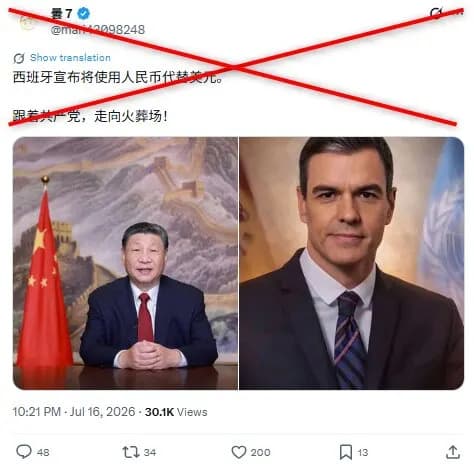
Screenshot of the false X post taken on July 30, 2026, with a red cross added by AFP
Spanish authorities have rejected viral social media claims that Madrid intends to stop using the US dollar and adopt the Chinese renminbi for international transactions. Government spokespeople and the Bank of Spain say no such directive exists and that Spain continues to hold the majority of its foreign reserves in dollars.
False Post Example:
"Spain announces it will use the renminbi to replace the dollar. Follow the Communist Party, head to the crematorium!" — A simplified Chinese post published on X on July 16, 2026, later flagged by AFP as false.
Context
The disinformation circulated after a tense NATO summit in Turkey (July 7–8) where US President Donald Trump described Spain as a "terrible partner in NATO" amid disputes over defence spending and Spanish policy on the Iran conflict. Spanish Prime Minister Pedro Sánchez later said relations with the United States remained "very positive" and described his exchange with Trump as cordial.
Official Responses
The Spanish Ministry of Economy, Trade and Business told AFP on July 24 that there is "no directive from any European or national authority" instructing the country to bill international trade in renminbi. The ministry added that no EU trade agreement prescribes a billing currency and that the choice of currency is a commercial decision made by contracting parties.
What The Data Shows
The Bank of Spain's 2025 annual accounts report that 73.9% of its international reserve assets are denominated in US dollars, while only 1% are held in Chinese renminbi. These reserves include current accounts, deposits, investment fund shares, debt securities and other foreign-currency claims.
Expert Views
Professor Chong Tai-leung of the Chinese University of Hong Kong told AFP that governments generally cannot force private companies to use a particular currency for trade; those decisions are negotiated between trading partners. Gary Ng, senior Asia‑Pacific economist at Natixis, said the renminbi's use is growing in China-related trade and investment but is still far from challenging the global dominance of the US dollar or the euro.
Conclusion: The claim that Spain will replace the dollar with the yuan is false. Spanish officials, the Bank of Spain's reserve data and independent economists all indicate that the euro and dollar remain central to Spain's international finances, and the renminbi is not currently displacing them.
Help us improve.