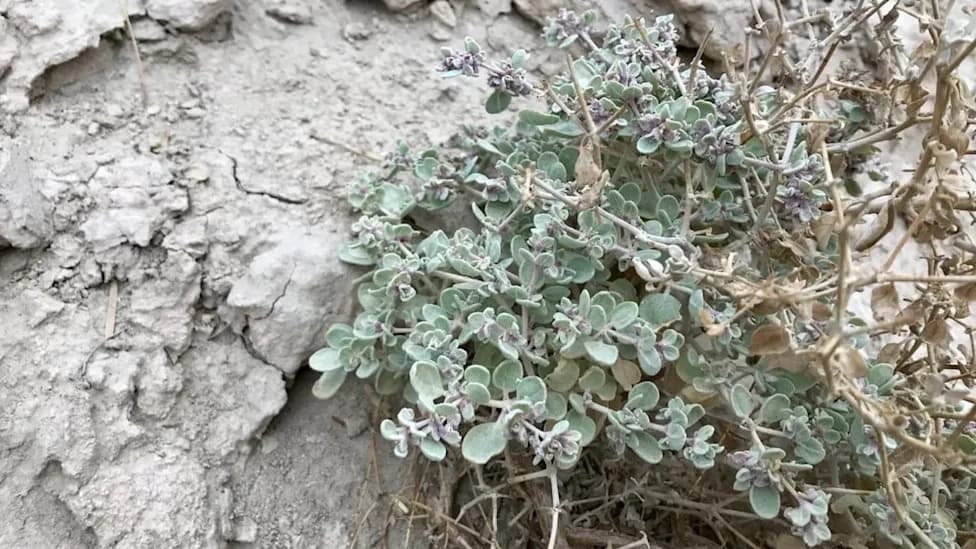
Death Valley is one of the hottest, driest places in North America, with summer daytime temperatures commonly near 49 °C (120 °F) and recorded highs of 56.7 °C (134.1 °F). Yet a wiry native shrub, Tidestromia oblongifolia (Arizona honeysweet), survives by actively cooling its leaves well below ambient air temperature — in some cases by as much as 13 °C.
What Researchers Did
Researchers collected seeds from 223 wild plants across the species' range, including populations in Death Valley. They grew more than 1,200 seedlings and subjected them to a heat-acclimation protocol that culminated in daily exposures of 60 °C (140 °F) for six to eight hours over more than a week.
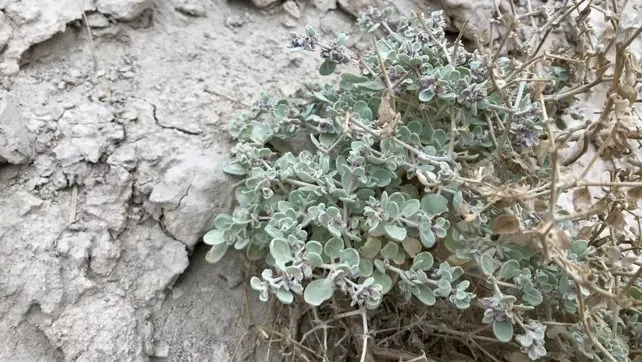
T. oblongifoliagrowing in Death Valley, California, photographed as part of aprevious studyon the plant. (Karine Prado)
Key Findings
Survival varied strongly by genetic line: depending on origin, survival rates after the heat treatment ranged from under 2% to over 34%, indicating substantial genetic variation in heat resilience. Infrared imaging showed that, on the hottest days, some leaves were 10–13 °C cooler than the surrounding air. Surviving seedlings typically kept leaf temperatures between about 54 °C and 59 °C — still extremely hot, but generally below the estimated upper thermal limit for complex eukaryotic life (~60 °C).
How The Cooling Works
Physiological and genetic analyses point to evaporative cooling through open stomata as a major mechanism. Plants that maintained cooler leaves showed activation of pathways associated with keeping stomata open, allowing water to evaporate from leaf surfaces much like perspiration cools human skin. In experiments where researchers artificially forced stomata to close, the plants lost much of their cooling ability.
Subscribe to ScienceAlert's free fact-checked newsletter
"Forcing the stomata (the pores on a plant leaf) to close interfered with cooling," said Joanna Feehan, first author and postdoctoral fellow at the Plant Resilience Institute in Michigan. "Part of transpiration is evaporation through stomata, so we do know this is a major component of their cooling mechanism."
Genetics, Water Use, And Unknowns
Genome-wide scans identified three chromosomal regions associated with heat survival, supporting a genetic basis for the trait, though the specific genes remain to be pinpointed. Unlike many desert plants, T. oblongifolia does not appear to store large amounts of water; researchers hypothesize it relies on deep or efficient roots and specialized internal hydraulics, plus cellular solute composition (salts, sugars, proteins) that help tissues stay hydrated while transpiring for cooling. Where exactly the water comes from in mature desert conditions remains an open question.
Caveats And Implications
The experiments were performed on well-watered seedlings in controlled conditions, not on mature plants coping with full desert complexities. The study is currently a preprint and has not been peer-reviewed. Still, the findings may have practical value: understanding the physiological and genetic basis of extreme-leaf cooling could offer new strategies to breed or engineer crops that better withstand heat waves as global temperatures rise.
Reference: Full study available as a preprint on bioRxiv.