A long-term experiment begun in 1987 in Victoria's Central Highlands originally seemed to favor large clearcuts for regenerating mountain ash (Eucalyptus regnans). A 2014 revisit, however, found that heavily thinned stands produced the largest trees — roughly 20% greater diameter — and stored at least as much carbon as unharvested forests. The authors argue thinning can supply timber while preserving habitat (hollows) for species like greater gliders and Leadbeater's possums, challenging a strict conservation-versus-production divide.
Revisit of Long-Term Study Challenges Case for Clearcutting Mountain Ash
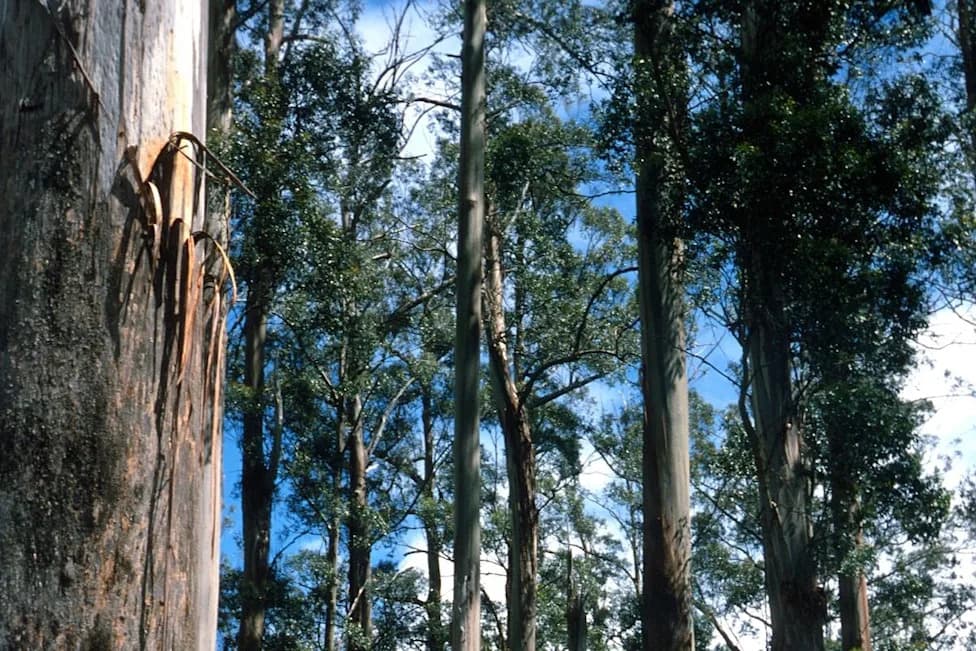
Mountain Ash trees. CSIRO
A landmark forest experiment in Victoria's Central Highlands — begun in 1987 to test how mountain ash (Eucalyptus regnans) respond to different logging regimes — produced surprising results when scientists returned decades later. Initial analyses supported large clearcutting as the best way to regenerate ash, but a 2014 revisit revealed that heavy thinning can produce larger, carbon-rich trees and deliver important conservation benefits.
Background
Debate over how to manage mountain ash forests has long divided conservationists and foresters. Conservation groups argue that large-scale clearcutting threatens koalas and other native wildlife; foresters counter that mountain ash are adapted to stand-replacing fires and that even-aged stands across the landscape reflect natural post-fire regeneration. In 1987 researchers set up a controlled experiment comparing three treatments: very large clearcuts (often >1,000 ft wide), small clearcuts (some <200 ft), and heavily thinned stands (at least 50% basal area removed).
Early Results and Abandonment
By the early 2000s the experiment appeared to validate the foresters' view: mountain ash regenerated best in the footprints of large clearcuts, while smaller cuts and thinned plots were dominated by shorter acacia species. Those published results led to the program being effectively abandoned.
What the 2014 Revisit Found
When scientists returned to the same plots in 2014, they found an unexpected trend. Although mountain ash remained abundant in both large and small clearcuts, trees in the thinned plots had advanced remarkably fast. Monitoring showed that, with reduced competition, the largest trees in thinned stands had roughly 20% greater diameter than comparable trees in unharvested areas. Those thinned stands also stored at least as much carbon as unlogged plots, suggesting that within a few decades the surviving ash in thinned areas had recovered the carbon lost to logging and then some. These findings were later published in the journal Forest Science.
Implications for Conservation and Forest Management
The authors emphasize several practical benefits of thinning: larger trees tend to be more fire-resistant, are more likely to develop the deep hollows used by species such as greater gliders and Leadbeater's possums, and can help retain or rebuild forest carbon stocks while still producing timber. As the researchers wrote in The Conversation, these results challenge the simplistic "conservation versus production" framing and point toward management options that can deliver multiple objectives.
Key takeaway: Thinning — not just large-scale clearcutting — can produce fast-growing, carbon-rich mountain ash that support wildlife habitat while allowing sustainable timber harvests.
Notes on evidence: The revisit does not erase earlier observations that regeneration dynamics vary by treatment and site; rather, it shows that long-term trajectories can differ from short-term outcomes and that management objectives (timber, carbon, habitat) can be better balanced with alternative silvicultural approaches.
Help us improve.