The NYC Clean-Powered Carts Challenge is a six-month pilot near the Unisphere that replaces gas generators on 10 food carts with swappable rechargeable batteries. The trial, run with Popwheels and coordinated with FDNY safety guidance, will assess performance, vendor feedback, and logistics. Officials say wider adoption could cut over 120,000 metric tons of CO2 annually, reduce noise and fumes, and improve vendor working conditions.
NYC Pilots Swappable Batteries for Food Carts to Cut Noise and Emissions
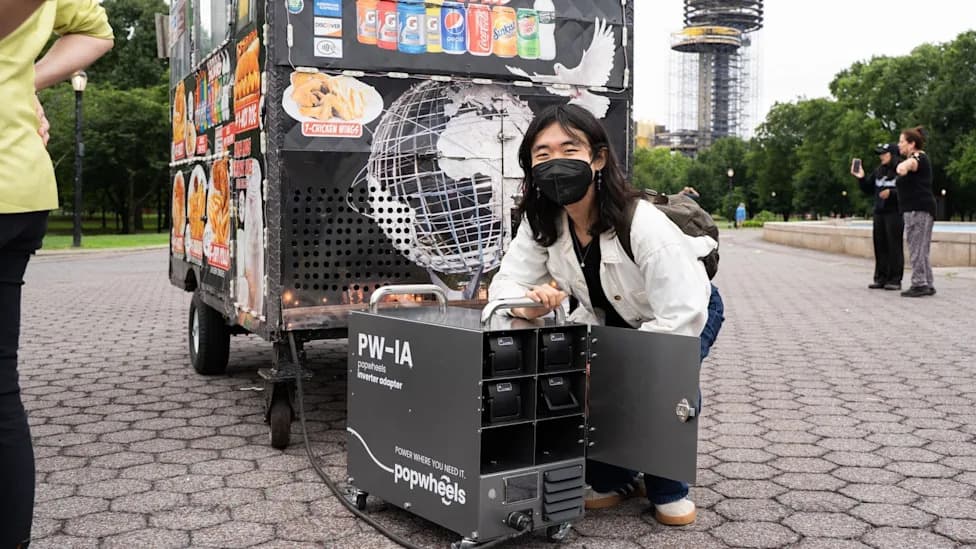
Photo Credit: Popwheels
New York City has launched a six-month pilot near the Unisphere in Flushing Meadows Corona Park that replaces noisy, polluting gas generators on 10 mobile food carts with removable, rechargeable batteries.
About the Pilot
The NYC Clean-Powered Carts Challenge, announced July 7 by Chief Climate Officer Louise Yeung, will test how battery-powered carts perform in everyday vending and gather vendor feedback before any wider rollout. The city is partnering with Popwheels, which supplied the battery-swapping infrastructure that lets vendors exchange depleted packs for fully charged units at the start and end of each shift.
How It Works
Carts are retrofitted to accept swappable battery modules. Depending on power draw, a single battery charge can last as little as about one hour or as long as a full day. Vendors will swap batteries at a charging hub rather than refueling and maintaining gas generators.
Environmental And Health Benefits
"If we electrified every food vending cart in New York City, we can reduce greenhouse gas emissions by over 120,000 metric tons of carbon dioxide, which is the equivalent of taking 30,000 cars off the road each year," said Louise Yeung.
Beyond emissions reductions, batteries eliminate generator fumes and constant engine noise, improving air quality and the daily working environment for vendors—and creating a quieter, more pleasant experience for park visitors.
Worker Well-Being And Operational Simplicity
Mohamed Attia, managing director of the Urban Justice Center's Street Vendor Project, described the change as an environmental justice measure: vendors have reported health problems from prolonged exposure to gasoline fumes. The swapping system also streamlines operations—vendors avoid handling fuel, reduce maintenance tasks, and save time during shifts.
Safety And Partnerships
The pilot brings together several city agencies and private partners. The Fire Department of the City of New York (FDNY) collaborated with the climate office to develop battery-safety guidance for the trial. Popwheels President and co-founder David Hammer demonstrated the noise reduction using a refurbished cart owned by participating vendor William Arévalo, who has operated multiple food businesses at Flushing Meadows Corona Park for about eight years.
What Comes Next
City officials will evaluate technical performance, vendor feedback, battery logistics, and safety outcomes during the six-month trial to decide whether to expand the program. If scaled citywide, officials say swapping batteries on the city’s thousands of carts could yield significant climate, health, and quality-of-life benefits for workers and New Yorkers alike.
Quick Facts: Ten carts, six months, Popwheels battery-swap infrastructure, battery life from roughly one hour to a full workday, and a potential reduction of more than 120,000 metric tons of CO2 annually if fully adopted citywide.
Help us improve.