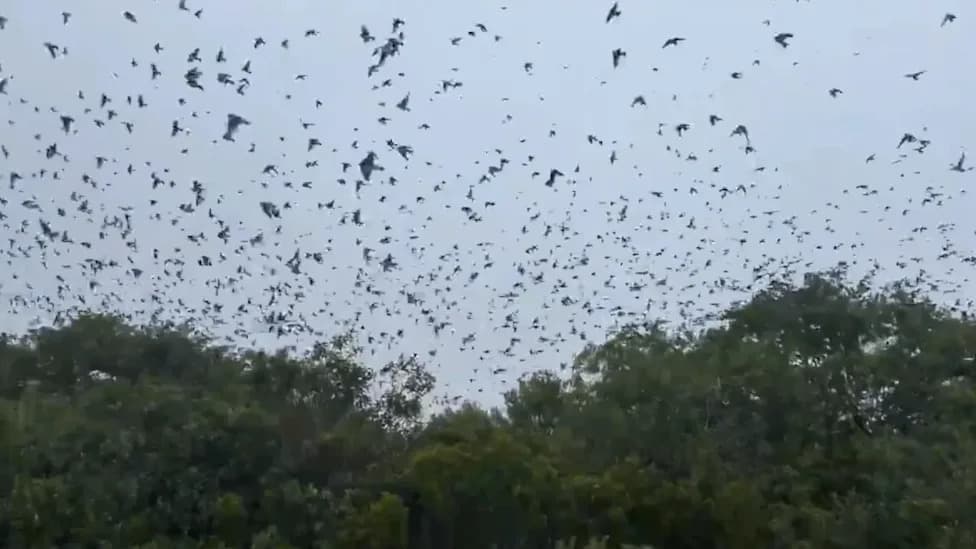
Murmurations are spectacular, coordinated flocks of European starlings that can number in the hundreds of thousands and reach speeds up to 50 mph (80 km/h). They typically form near communal roosts about an hour before sunset and last around 30–60 minutes. Scientists believe murmurations help attract birds to roosts and protect individuals through dilution, increased detection and predator confusion. Studies using multi-camera 3D reconstructions and computer simulations suggest each bird coordinates with roughly seven nearest neighbours, producing complex group patterns without any leader.
Why Do Starlings Swoop and Swirl? The Science Behind Murmurations
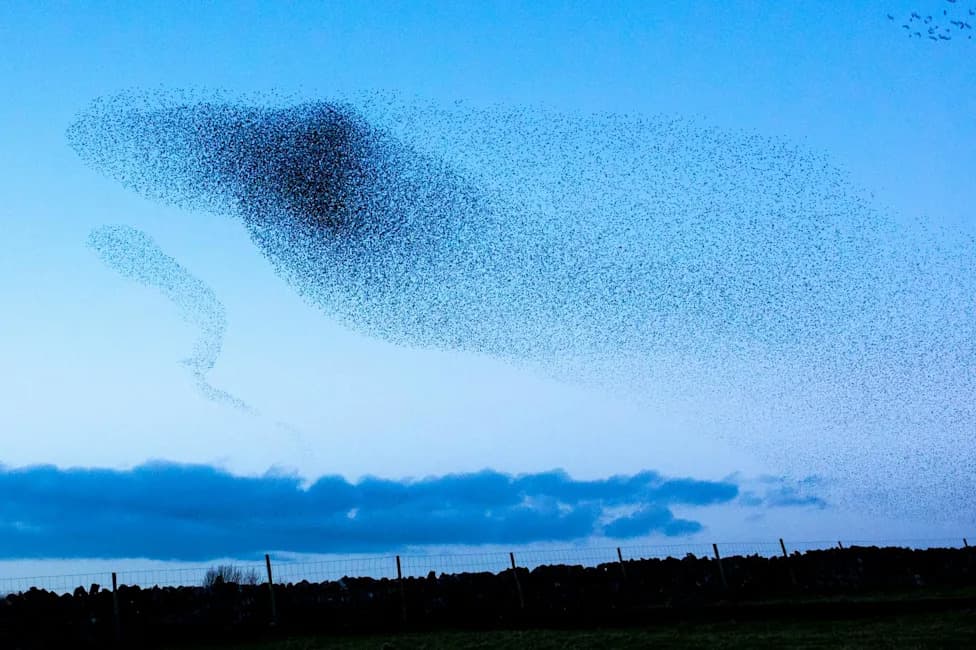
Murmurations can have as many as 750,000 birds flying in unison.mikedabell/iStock via Getty Images
A shifting, living cloud of thousands of European starlings — known as a murmuration — is one of nature’s most striking spectacles. These flocks can swell to hundreds of thousands of birds, spreading out and collapsing, splitting and fusing while tracing teardrops, figure-eights, columns and other flowing shapes. Individual starlings in a murmuration can reach speeds of up to 50 miles per hour (80 km/h) as the flock surges hundreds of meters up and then plunges nearly to the ground.
What Is a Murmuration?
The European or common starling often forms flocks while feeding or migrating, but a murmuration is a distinct behaviour named for the low, continuous murmur created by thousands of wingbeats and soft contact calls. Murmurations typically begin about an hour before sunset in autumn, winter and early spring, when birds assemble near a chosen communal roost. After roughly 30–60 minutes of aerial choreography, the entire flock will suddenly drop down into the roost for the night.
Why Do Starlings Form Murmurations?
Scientists believe murmurations serve several likely purposes rather than providing aerodynamic benefits (like the V-formation of geese). Key reasons include:
- Finding and attracting a communal roost — the swirling display acts as a visual cue that draws other starlings to the gathering site.
- Predator defence through dilution — the larger the flock, the smaller an individual bird’s chance of being singled out by a predator.
- Selfish herd dynamics — birds on the edges often move toward the centre to reduce risk, which produces much of the motion and jostling seen in a murmuration.
- Confusion of predators — the rapidly changing mass and wave-like patterns make it hard for a raptor to lock on to a single target.
- Increased detection — many birds together mean more eyes and ears to spot threats.
What Do Observations and Studies Show?
Citizen scientists reported more than 3,000 murmuration sightings in a recent study, and about one-third of observers saw a raptor attack the flock. That supports a protective role for murmurations, although a large, conspicuous flock may also attract predators in the first place.
Researchers find that murmurations have no central leader or planned choreography. Instead, coordination emerges from local interactions: each bird watches nearby neighbours and adjusts its flight. Detailed studies using synchronized multi-camera arrays and computer tracking reconstruct three-dimensional flock movements and show that birds are not as tightly packed as they appear from the ground — there is room to manoeuvre.
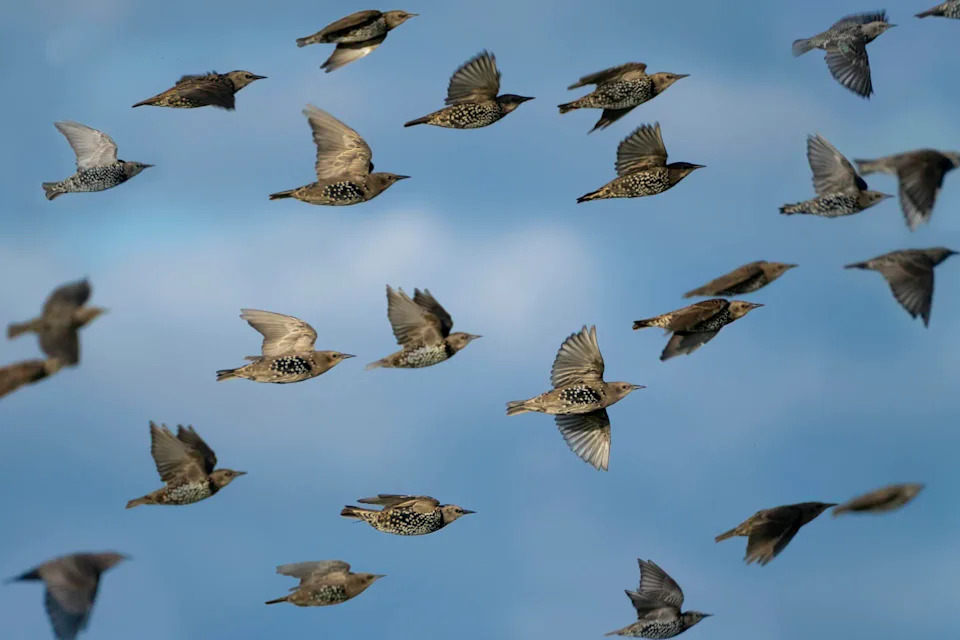
Within the murmuration, individual birds aren't tightly packed together.K C Bailey/iStock via Getty Images
Computer simulations built on simple rules (align with neighbours, avoid collisions, keep together) indicate that each starling likely tracks about seven nearest neighbours to maintain the flock’s cohesion and fluid patterns while flying fast. Similar principles explain coordinated motion in schools of fish and some insect swarms.
Why Study Murmurations?
Understanding how thousands of individuals coordinate quickly without colliding fascinates scientists across biology, mathematics, physics, computer science and engineering. Beyond pure curiosity, these insights can inform the design of autonomous vehicles and robot swarms that need to travel in tight formation and cooperate safely.
Films and Further Reading
Photographers and filmmakers have captured murmurations worldwide. The short film Flight of the Starlings (Jan van IJken) and the video Murmuration (Sophie Windsor Clive & Liberty Smith) vividly convey the sound and motion that give these displays their name.
Source: This article is adapted from a Curious Kids piece by Tom Langen, Clarkson University, republished from The Conversation.
Hello, curious readers! If you have a question you'd like an expert to answer, consider sending it to [email protected] with your name, age and city. Adults are welcome to send questions too.
Help us improve.