United Nations Secretary-General Antonio Guterres concluded a two-day visit to Damascus, urging the immediate lifting of all sanctions imposed during the era of Bashar al-Assad to enable recovery. He welcomed partial easing by some Western countries but said a full repeal is needed to attract investment and rebuild. The World Bank estimates reconstruction could cost up to $216 billion; UN figures show about 1.7 million refugees have returned while millions remain displaced. Guterres met Syrian leaders, visited Sednaya prison and warned against violations of Syria's sovereignty amid reported Israeli incursions.
Guterres Urges Immediate Lifting Of All Syria Sanctions After Historic Damascus Visit
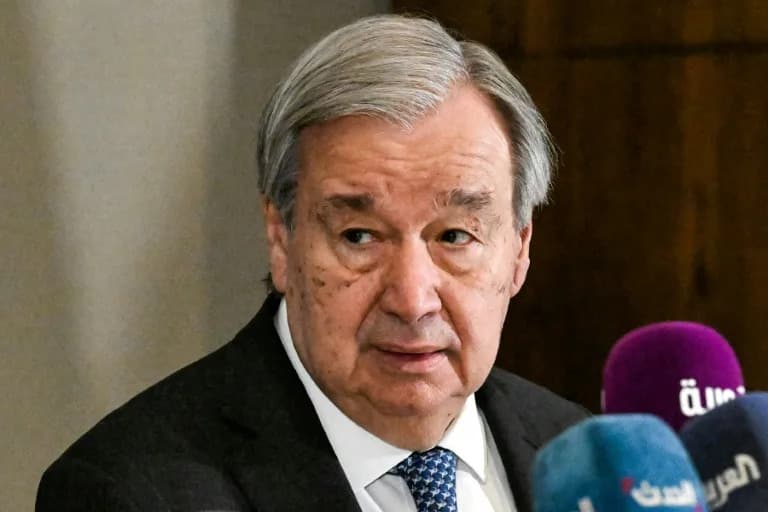
United Nations Secretary-General Antonio Guterres gives a press conference in Damascus (LOUAI BESHARA)
United Nations Secretary-General Antonio Guterres concluded a two-day visit to Damascus on Sunday by urging the international community to lift all sanctions imposed during the era of Bashar al-Assad. He described the trip as "deeply meaningful and productive" and called for swift action to enable economic recovery and large-scale reconstruction.
Post-Conflict Recovery Needs
Syria's new authorities, who assumed power in December 2024, are seeking to move beyond more than 13 years of conflict and to restart their economy while rebuilding infrastructure and public institutions. The World Bank estimates that post-war reconstruction could cost up to $216 billion, a figure Guterres said underscores the urgency of opening the country to investment and assistance.
Sanctions, Investment And Reconstruction
Guterres welcomed recent steps by some Western countries, including the United States, to ease certain measures but insisted that partial steps are not enough.
"I welcome steps that have eased sanctions, and opening new possibilities for economic recovery, but all these sanctions must be removed immediately,"
He argued that a full removal of sanctions is necessary to attract investors, restore services, revive livelihoods and allow humanitarian and development actors to operate effectively.
Humanitarian And Social Priorities
Guterres emphasized the need for investment in people, institutions and essential services. He highlighted the importance of enabling the safe, voluntary and dignified return of refugees and internally displaced persons. According to UN figures, about 1.7 million refugees have returned to Syria since the change of authorities in late 2024, while roughly 5.5 million remain displaced inside the country and about six million are living abroad.
Meetings And Observations
During his visit, Guterres met senior officials including President Ahmed al-Sharaa, Foreign Minister Asaad al-Shaibani and the speaker of the new transitional parliament, which held its first session this month. He also met members of the UN peacekeeping contingent in the Israeli-occupied Golan Heights and representatives of Syrian civil society, including women, youth and community leaders.
Guterres visited Sednaya prison near Damascus, a facility long associated with harsh conditions under the previous regime, underlining concerns about justice, human rights and the rule of law as reconstruction advances.
Sovereignty And Regional Tensions
He reiterated that violations of Syria's sovereignty and territorial integrity are unacceptable. His remarks came hours after Syrian state media reported an Israeli incursion and artillery shelling in the country's south. Israel has in recent years conducted operations and occasional incursions beyond the UN-monitored buffer zone on the Golan Heights.
Historic Visit
Guterres is the first UN secretary-general to visit Syria since Ban Ki-moon in 2009, two years before the outbreak of the civil war that ultimately killed more than half a million people and displaced millions. The visit signals renewed international engagement at a pivotal moment for Syria's future.
Help us improve.