U.S. District Judge Emmet Sullivan ordered Acting Attorney General Todd Blanche to produce unredacted Epstein-related emails and documents for an in camera review, together with the evidence supporting the Justice Department's redactions. The order demands eight unredacted email chains and additional records, with a firm production deadline of 3:00 p.m. ET on July 30. Sullivan invoked recent D.C. Circuit precedent and made clear the court — not the DOJ — will assess whether withheld names are legitimately protected victims or law-enforcement personnel. The Justice Department denies conceding any statutory violation and plans to appeal, but must first comply with the production order.
Judge Forces Acting AG to Produce Unredacted Epstein Files for Private Court Scrutiny
Screenshot
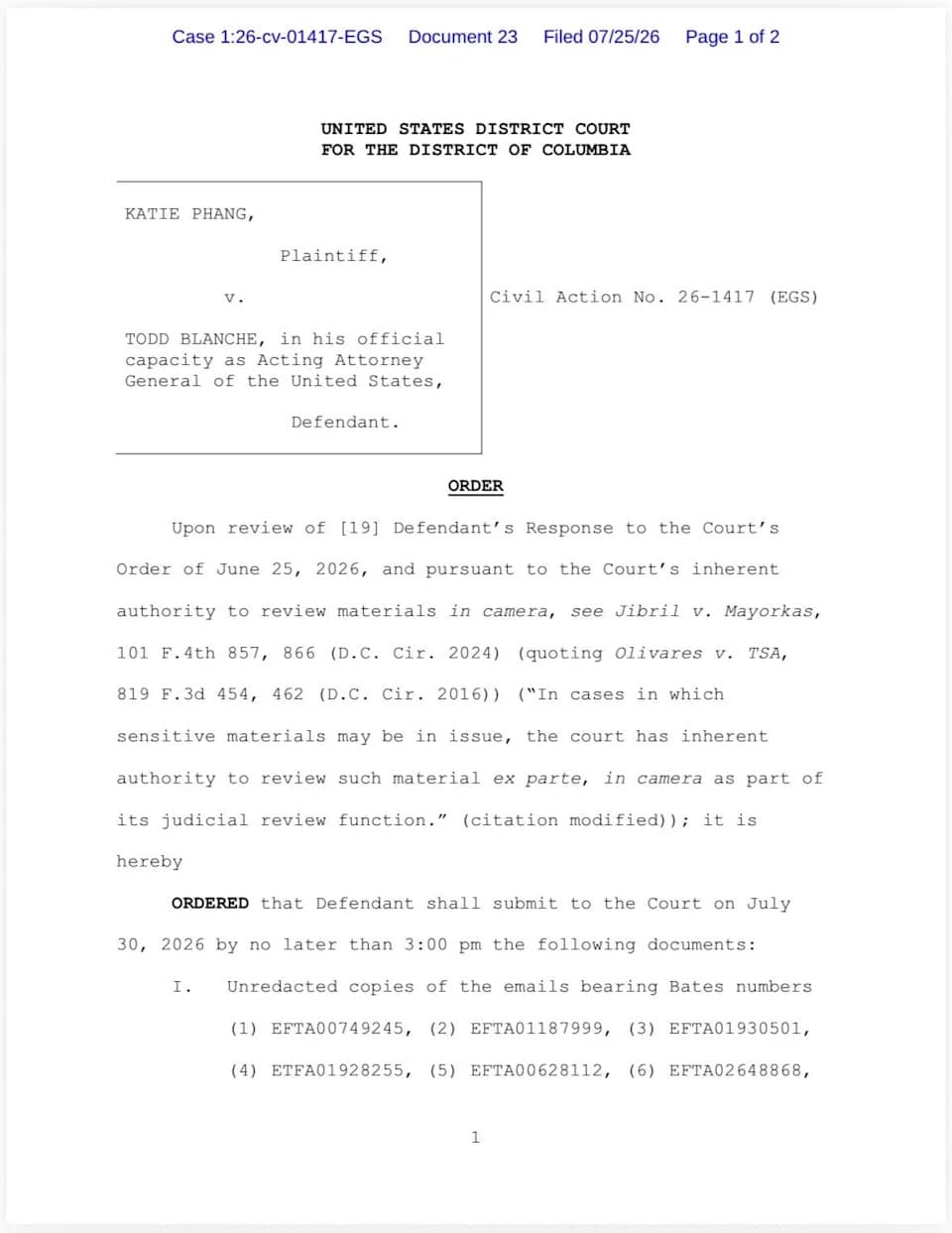
A federal judge overseeing Katie Phang's lawsuit against the Justice Department has ordered Acting Attorney General Todd Blanche to deliver unredacted Jeffrey Epstein–related documents to the court for an in camera (private) review — and to provide the evidence supporting the Justice Department's claims for each redaction.
What the Order Requires
In an order issued Saturday, U.S. District Judge Emmet Sullivan directed Blanche to submit:
- Eight unredacted email chains identified by Bates numbers, along with documentation supporting the DOJ's assertion that the redacted names are legally protected victims;
- An unredacted copy of a separate document with evidence that the names removed from the "to" and "from" lines are law-enforcement personnel; and
- A third document in unredacted form, accompanied by materials supporting the department's claim that the redactions conceal victim identities.
The court set a firm deadline for production: 3:00 p.m. ET on July 30.
Why the Court Is Involved
Sullivan emphasized that the court will not simply accept the Justice Department's representations about redactions at face value. Citing recent D.C. Circuit precedent recognizing a court's inherent authority to review sensitive material privately, the judge ordered the unredacted records brought directly into his chambers so the court — not the department — can determine whether the government's explanations are supported by evidence.
Case Background
The suit was filed by media personality Katie Phang of MeidasTouch under the Epstein Files Transparency Act, a bipartisan law passed last year requiring the release of the majority of the government's Jeffrey Epstein records. The records at issue include FBI interview notes tied to allegations connected to Epstein, communications referencing a purported "torture video" and alleged sexual activity involving minors, draft indictment materials naming alleged co-conspirators, and other heavily redacted documents. Many allegations in the files remain unverified.
In an earlier opinion, Sullivan wrote: "The Attorney General does not respond substantively to any of these arguments," and concluded, "The Attorney General has conceded that he is in violation of the Act."
The Justice Department has since denied that it conceded any statutory violation and has indicated it intends to appeal Sullivan's earlier ruling. Nevertheless, before an appeal proceeds, the department must place the unredacted records before the judge so he can independently evaluate whether the redactions comply with the law.
Procedure And Access
Judge Sullivan denied Phang's request to attend the in camera review herself. Phang publicly shared the order on social platforms and described the ruling as an important step in the litigation, noting that the court asked the government to "basically 'prove it.'"
What Happens Next
Blanche must submit the specified unredacted materials and supporting documentation by the July 30 deadline. After reviewing them in chambers, the court will decide whether the claimed protections for victims and law-enforcement identities are valid under the Epstein Files Transparency Act and related law. If the court finds the government’s justifications insufficient, it could order additional disclosures; if it accepts them, the redactions may stand. Either party may pursue appellate review as allowed by law.
Note: This story was originally published by MeidasTouch on July 25, 2026.
Help us improve.