The conflict with Iran has shifted toward control of the Strait of Hormuz, a chokepoint responsible for roughly 20% of global energy trade. Repeated attacks on civilian shipping have prompted Gulf states and energy firms — with U.S. support — to accelerate pipelines, ports and corridors that bypass Hormuz. Major efforts include Saudi and Emirati pipeline expansions and Iraq-linked routes via Syria, Turkey and Jordan; Goldman Sachs estimates bypasses could carry about 60% of Hormuz traffic by 2028. If completed, these alternatives would significantly reduce Iran's strategic leverage.
Iran Has Weaponized the Strait of Hormuz — Gulf States Are Building Bypasses
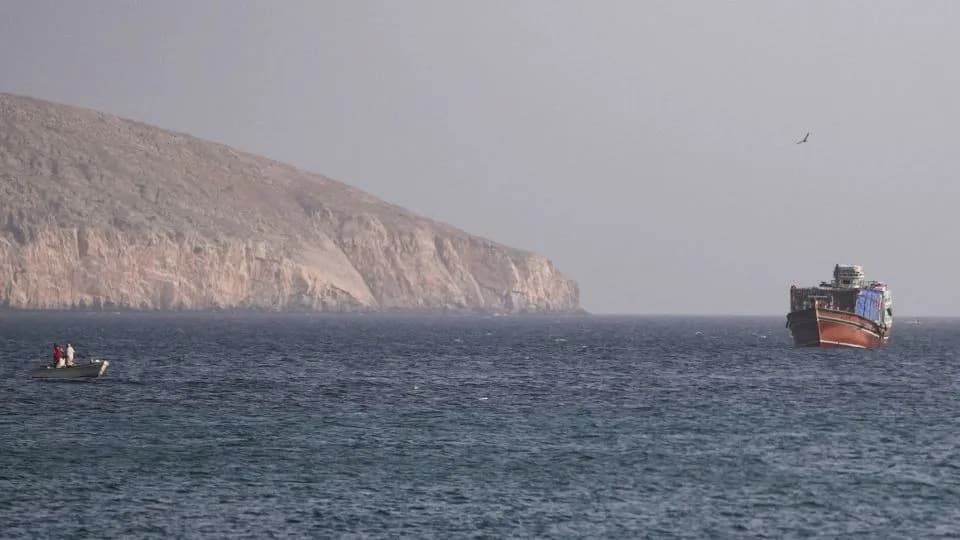
A vessel in the Strait of Hormuz, as seen from Musandam, Oman, on July 16. - Stringer/Reuters
Wars often end in places very different from where they began. What began as a diffuse confrontation with Iran — with ambitions ranging from regime change to degrading Tehran's nuclear and military capacity — has narrowed into a high-stakes contest over the Strait of Hormuz, one of the world's most important energy arteries.
Nearly six months into the conflict, Iran has demonstrated both the capability and the willingness to strike commercial shipping in and around Hormuz with drones and cruise missiles unless transit follows conditions set by Tehran. The United States, Gulf partners and much of the international community have judged that such de facto control over an international waterway would be unacceptable.
The strategic question is now straightforward: will the Strait of Hormuz remain an international passage, or will Iran acquire the power to decide who passes and on what terms? If Tehran were to exercise that authority, it could extract tens of billions of dollars in transit fees and meter energy flows — effectively holding a hand on a key lever of the global economy.
Iran is not physically sealing the strait, but attacks on civilian shipping are sufficient to halt commercial traffic and overturn the long-standing assumption that Hormuz would stay open even during conflict. The breakdown of that assumption poses a major strategic challenge.
Lessons From the Red Sea
I saw a similar dynamic when the Houthi militia, backed by Iran, used missiles and drones to disrupt traffic through the Bab al‑Mandeb. The U.S. built a coalition and carried out air operations to degrade Houthi capabilities, but we could not stop every launch or immediately restore commercial confidence. Only after a negotiated deal did the strikes cease. The problem Washington now faces with Iran is comparable — but larger in scale and complexity.

Satellite imagery appears to show Saudi oil tanker, Encelia, on fire after being struck in the Red Sea. - NASA Worldview
Hormuz matters more: the Bab al‑Mandeb carries roughly 10% of global shipping, while Hormuz handles about 20% of global energy trade. Disruption in Hormuz risks far greater economic consequences.
Regional Response: Building Around Hormuz
Rather than accept Tehran's bid for leverage, Gulf states and energy companies are accelerating pipelines, ports and transport corridors to route oil, gas and cargo around Hormuz. The U.S. is supporting many of these initiatives. For the first time in decades, the region is investing seriously in a future where the strait is not indispensable.
Before the conflict, roughly 23 million barrels per day (bpd) of oil and petroleum products passed through Hormuz. That made it the principal export route for Iraq, Kuwait, Qatar and Bahrain, and a major transit corridor for Saudi Arabia and the UAE. Governments now plan for scenarios in which Hormuz is periodically closed or commercially unreliable and are building multiple alternative export routes to reduce Tehran's leverage.
Key Bypass Projects Accelerating Because of the Crisis
Saudi Arabia — Up To 9 Million Bpd: Saudi Arabia’s east–west pipeline has supplied roughly 7 million bpd during the crisis. Riyadh plans to expand the system by another 1–2 million bpd by the end of 2029, potentially raising bypass capacity to about 9 million bpd.
United Arab Emirates — 3.6 Million Bpd: The UAE’s southern port-and-pipeline complex currently moves about 1.8 million bpd. Abu Dhabi plans to double that capacity to roughly 3.6 million bpd by the end of 2027.
Iraq–Syria Corridor — 2–3 Million Bpd: Baghdad has announced significant investments, including partnerships with U.S. oil firms, to refurbish and add pipelines to route Iraqi and Kuwaiti barrels to the Mediterranean through Syria. Timetables are optimistic (around 2030), but the shift could be transformative if realized.
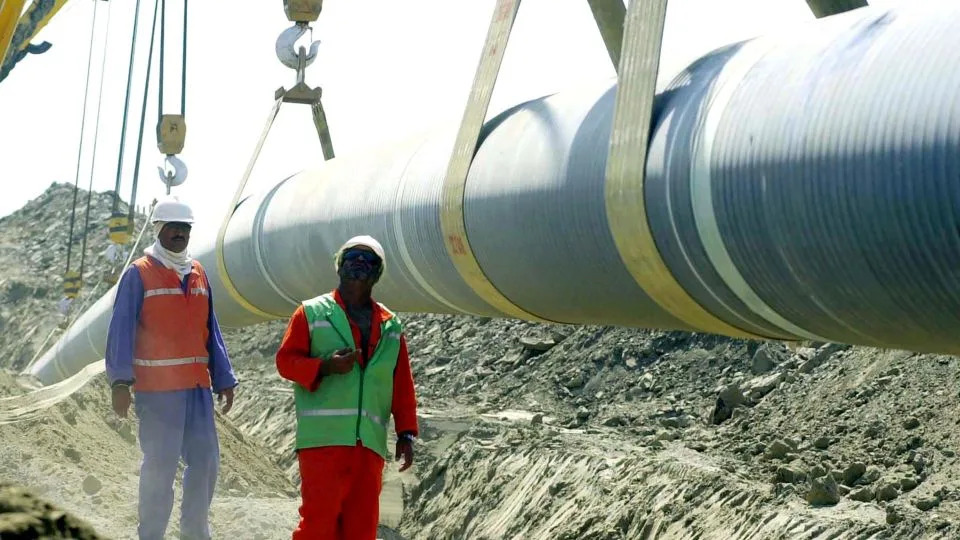
Workers lay a section of the Baku-Tbilisi-Ceyhan oil pipeline near the Sangachal terminal near Baku, on August 11, 2003. - Riza Ozel/AFP/Getty Images/File
Iraq–Turkey — ~1 Million Bpd: Reconditioning the underused Kirkuk–Ceyhan pipeline is back on the agenda as political incentives shift in favor of western routes to the Mediterranean.
Iraq–Jordan — 1–2.5 Million Bpd: Baghdad and Amman are fast-tracking a long-discussed pipeline that would move Basra crude westward to Aqaba for Red Sea export.
Other options under discussion include northern corridors through Jordan and Turkey or expanded port capacity on the Red Sea. Goldman Sachs estimates that existing or newly developed bypass routes could carry roughly 60% of the oil typically shipped through Hormuz by the end of 2028. These projects will not replace every barrel, but together they will materially reduce Iran’s chokehold on the waterway over time.
Historical Parallel and Outlook
There is precedent for infrastructure reshaping geopolitics. The Baku‑Tbilisi‑Ceyhan pipeline — once considered politically and technically daunting — reduced Eurasian dependence on Russian export routes after it opened in 2006. Gulf states now appear determined not to repeat Europe's later overreliance on a single supplier.
Challenges remain: Iran may attempt to target static infrastructure, construction can be delayed by finance and politics, and timelines may slip. But the strategic trajectory is clear: regional capitals now treat export-route redundancy as a national-security imperative, backed by sovereign funds and international partners.
By weaponizing Hormuz, Tehran risks persuading its neighbors — with U.S. support — to build an energy architecture that makes the strait less central. That outcome would materially reduce Iran’s leverage, and it is an outcome Washington and its partners should proactively help bring about.
For more analysis and updates, visit CNN.com.
Help us improve.