The surge in climate-related lawsuits is prompting an aggressive legal and political response from major oil companies as courts allow new claims to proceed. A high-profile Washington wrongful-death suit links fossil-fuel producers to a deadly 2021 heat wave that scientists say was made far more likely by human-driven warming. Industry groups and allied conservatives are pursuing immunity laws and contesting attribution science, while the Justice Department has intervened in state suits. Scientific evidence tying climate change to extreme heat and other events has grown stronger, raising the stakes of upcoming trials.
As Climate Lawsuits Multiply, Big Oil Enters 'Panic Mode' — Could Companies Be Held Liable For A Heat-Related Death?
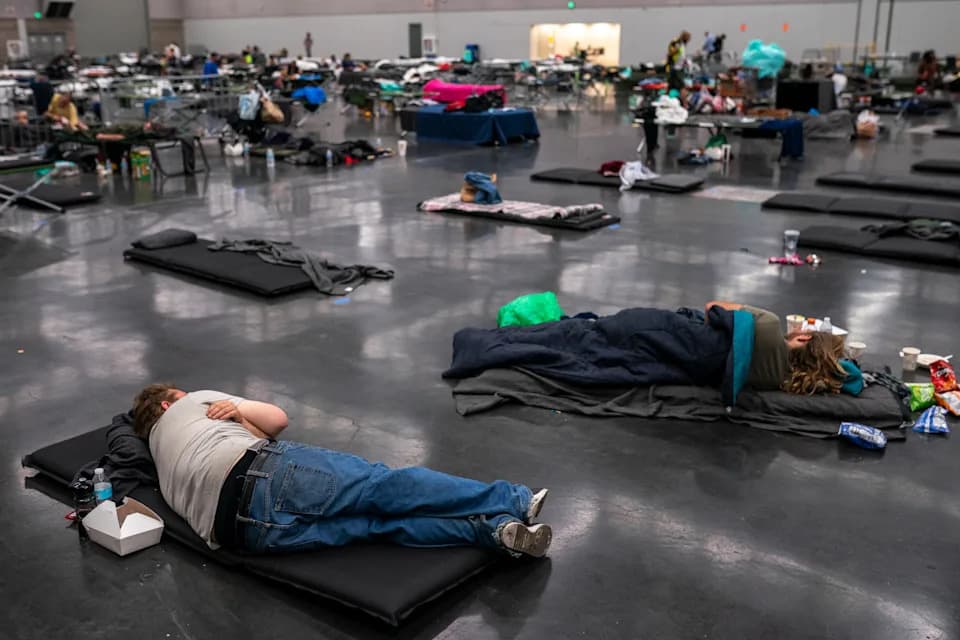
Portland residents fill a cooling center at the Oregon Convention Center during the June 2021 heat dome.
Could major fossil-fuel companies be held legally responsible for the extreme heat that contributed to a woman's death? That question sits at the center of a novel wrongful-death lawsuit filed in Washington state after an unprecedented heat dome baked the Pacific Northwest in June 2021.
Misti Leon alleges that her mother died from overheating when temperatures reached 108°F and that the heat event — which scientists say would have been "virtually impossible" without human-driven climate change — played a direct role. An estimated 1,200 people across the region died during that week-long heat wave.
Legal Momentum
Last year Leon sued Exxon Mobil, BP, Chevron, Shell and other oil majors, arguing they knew for decades that burning fossil fuels would cause destructive climate impacts but misled the public and delayed action that might have averted the tragedy. Earlier this month, a King County judge denied the oil companies' motions to dismiss, allowing the case to proceed toward trial — a decision advocates say gives the claim legal weight and could set precedent.
"It's the latest type of legal liability that the oil companies are absolutely terrified of," said Mike Meno, communications director at the Center for Climate Integrity.
Broader Wave Of Litigation
More than a decade after reporting showed Exxon Mobil had internal knowledge of climate risks since the 1970s, climate-related lawsuits against oil companies have proliferated. Columbia Law School's Sabin Center tracks nearly 40 pending cases nationwide. After years of delay tactics, at least five suits — in Massachusetts, Vermont, Connecticut, the District of Columbia and Honolulu — have entered discovery, the phase before trial when both sides gather evidence and can depose executives.
Some cases are paused while judges await the Supreme Court's handling this fall of a Boulder, Colorado matter in which the city and county allege Exxon Mobil and Suncor concealed the risks of their products and seek funds to strengthen infrastructure against heat waves, wildfires and floods. That ruling could shape the legal landscape or prompt new strategies from plaintiffs.
Portland residents sought relief at a cooling center during the June 2021 heat dome.
Industry Response: Law, Lobbying And Science Challenges
The oil industry has mobilized a robust political and legal counterattack. The American Petroleum Institute has listed stopping "extreme climate liability policy" as a 2026 priority, while industry lawyers are increasingly challenging "attribution science" — the field that connects specific extreme weather events to human-caused climate change and, in some analyses, to companies' emissions.
Republican-controlled state legislatures have passed laws aimed at shielding fossil-fuel companies from certain climate lawsuits. States including Utah, Iowa, Tennessee, Oklahoma and Louisiana recently enacted protections, and Montana and Utah revised public-nuisance law to limit climate claims. At the federal level, Republicans in Congress introduced bills this spring that would grant broad immunity to energy companies, backed by the American Petroleum Institute.
Investigations by ProPublica and documents obtained by the watchdog Fieldnotes show coordinated campaigns behind many "liability shield" laws, involving conservative groups connected to Leonard Leo and corporate ties to Koch Industries and Exxon via organizations such as the American Legislative Exchange Council and the American Tort Reform Association.
Federal Involvement
Following an executive order from President Donald Trump directing the attorney general to prioritize blocking state climate suits, the Department of Justice filed suit against Minnesota in May as that state's case moved into discovery, arguing states were attempting to regulate greenhouse gases in ways that infringe on federal authority and harm "American energy dominance." The DOJ also renamed its Environment and Natural Resources Division to the "Energy and Natural Resources Division," and longtime Exxon lawyer Robert Levy recently joined the department.
Science Under Scrutiny — And Strengthened
Scientific support linking climate change to extreme weather has grown stronger. A major National Academies of Sciences, Engineering, and Medicine report concluded the evidence connecting climate change to extreme heat, extreme cold and heavy rainfall is increasingly robust. The report did not issue legal recommendations, but it drew intense scrutiny: ahead of publication, researchers reported requests from an opposition research firm for internal communications among panel members and correspondence with academics and attorneys exploring legal strategies.
"We saw pushback not on the science itself, but on the process," said Carly Phillips of the Union of Concerned Scientists' climate litigation hub. "For me, that was really illustrative, because the science is really sound."
Republican state attorneys general pressured the National Academies and the Federal Judicial Center to remove a chapter on climate science from an updated judges' reference manual; the Judicial Center complied. The debate escalated when the president ordered a review of the National Academies' conduct, calling into question the use of climate science in courts.
Why It Matters
Big Oil is keen to avoid the fate of Big Tobacco, which paid hundreds of billions to resolve claims that it had deceived the public about health risks. As plaintiffs refine legal theories and courts begin allowing novel claims to proceed, oil executives could face depositions and trials that publicly test decades of internal company research and communications.
"Why do they keep adapting and changing their theories?" asked Justin Anderson, an Exxon attorney. "It's kind of obvious. I have to win every time. I have to win every case that is brought." For advocates and affected communities, the coming months and years will determine whether courts hold companies accountable and how the law addresses climate-linked harms.
Help us improve.