The Fields Medal was awarded to four young mathematicians: Hong Wang and Yu Deng of China, John Pardon of the United States, and Jacob Tsimerman of Canada. Wang, 35, is only the third woman to receive the medal and is recognized for resolving a century-old Kakeya conjecture with collaborator Josh Zahl. The medals were presented at the International Congress of Mathematicians in Philadelphia. The event also highlighted concerns in the Leiden Declaration about AI systems producing plausible but potentially unreliable mathematical arguments.
Four Young Mathematicians Win Fields Medal — Wang Becomes Third Woman Laureate
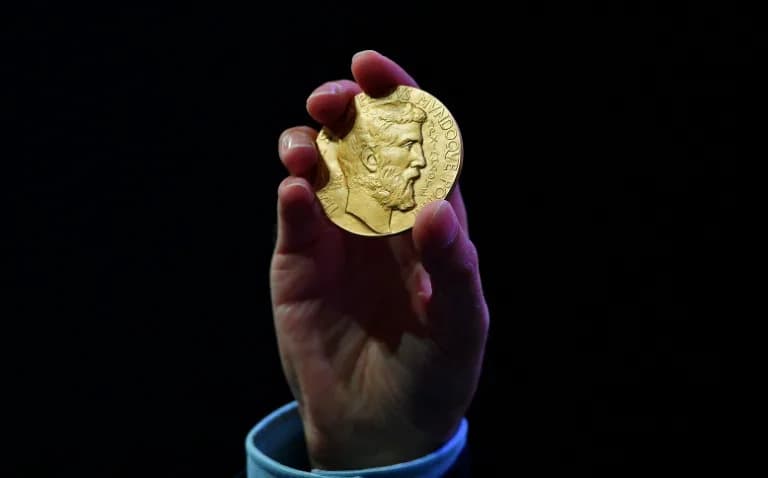
The Fields medal, known as the Nobel prize for math (CARL DE SOUZA)
The Fields Medal, often described as the Nobel Prize of mathematics, was presented on Thursday to four outstanding young researchers: Hong Wang and Yu Deng of China, John Pardon of the United States, and Jacob Tsimerman of Canada.
The award, conferred every four years by the International Mathematical Union, recognizes exceptional discoveries by mathematicians under 40. Each laureate receives a gold medallion bearing the likeness of Archimedes and a cash prize of 15,000 Canadian dollars (about USD 17,000).
Wang: A Breakthrough and a Milestone
Hong Wang, 35, who holds positions in France and at New York University, becomes only the third woman to win the Fields Medal since the prize began in 1936. She is honored for work that led to the resolution of a long-standing conjecture first posed by Japanese mathematician Soichi Kakeya. Working with collaborator Josh Zahl, Wang analyzed a three-dimensional version of the problem and produced the key insight that cracked a question that had puzzled mathematicians for more than a century.
'In 1917, Kakeya asked a very simple question: if you rotate a pencil so as to turn it completely around, what is the smallest area it sweeps out?' Wang said, describing the geometric intuition behind the problem.
Other Laureates
Yu Deng, a faculty member at the University of Chicago, shares the honor and highlights the growing global influence of Chinese mathematicians. John Pardon, 37, represents the United States, which has historically produced the largest number of Fields laureates. Jacob Tsimerman, 38, a specialist in complex algebraic geometry and analytic number theory from Canada, completes the quartet.
At the opening ceremony of the International Congress of Mathematicians in Philadelphia, Tsimerman recalled the moment that kindled his love of mathematics: a childhood puzzle about a broken toaster his grandfather posed, which he described as the first time he felt that sense of mathematical beauty.
Mathematics and Artificial Intelligence
The congress arrives amid rapid advances in artificial intelligence that are already affecting mathematical research. In recent months, some AI systems have produced high-level mathematical proofs, surprising many experts. While these developments show promise, a group of mathematicians warned in June about potential pitfalls in the document titled the Leiden Declaration.
The declaration cautions that automated techniques can produce arguments that appear convincing but may be incorrect or unreliable and that such outputs can be difficult to distinguish from valid proofs. It calls for frameworks and safeguards to address scientific and ethical concerns as AI becomes more widely used in research.
Looking Ahead
The 2026 Fields Medals honor a mix of deep theoretical breakthroughs and a generational shift in the global mathematical community. The laureates' work will continue to influence fields ranging from geometry and number theory to applied areas where these mathematical ideas emerge.
Help us improve.