The Heidelberg Laureate Forum's AI panel ignited debate after OpenAI said it used roughly 10,000 AI agents on the Navier–Stokes Millennium Prize Problem. Michael Harris accused big tech of 'predatory' behavior after allegations that OpenAI rushed to pre-empt researchers Tristan Buckmaster and Levent Alpöge. Jacob Tsimerman hailed the claim as a landmark technical milestone, while Peter Scholze dismissed it as PR and emphasized the importance of human insight. Panelists noted initiatives to protect human-centered mathematics but said the field's future remains uncertain.
‘Predatory Behavior?’ Leading Mathematicians Clash Over OpenAI’s Claimed Navier–Stokes Breakthrough
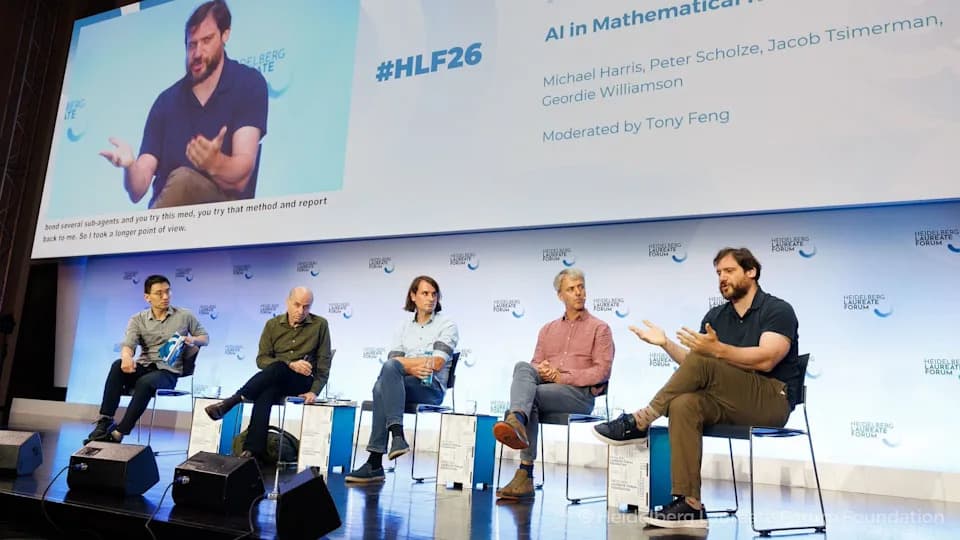
The panellists of the Heidelberg Laureate Forum 2026's AI in Mathematics panel. From right to left: Jacob Tsimerman, Geordie Williamson, Peter Scholze, Michael Harris and moderator Tony Feng. | Credit: Bernhard Kreutzer for the Heidelberg Laureate Forum Foundation
HEIDELBERG, Germany — A high-profile panel at the Heidelberg Laureate Forum on Sept. 15 pushed mathematics into the headlines as elite researchers confronted the rapid rise of artificial intelligence and a controversy over who claims credit for major mathematical advances.
In recent months, AI systems have stunned the discipline: contributing to solutions for dozens of problems posed by Paul Erdős, producing work at publishable doctoral level, formally verifying two proofs that previously earned their authors Fields Medals, and making progress on roughly ten other longstanding problems. On Sept. 8, OpenAI announced it had deployed about 10,000 AI agents to attack the Navier–Stokes existence-and-smoothness problem — one of seven Clay Mathematics Institute Millennium Prize Problems that carries a $1 million reward.
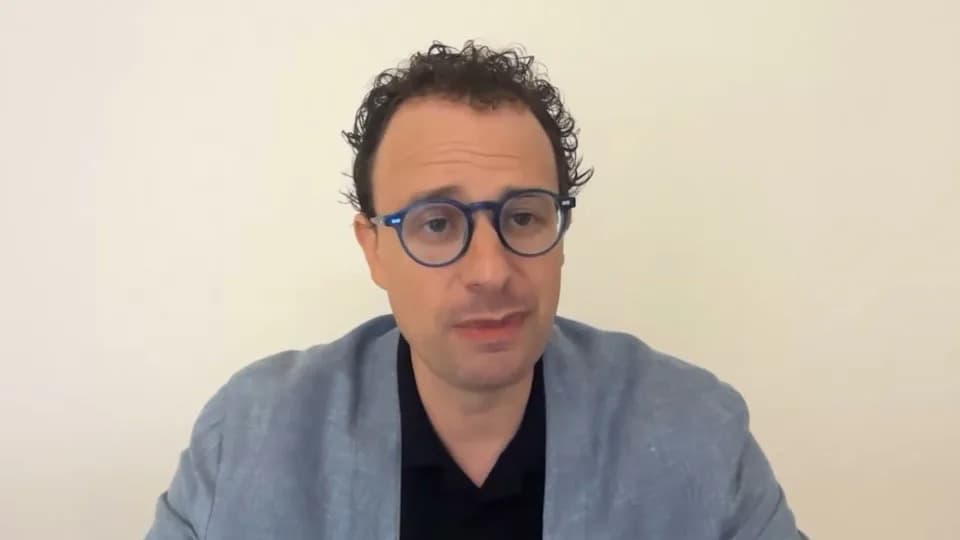
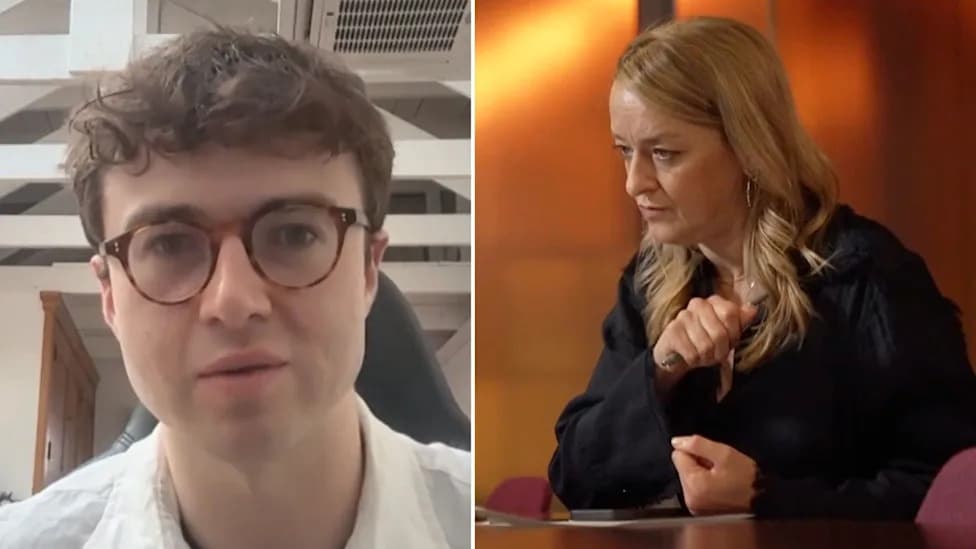
The announcement provoked fresh controversy when mathematicians Tristan Buckmaster and Levent Alpöge said they had been working on Navier–Stokes for about a year and alleged OpenAI learned of their research, rushed to pre-empt them, and pressured them not to publish. Columbia University professor Michael Harris amplified those allegations on his Substack newsletter Silicon Reckoner, calling the episode an example of what he termed 'predatory' behavior by big tech and urging regulatory protections for the mathematical community.
"There's no legal obstacle to the kind of predatory behavior that we've seen particularly over the last month," Harris told the forum, arguing that new safeguards are needed to protect researchers and scholarship.
At the panel, reactions diverged sharply. Jacob Tsimerman, a 2026 Fields Medalist who joined OpenAI in July as an AI safety researcher, emphasized the technical significance of the claim. He argued that an AI system ostensibly solving a Millennium Prize Problem is a landmark moment that could reshape who does mathematics and how it is produced.
"If we put our value in human beings doing research in mathematics at the frontier level, developing expertise and slowly making progress, then I think that's coming to an end," Tsimerman said, while also suggesting that prioritizing the creation of new mathematics could lead to a productive 'golden age.'
Peter Scholze, co-director of the Max Planck Institute for Mathematics and a 2018 Fields Medalist, took a contrasting view. He described the OpenAI announcement as largely promotional and argued that the spirit of the Millennium Problems is not just to obtain a formal solution but to generate human-understandable insight across a web of related questions — something a long, machine-produced proof may not provide.
Other panelists, including Geordie Williamson, echoed concerns about the social and ethical implications of corporate-driven research practices. Several initiatives — such as Proofs and Prompts, Mathematical Discourse, and the Association for Human Mathematics — were highlighted as efforts to preserve a human-centered core of mathematical practice and education.
Panelists agreed on one clear point: the pace of AI-driven change makes concrete predictions difficult. "To be honest, whenever anyone talks about 10 years from now, or even five years from now … it just seems unfathomably far away," Tsimerman said. "The world in two years is going to look so incredibly different than it does now."
The debate at Heidelberg underscores both the technical promise and the ethical, professional and cultural questions raised by advanced AI in mathematics — from credit and transparency to the kinds of understanding the field values.
Help us improve.