The Reuters/Ipsos poll finds 53% of Americans worry AI could cause someone in their household to lose a job, a concern that cuts across age, gender and education. Democrats registered greater anxiety (61%) than Republicans (47%). The six-day survey of 4,531 adults has a margin of error of ±2 percentage points. Respondents also reported rising unease about AI’s broader uses, while college graduates report the highest regular AI use.
Half of Americans Worry AI Could Cost a Household Job, Reuters/Ipsos Poll Finds

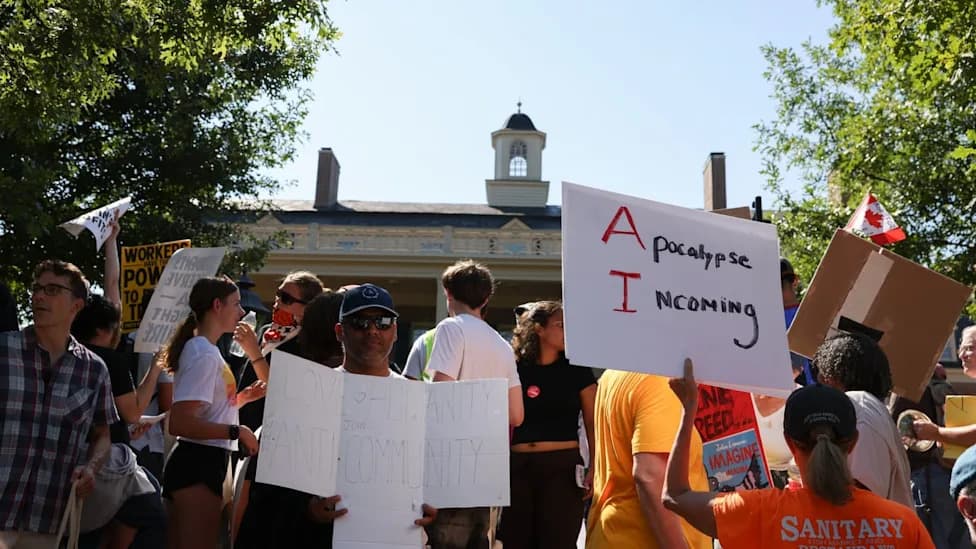
Protesters rally calling on AI companies to pause development, in San Francisco
WASHINGTON, June 10 (Reuters) - Roughly half of U.S. adults say they worry the spread of artificial intelligence could lead to someone in their household losing a job, according to a new Reuters/Ipsos survey that also revealed broad unease about how quickly the technology is being adopted.
The six-day poll, completed on Monday, found 53% of respondents expressed that concern, with the fear distributed fairly evenly across age groups, genders and education levels. Some 37% of those surveyed said they were not worried at all, while the remaining 10% were either unsure or declined to answer.
Key Findings
Worries about AI and employment were higher among Democrats—61%—than among Republicans, at 47%. The Reuters/Ipsos survey interviewed 4,531 U.S. adults nationwide and carries a margin of error of plus or minus 2 percentage points.
Context and Examples
The poll comes after a wave of AI-related job cuts at major companies. Software maker Intuit announced last month it would reduce its global workforce by about 17% as it reorganizes to focus on priority areas, including AI initiatives. At a separate event, University of Arizona students booed former Google CEO Eric Schmidt when he discussed AI’s effects at a commencement ceremony.
Concerns about AI extend beyond employment. Its potential use in political propaganda, entertainment and even warfare has prompted warnings from elected officials and religious leaders, including Pope Francis.
Who’s Using AI?
The Reuters/Ipsos poll also found college graduates report higher regular use of AI (50%) compared with people without degrees (34%) and 40% of adults overall. Additionally, 73% of Americans said they are worried about increased AI use—up from 68% in a 2023 Reuters/Ipsos poll.
Voices on the Ground
"AI is taking over because people care less and less about the quality of the work that gets produced," said Jennifer Schalhoub, 62, a freelance writer from Little Ferry, New Jersey, who said she recently lost a job drafting letters to government officials and suspects AI played a role.
"I don't believe that artificial intelligence is able to have the nuance that a person has," said Lauren Hayes, a clinical psychologist in Washington state, after several clients reported consulting AI between therapy sessions to manage anxiety.
Industry Developments
Artificial intelligence surged into the public spotlight in 2022 when OpenAI introduced ChatGPT, a consumer-facing conversational tool that reshaped how people search and interact online. Anthropic, another leading AI company, has gained corporate clients with products such as its coding assistant Claude Code. Both companies have drawn strong interest from investors with plans to sell shares publicly.
Reporting by Jason Lange and Courtney Rozen; editing by Scott Malone and Alistair Bell.
Help us improve.