The 2026 Long-Term Trends NAEP shows a split recovery: 9-year-olds gained an average of 4 points since 2022, with the biggest improvements at the lowest performance percentiles, while 13-year-olds’ scores are flat or worse and reading is no higher than in 1971. Survey data highlight lower attendance, reduced homework among younger children, and sharp declines in leisure reading. Experts point to pandemic timing for middle-school cohorts and a longer-term decline since about 2012 as overlapping causes.
NAEP Long-Term Trends: Real Gains for 9-Year-Olds, Persistent Stagnation for Teens
New data from the 2026 Long-Term Trends edition of the National Assessment of Educational Progress (NAEP) paint a split picture of student performance in the United States: measurable recovery among the youngest test takers, and continued stagnation or decline for early adolescents.
(NAEP)
Key Findings
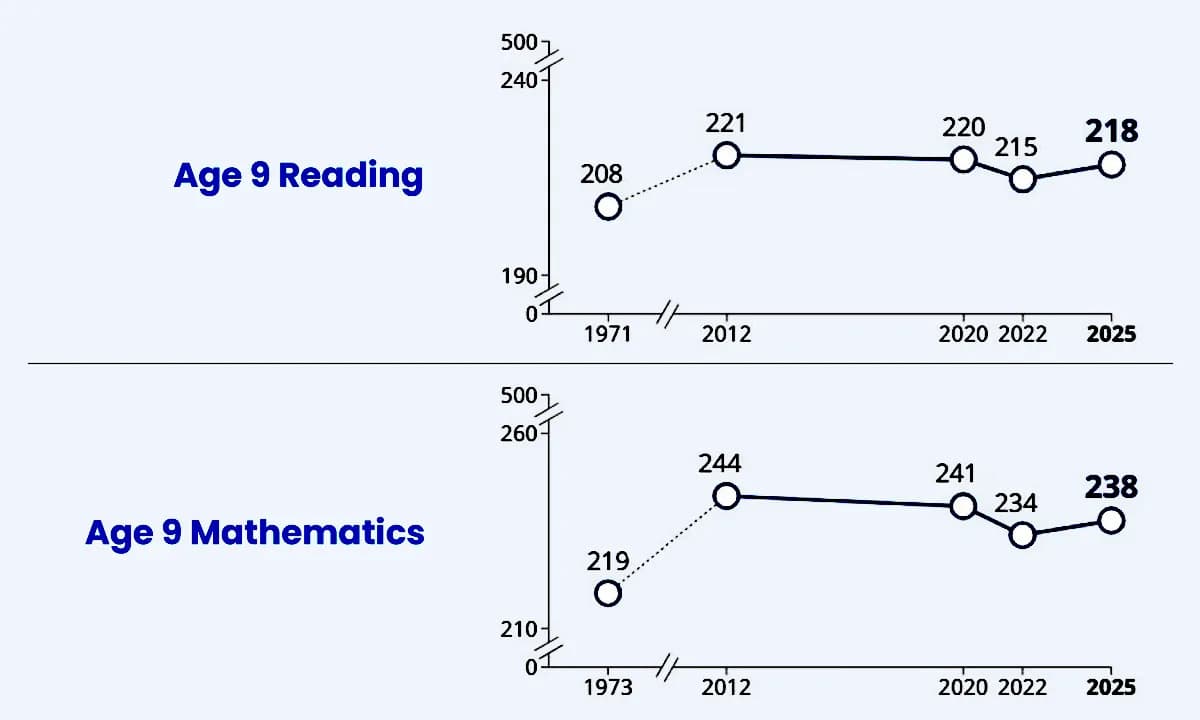
On average, 9-year-olds posted a 4-point increase in combined math and reading scores since 2022, suggesting partial recovery from COVID-era learning loss. These gains were driven largely by lower-performing students: 9-year-olds at the 25th percentile gained 7 points in math and 6 points in reading since 2022, while those at the 10th percentile rose 9 points in math and 8 points in reading. Compared with the test's earliest administrations, nine-year-olds’ average reading score is now 10 points higher than in 1971 (on a 500-point scale), and math scores are about 19 points above late-1970s levels.
(NAEP)
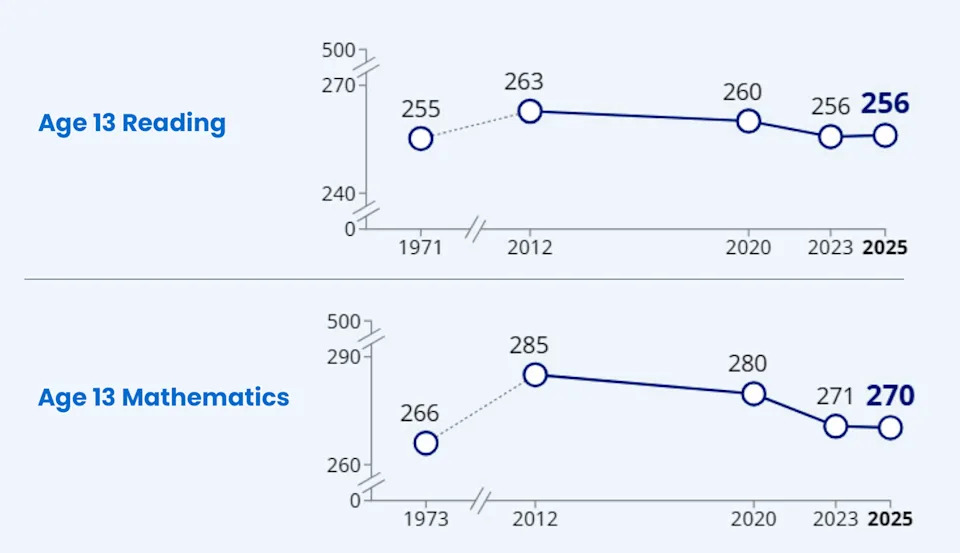
By contrast, 13-year-olds showed little or no improvement. Average scores for this group have been flat since 2022 and are statistically lower than in 2020. Reading performance for 13-year-olds is now no higher than when the exam began in 1971. In math, the share scoring at or above 250 points — a benchmark indicating basic one-step word-problem skills — fell from 85% in 2012 to 70% in the most recent administration; the share scoring 250 or higher in reading declined from 66% to 58% over the same period.
Who Improved — And Who Didn’t
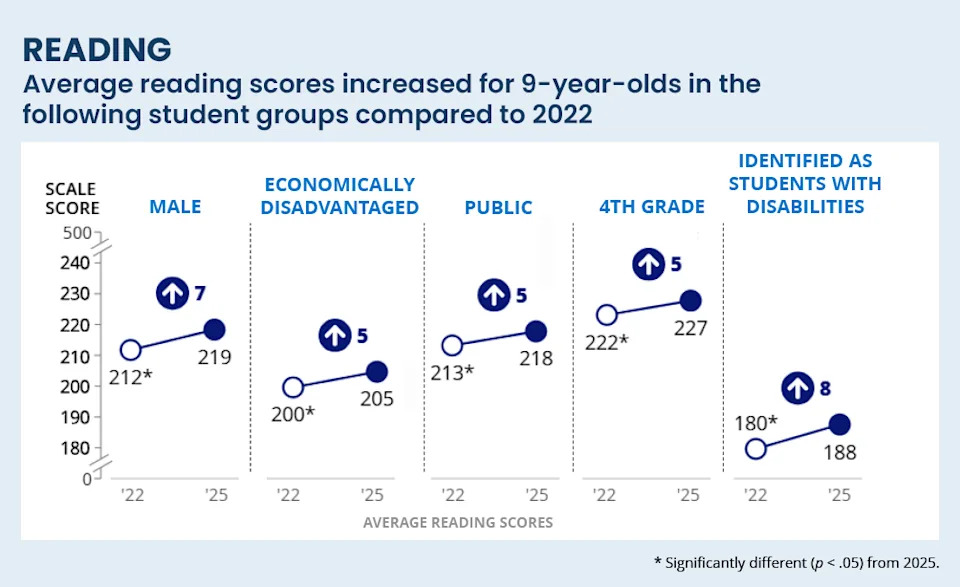
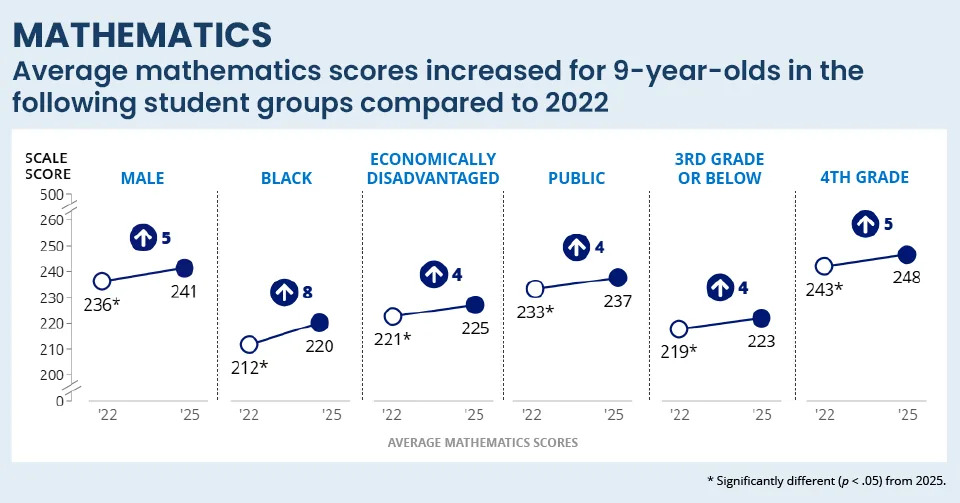
Demographic trajectories were broadly similar across racial and socioeconomic groups, but sex differences were notable among younger pupils: the statistically significant gains for 9-year-olds were concentrated among boys, who improved by an average of 7 points in reading and 5 points in math; girls showed smaller increases (1 point in reading, 3 points in math).
Context From Student Surveys
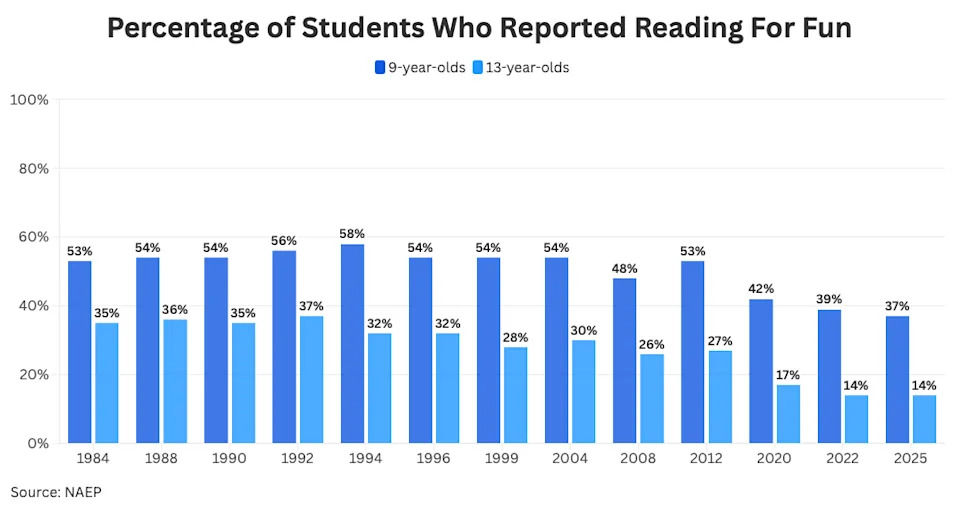
Accompanying survey responses help explain part of the picture. School attendance remains below pre-pandemic levels: the share of 13-year-olds absent at least one day per month rose from 44% in 2012 to 61% in 2025. The share of 9-year-olds reporting they had no homework the previous night has climbed from 19% to 39% over roughly two decades. Leisure reading has fallen sharply: in 2025, only 37% of 9-year-olds and 14% of 13-year-olds said they read for fun "almost every day," compared with historical peaks of 53% and 35% more than 40 years ago.
"They were in some of their most formative years of both literacy and numeracy [at the onset of the pandemic], and it was a seismic event," said Kirsten Baesler, head of the Education Department's Office of Elementary and Secondary Education. "It’s going to take equally seismic effort to ensure that those students are coming back to where they need to be."
Explanations And Debate
Experts offer two overlapping explanations. Many attribute the gap to timing: the 9-year-olds who improved were largely in preschool during the pandemic and avoided its worst instructional disruptions, while today’s 13-year-olds were in second or third grade when schools closed and shifted to virtual instruction. Others argue the decline in adolescent achievement predates COVID: research and commentary describe a "learning recession" since around 2012, with middle grades showing particular weakness.
Observers also debate the future of the Long-Term Trends assessment itself. Supporters value its consistent, paper-and-pencil format and stable content as a half-century long record of student skills. Critics, including some federal officials, question whether its format and content remain aligned with today’s curricula and learning goals. The NAEP assessment for 17-year-olds was cancelled early last year, and the future of some Long-Term Trends components remains under discussion.
"Every time we see a little bright spot about what 9-year-olds are doing, for example, people jump on it as though it’s a long-run trend," said economist Eric Hanushek. "It’s going to take a lot to convince me that we’re not still in a general downhill slide, even with some nice green shoots here and there."
Taken together, the 2026 Long-Term Trends NAEP results show important progress for the youngest learners — especially those who have struggled most — but continuing stagnation or decline for early adolescents. That combination suggests targeted, intensive interventions will be needed for the middle grades even as policymakers consider how best to preserve useful long-term measures of student learning.
Help us improve.