Antoni Gaudí died after being struck by a tram on 7 June 1926 and was buried in the crypt of the Sagrada Família. His career coincided with Catalonia’s Renaixença and the rise of Catalan Modernisme, shaping Barcelona’s distinctive urban identity. Gaudí pioneered techniques such as trencadís and developed an organic, nature-infused architectural language evident in landmarks like Casa Milà, Casa Batlló and Park Güell. He devoted his final years to the Sagrada Família, living in its workshop and leaving an unfinished masterpiece that continues to draw millions of visitors.
A Century Without Gaudí: How Barcelona Became His Living Masterpiece
A century without Gaudí: Barcelona celebrates the architect who turned the city into a work of art
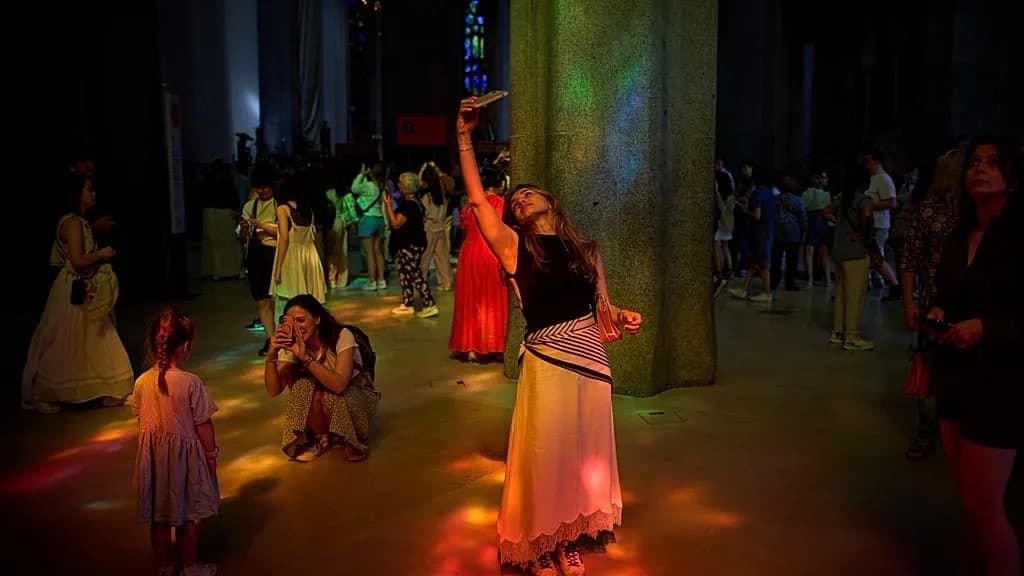
On the evening of 7 June 1926, about six o’clock, Antoni Gaudí i Cornet was walking to his regular mass at Plaça de Sant Felip Neri, a secluded courtyard in Barcelona’s Gòtic quarter. That quiet corner—still used by children from a nearby school and treasured by locals—now sits amid a city that draws roughly 26.1 million visitors a year, many coming to see the work of Catalonia’s most famous architect.
The Accident and Final Days
As contemporary accounts recount, Gaudí was crossing the Gran Via between Carrer de Bailèn and Carrer de Girona when two trams converged on the tracks. He stepped back to avoid one but was struck by the other. The collision occurred roughly halfway between two of his signature creations, Casa Milà (La Pedrera) and the Sagrada Família. He suffered a concussion and multiple broken ribs. Because bystanders did not recognize him, he was first taken to a small clinic at Sant Pere Més Alt and later transferred to the old Hospital de la Santa Creu, where he died around 48 hours later at the age of 74.
Gaudí was buried in the Chapel of Our Lady of Mount Carmel, in the crypt of the Sagrada Família—the monumental basilica that had consumed the last decades of his life.
Roots, Education and Early Work
Born in 1852 to a modest family of coppersmiths, Gaudí grew up between Reus and the village of Riudoms in Tarragona. Frail in childhood and often hampered by rheumatic fever, he learned his father’s trade and later moved with his family to Barcelona in 1868 so the children could access better education. Financial constraints delayed his entry to the School of Architecture until 1874; by then he was working as a draughtsman and soon began signing projects.
One of his earliest important commissions was the hydraulic design for the monumental waterfall in the Parc de la Ciutadella (1875), supervised by Josep Fontserè and later associated with Barcelona’s 1888 Universal Exposition. These years also coincided with the Renaixença, a late-19th-century cultural revival that helped shape Catalan Modernisme—an exuberant, nature-inspired architectural style with which Gaudí became synonymous.
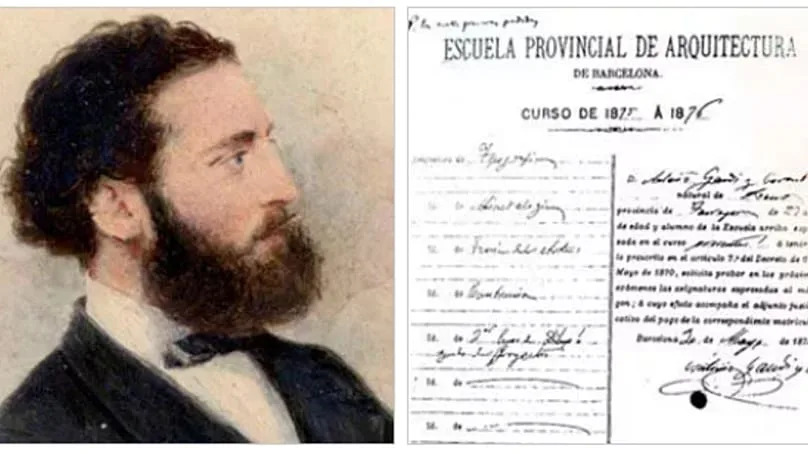
Antoni Gaudí’s degree from the Barcelona School of Architecture- @CasaBatlloGaudi
Style, Innovations and Politics
Gaudí’s work fused organic forms, religious symbolism and inventive structural solutions. He experimented with neo-Mudéjar motifs and developed trencadís—the distinctive mosaic technique using broken ceramic, glass or marble fragments—most famously in the Güell pavilions and Park Güell. An oft-repeated workshop anecdote has him frustrated at the slow, meticulous laying of tiles and urging helpers to work "by the handful"—a moment that captures both his impatience and his pragmatic creativity.
Politically, Gaudí sympathised with some liberal currents of his youth—he supported the Glorious Revolution and the short-lived Democratic Six-Year Period—and he worked on socially minded projects such as the Mataró Workers’ Cooperative (1878–1882), a complex that combined factory functions with affordable housing and communal services.
The Sagrada Família: A Life’s Obsession
In 1883 Gaudí took charge of the Sagrada Família, radically transforming the original plan and reorienting the project around a vast theological programme and an innovative structural vocabulary. He devoted the rest of his career to the basilica, increasingly living at the site after the deaths of close collaborators and friends. Following the 1925 death of sculptor and modeller Llorenç Matamala, Gaudí moved into a small room at the Sagrada Família workshop and focused almost exclusively on completing the church.
Though construction has progressed over the decades—including recent work on the central tower—the basilica remains, in many respects, an unfinished testament to Gaudí’s ambitions. His fusion of natural forms, structural daring and devotional intensity continues to define the city’s visual identity.
Legacy
Gaudí left an unmistakable imprint on Barcelona. Major works such as Casa Milà (La Pedrera), Casa Batlló, Casa Calvet and Park Güell showcase his vivid use of color, flowing surfaces, helical columns and organic ornament. His influence reaches beyond Barcelona—examples include Villa Quijano ("El Capricho") in Comillas—and his techniques, especially trencadís, remain closely associated with Catalan Modernisme.
"I do not know whether we have given the title to a madman or to a genius; time will tell." — Elies Rogent, on Gaudí’s 1879 diploma
Despite personal losses and increasing isolation late in life, Gaudí’s work endures as a major cultural and architectural legacy. The Sagrada Família serves as his tomb, his home in later years, and the centerpiece of a city many still describe as his living masterpiece.
Help us improve.