Researchers at ETH Zurich report a quantum experiment that produces certified randomness by entangling two superconducting qubits linked by a 98-foot (30 m) supercooled waveguide. Using a biased seed only to set measurement bases, the team amplifies and purges bias from measurement outcomes to produce a provably unpredictable bit stream. The method requires little classical computation and could become a physical standard for cryptographic systems, digital identities, lotteries and blockchain services.
ETH Zurich Demonstrates 'Certified' Perfect Randomness Using Entangled Superconducting Qubits

A random sequence of zeroes and ones. Physicists say they have demonstrated perfect randomness for the first time, overcoming the inherent biases of existing random number generators. | Credit: matejmo via Getty Images
Researchers at ETH Zurich report a major advance in generating provable randomness by using entangled superconducting qubits. The team—led by professors Renato Renner and Andreas Wallraff—says their experiment produces a bit stream whose unpredictability is certified by quantum physics rather than only by statistical tests.
How the experiment works
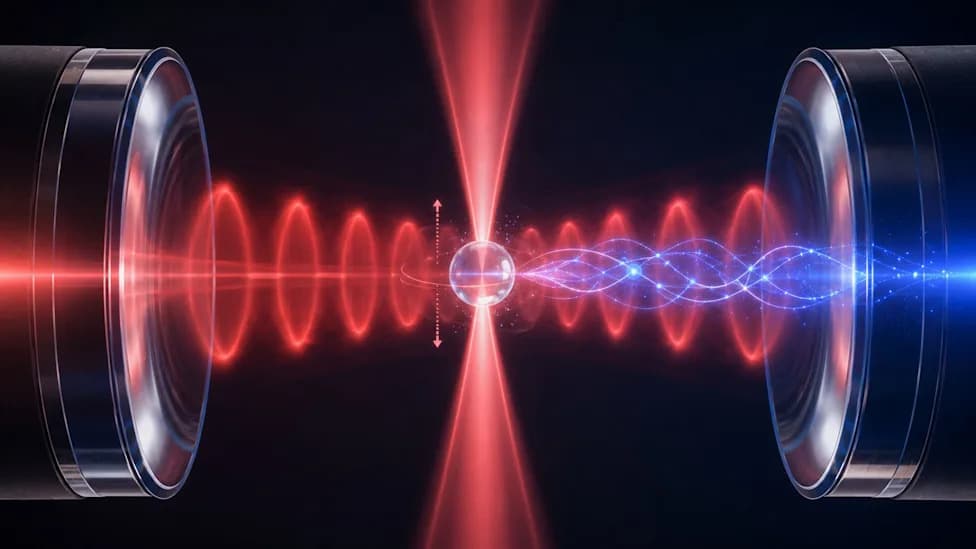
The setup uses two superconducting chips cooled to temperatures near absolute zero. Each chip functions as a qubit, the quantum analogue of a classical bit. The chips are connected by a 98-foot (30-meter) supercooled waveguide that allows microwave photons to travel between them and establish entanglement: a quantum link in which measuring one qubit immediately affects the other.
Crucially, the qubits were measured while kept nearly 100 feet apart so that even signals traveling at light speed could not move between them quickly enough to influence outcomes during the measurement interval. This spatial separation closes a potential communication loophole and helps ensure that the observed correlations are genuinely quantum in origin.

Andreas Wallraff and Renato Renner next to the 100-foot link connecting two quantum chips. | Credit: Kilian Kessler / ETH Zurich
From imperfect seed to certified randomness
The protocol begins with an imperfect (biased) random seed used only to choose measurement settings. After performing entangled quantum measurements, the team applies a randomness-amplification procedure to the outcomes. The result is an output bit stream whose lack of bias and unpredictability is certified by the quantum correlations in the experiment—meaning the randomness is backed by physical principles rather than only by classical statistical verification.
“Our method does not really require a computation,” Renner told Live Science. “All the randomness is generated by measuring quantum bits. In this sense, the computational cost of our approach is negligible compared to that of pseudo-random number generators.”
Why it matters
Generating truly unpredictable numbers is a long-standing challenge: tiny biases in conventional generators can be exploited in cryptography and security systems. The ETH Zurich protocol promises a dependable physical standard for randomness—analogous to how an atomic clock sets a timekeeping benchmark. Potential applications include encryption, secure digital identities, trusted lottery and gambling systems, and blockchain protocols that require high-quality randomness.
The researchers emphasize the protocol’s suitability for networked environments where nodes can access a server that implements the randomness service. They also note that future work will focus on scaling, integration into networks, and examining robustness under real-world conditions.
Limits and outlook
While the experiment is described as the first certified realization of perfect randomness, that claim is careful: it is grounded in current experimental assumptions and quantum-theoretical certification methods. As with any frontier result, independent replication, engineering improvements, and integration work are needed before widespread deployment. Still, this demonstration is an important step toward physically backed randomness sources for high-security applications.
Help us improve.